Showing posts with label being seen. Show all posts

Thursday, January 16, 2014

"Flowers in the Attic" Is the Best Book Ever* And Here Is Why


Yes, I’m serious. Flowers in the Attic—a.k.a. “The book that made teenage girls look sideways at their brothers and shudder,” as my similarly besotted pal Lindsay put it—wasn’t originally marketed as a young adult book when it was first printed in 1979, but it soon found its niche in the hearts of pubescent girls across the land. (And now it’s popularly acknowledged as a YA book; in fact, my library categorizes it as such.) It hit bestseller lists within two weeks of its publication, and the popularity of that book and the numerous other works by V.C. Andrews** that followed didn’t dwindle for years—in 1990, V.C. Andrews was still the second-most-popular author among teens.

I was one of those teenagers, and maybe you were too. I’d grown up on a steady supply of classics and earnest Newbery award-winning books for children and young adults, so it wasn’t like I was deprived of good literature. But come the sophisticated age of 12, I was ready for something juicier than Tom Sawyer kissing Becky Thatcher, and I moved straight into—spoiler alert, here and throughout—brotherfucking. And, you know, I knew it was trash, but damn if I didn’t stay up nights sixth through ninth grade blazing through the entire Flowers in the Attic Dollanganger series, followed by the Casteel series, followed by the Dawn series, followed by My Sweet Audrina, which I thought was lame*** and then I stopped. But when I heard that Lifetime was premiering a new**** Flowers in the Attic movie this Saturday, I went back for a reread, and thus, my declaration that Flowers in the Attic Is the Best Book Ever.

And here’s why.

1) The incest plot was hot. 
Which is not to say that girls actually want to sleep with their brothers / sisters / uncles / cousins / parents / etc. It’s not even to say that girls fantasize about it in great numbers. But consensual incest caters to the nascent desires of many a pre/teen girl—that is, girls who aren’t yet sexually active, but who are beginning to think in terms of sexuality and have erotic impulses. A 12-year-old who has yet to be kissed might well be simultaneously drawn to and repulsed by the thought of sex—and what would make it a mentally “safe spot” where she could feel aroused and not repulsed? A known, loving, nonthreatening partner. That is...a brother. Not her own brother, of course; I’m guessing most girls would be repulsed by the thought of actually kissing her own brother. But with Flowers in the Attic, the teen reader is aligned with protagonist Cathy by dint of being a girl. She gets to experience the thrill of sex without having to entirely shed any vestiges of “eww boys,” because she knows that “her” brother (that is, Chris, Cathy's brother) is a loving, nurturing person who is, above all, safe. So by “becoming” Cathy, the reader is able to experience sex—which, if memory serves, the average early adolescent sees as a combination of forbidden and arousing—in a way that’s both. 

Consensual incest is actually a recurring theme in Gothic novels (“the perfect linking of the most desirable object with the prohibited object”), and it showed up in the work of one of the most-read feminine***** erotica writers (Anaïs Nin, whose incest erotica was published just two years before Flowers in the Attic). It’s actually a surprise that there aren’t a whole lot more Gothic YA books with brother bangin’. Of course, the whole “brothers are safe” thing is complicated just a bit by the wee matter of consent. Chris and Cathy’s major sexual interlude begins with this:


… “You’re mine, Cathy! Mine! You’ll always be mine! No matter who comes into your future, you’ll always belong to me! I”ll make you mine...tonight...now!”

I didn’t believe it, not Chris!

And I did not fully understand what he had in mind, nor, if I am to give him credit, do I think he really meant what he said, but passion has a way of taking over.

We fell to the floor, both of us. I tried to fight him off. We wrestled, turning over and over, writing, silent a frantic struggle of his strength against mine.

It wasn’t much of a battle.


Two pages later, Chris is quick to offer the world’s most awful/awesome apology (“I didn’t mean to rape you, I swear to God”). But Cathy is just as quick to clarify that he didn’t rape her. “I could have stopped you if I’d really wanted to. All I had to do was bring my knee up hard… It was my fault too.” Yet the pretense that there was force involved may well have helped girls derive pleasure from it—“good girls” don’t actively want to have sex, after all. But if you’re simply overpowered, then you didn’t want it, it just happened. Applied to real life, this is terrible logic (in fact, it’s rapist logic); applied to the fantasy life of girls who have desires but not the know-how to give them form even in her imagination, it makes some sort of sense. Rape fantasies aren’t uncommon for women to have; about 4 in 10 women have them, with a median frequency of once a month. I couldn’t find any numbers about rape fantasies among girls/teens, but my hunch says that the idea of having to have sex whether you want to or not is probably far more appealing to someone who hasn’t yet learned how to express her sexual agency.

The first time I floated this girls-like-incest-fantasies bit out loud, one woman pointed out that for a good number of girls, rape and incest are realities, and that eroticizing them reinforces the idea that there’s something sexy about nonconsensual sex. (Keeping in mind that while consensual incest does happen, many survivors of coercive incest convince themselves their abuse is quasi-consensual, as a survival tactic.) I agree, at least in the sense that popular culture is a part of rape culture, which then colors the idea of what rape is (and—surprise!—usually not in a way that is helpful to its victims). But that’s not what’s going on in Flowers in the Attic. (Later “V.C. Andrews” novels, perhaps, but that’s a different post.) It’s in the realm of fantasy—it’s even constructed as such within the book. As literature professor Cynthia Griffin Wolff writes of earlier Gothic work, part of the hallmarks of Gothic literature is “a set of conventions within which ‘respectable’ feminine sexuality might find expression.” It’s understood by the reader as a way to get to read utter filth with a sort of “free pass” for wanting to do so in the first place. Case in point: When I read it as an adult, I found that I’d erased any rapey overtones from my memory of reading it as a kid. I saw it for what it was, and judging from the way my friends talked about it at the time, they did too. Nobody in their right mind would hand it to a young rape victim as a depiction of her experience—read as such, it’s horrific (“It was my fault too”?). But that’s not how it’s read by its readers, I don’t think. (Of course, when I read this book the first time, I hadn’t experienced a whit of sexual trauma; perhaps if I had, my memory of it would be different. I can only go off my own experience here.) 

Point is: Girls don’t want to be raped, any more than they want to sleep with their brothers. But are there elements of it that appeal to the V.C. Andrews target demographic beyond the mere taboo? Yeah.


2) It lets you hate the mother but still love your own. 
You know those goody-two-shoes YA novels where the protagonist and her mother might fight but deep down there’s a Very Special Connection? V.C. Andrews offers an ear-shattering Screw that and gives the reader every excuse to seriously hate on Cathy's mother, Corinne. SHE KILLED CORY, I mean, come on. Now, my mom and I have always had a pretty good relationship (I mean, I’m choosy about my guest bloggers, and here she is! Twice!). But our mother-daughter relationship took a definite downswing during my prime V.C. Andrews years. A catalogue of my mother’s sins circa 1987-89: She made me wear a hat and scarf in when it was a measly -18 outside (hats are for dorks!), she made me take a study skills course (study skills omg mom!), she enrolled me in a girls’ self-defense seminar against my will (on a Saturday, which is a weekend!), she made me read Charlotte Freakin’ Bronte (life is not school!), she wouldn’t buy me a Guess sweatshirt just because I wanted one (everyone but meee had one!), and she wouldn’t let me see Dirty Dancing (actually, I still think I’m right on this one). 

Anyway. So while I never resorted to any “I hate you!” antics, there was definite tension, and it doesn’t require years of therapy to understand that part of it was my pubescent resistance to becoming anything like my mother—that is, a woman. Eager as I was to grow up, my fantasy of womanhood clashed hard against the reality of womanhood I saw in the form of the actual woman I knew best. In my head, being a woman meant, like, going to balls and wearing updos and going out with a different dashing suitor every night, but then here was this flesh-and-blood woman who was doing things like making taco salad. It wasn’t long before I woke up and started appreciating her and everything she did for our family, but at 12 I was just too self-absorbed.

Enter a mom who went from basically being a Christmas card to locking up her four children in an attic and slowly poisoning them while she...went to balls and wore updos and went out with dashing suitors. Corinne takes every bit of perfectly normal mother-daughter strife and balloons it into grotesquerie. She’s a nightmare in the truest sense—just as you might manifest everyday anxiety into the classic why-am-I-in-my-underwear dream, Corinne’s evil is an enormously exaggerated version of what a lot of girls might feel toward their mothers at that age, shown from the girl’s perspective. That includes love and adoration too—Cathy might need prompting at times, but she’s still willing to melt into Corinne’s arms for quite some time after Corinne locked her away.

As Adrienne Rich writes in Of Woman Born: Motherhood as Experience and Institution, mother-hatred is interpreted as “a womanly splitting of the self, in the desire to become individuated and free. The mother stands in for the victim in ourselves, the unfree woman, the martyr.” Gee: split self, desire to become individuated and free, victim, martyr, sounds like a whole lotta 12-year-olds I knew. Cathy’s physical resemblance to Corinne is more than a handy plot point (not to detract from the awesome doppelganger subplot in Petals in the Wind******, but I digress); it’s an extension of this idea that mother is daughter, and daughter mother, as much as she wishes not to be. And it also leads to…


3) It depicts aspects of beauty that we don’t often see. 
Plenty of books explicitly aimed at teens and preteens involve looks, but it tends to be some variation on the protagonist’s dissatisfaction. Maybe she doesn’t think she’s pretty (but some boy just might teach her otherwise!), maybe she’s jealous of her best friend’s looks, maybe she has a movie-moment makeover in which she sees herself as she wishes to be seen. The better of the YA set will deal with these in a more complex manner, but at best there’s ambivalence about whether or not the girl feels attractive.

Not so with Cathy: She’s a babe, and she knows it, and it isn’t because of any makeover. In fact, she has a disdain for artifice—when her brother tells her that if she develops an hourglass figure, she’ll “make a fortune,” she schools him on the dangers of corsetry. She takes sensual pleasure in herself: “[A]lways before I went to sleep, I spread my hair on my pillow so I could...nestle my cheek in the sweet-smelling silkiness of very pampered, well-cared-for, healthy, strong hair.” She waits until she’s alone and “then I stared, preened, and admired” herself in the mirror, for “Certainly I was much prettier than when I came here.” As for body image, when she talks of her dream of becoming a ballerina, she points out that “dancers have to eat and eat or else they’d be just skin and bones, so I’m going to eat a whole gallon of ice cream each day, and one day I’m going to eat nothing but cheese…”—a far cry from the prototypical YA-ballet-eating-disorder storyline. (I mean, eating a gallon of ice cream a day is an eating disorder, but whatever.)

Cathy takes pride in her looks, something that we cheer her on about, especially when she’s punished by the grandmother after she catches Cathy admiring herself naked in the mirror. (Naturally, the punishment befits the crime: She pours tar in Cathy’s long blond hair, forcing her to cut it off.) Pride isn’t the sin here—the sin, as the reader sees it, is all on the grandmother. In what other universe are girls cheered on for their vanity? Not just her pride or resilience with her body image or ability to recite “I’m beautiful just the way I am!” or whatever, but her downright vanity? It’s the cardinal sin of girldom, thinking you’re “all that.” But Cathy does it. The only “mean girl” around to side-eye her is the grandmother (“‘You think you look pretty? You think those new young curves are attractive?’” she hisses at Cathy), and obviously we’re going to be on Cathy’s side here. We freakin’ eat it up.

The leadup to Cathy and Chris getting all bow-chicka-bow-bow is less about anything that actually happens between them physically, and more about him seeing her (something her mother never does—Cathy totally freaks when Corinne brings her a bunch of “silly, sweet little-girl garments that screamed out she didn’t see,” none of which have room for her new curves). “[Y]ou look so beautiful. It’s like I never saw you before. How did you grow so lovely, when I was here all the time?” Chris says to Cathy upon catching her naked. The only other eyes on her as a woman are her own. Remember that whole “girls mature faster than boys” thing that turned out to be painfully true? Remember that sensation of wishing boys would just see you already? Yeah.

Andrews herself had experience with looks bringing a mixed bag of tricks: After suffering a severe fall as a teenager (which eventually landed her in a wheelchair), doctors didn’t believe that she was in pain, telling her she “looked too good” to be seriously hurt. Says Andrews of that age, “I was very pretty, and some fathers of my little girl friends made advances.” She never spoke publicly of anything abusive that might have happened, but it’s interesting to note that alongside the wording she chooses for Corinne when describing how she fell in love with her husband/half-uncle-half-brother: “I was fourteen years old—and that is an age when a girl just begins to feel her power over men. And I knew I was what most boys and men considered beautiful…” Girls are usually cautioned against playing with this particular kind of fire—as well they should be, given the potential fallout. But denying that there’s a lure to discovering one’s own appeal does girls a disservice, particularly when young women’s bodies are still the universal symbol for sex.


Okay, now that I’ve convinced you that Flowers in the Attic is the best movie ever, you should all watch Saturday’s premiere with me and live-tweet the whole damn thing. That’s my plan, at least, but I am not kidding when I say that if tweeting interferes with the sheer enjoyment of it I will turn off all devices except the television immediately. In any case, I’ll hop on the Lifetime hashtag and go with #badgrandma too. Join in!


_________________________________________

* Okay, seriously, it’s more like, Anna Karenina, Beloved, The Sun Also Rises, and then Flowers in the Attic. Or is it?!?!

** And by “V.C. Andrews” I mean both Flowers in the Attic author Virginia Andrews and ghostwriter Andrew Neiderman, who continued to write books under her name after Virginia’s death. Tracie Egan Morrissey interviewed him for Jezebel here.

*** Duh, of course it was lame. The first two lines of the Wikipedia entry about it: “My Sweet Audrina is a 1982 novel by V. C. Andrews. It was the only standalone novel without incest published during Andrews' lifetime.” Bo-ring!

**** As opposed to the old FITA movie with Victoria Tennant and Kristy Swanson, which was unfaithful to the book in the lamest possible ways (see also ***, above).

***** The literature scholars among you will likely not be surprised to learn this, but I was: There’s actually an entire genre of Gothic literature dubbed “female Gothic,” the hallmarks of which include ambivalent feelings toward female sexuality, and women being literally or symbolically motherless while simultaneously being shaped by patriarchal culture. For more on female Gothic—and for V.C. Andrews in particular—check out V.C. Andrews: A Critical Companion, which A) exists, and B) is now officially replacing Flowers in the Attic as The Best Book Ever. And now I’m absolutely serious—no, really, I am—it’s totally awesome and if you enjoyed this post at all you should at least skim it. Fascinating stuff.

****** Cathy dresses up just as Corinne did for a Christmas party 15 years earlier, then stuns the guests at the very same annual party by making a grand entrance as "Corinne" and revealing that she had kept four children locked away in the attic while she spent her evenings drinking from champagne fountains and slowly poisoning her kids with arsenic doughnuts. Then the mansion burns down, and Corinne winds up in an insane asylum. THE BEST.

Tuesday, June 18, 2013

I'll Be Watching You: NSA Surveillance and the Male Gaze


I would give readers a quick 101 on the NSA surveillance scandal before I go on to make my point, but the fact is, I’ve got no facts. I saw the headlines, heard the occasional bits of cocktail party buzz, and saw a flurry of blog posts—which I skimmed at best, or skipped altogether—crop up in my RSS feed. And then, I shrugged.

Apathy doesn’t seem like the greatest reason to tune out of something that, intellectually and politically speaking, enrages me—or at least should enrage me, if rage were a rational response that arose upon provocation of our most deeply held beliefs. But there it is: In a country whose founding principles include freedom of expression, learning that the government is—what, reading our e-mails? listening to our phone conversations?—this citizen’s response is meh.

The longer this story has remained in the news, the more bizarre my apathy seemed to me. Until it didn’t. I began to wonder if the reason the NSA activities didn’t upset me more on a visceral level, as opposed to an intellectual one, was that my default assumption of day-to-day experience was that I was being watched. Watched by Big Brother? Not so much. But being watched, observed, surveyed, seen? Yes. Welcome to what it’s like to be a woman, gentlemen.

Consider the headline of this excellent piece by Laurie Penny in New Statesman, spurred by the NSA revelations: If you live in a surveillance state for long enough, you create a censor in your head. It’s an incisive, uncomfortable truth, and it’s made all the more uncomfortable when coupled with one of my favorite passages from John Berger’s Ways of Seeing:

A woman must continually watch herself. … Whilst she is walking across a room or weeping at the death of her father, she can scarcely avoid envisaging herself walking or weeping. From earliest childhood she has been taught and persuaded to survey herself continually. … Men look at women. Women watch themselves being looked at. This determines not only most relations between men and women but also the relation of women to themselves. The surveyor of woman in herself is male: the surveyed female. Thus she turns herself into an object—and most particularly an object of vision: a sight.

To conflate Penny and Berger: If you spend a lifetime housing your internal surveyor, you might not be terribly surprised when you find that there are external surveyors you hadn’t considered. Not that women walk through our days consciously considering that men might be looking at us. In fact, that’s part of the point: Being seen becomes such a default part of the way you operate that it ceases to be something you need to be actively aware of.

Not that the cold slap of Hey, baby is ever so far away as to keep women truly unaware of the public dynamic surrounding gender. In urban areas (and plenty of non-urban areas too), we deal with street harassment so frequently that it begins to feel difficult to overestimate just how much we’re actually being observed by passersby. The triumphant joke of the tinfoil-hat crowd rings frightfully true in the light of the NSA activities—just because you’re paranoid, doesn’t mean they’re not after you—is yesterday’s news to women. Am I actually being looked at—specifically by men, and specifically as a woman—every time I leave my house? Probably not. But the expectation or possibility of being seen has been there as long as I can remember. And the minute I think I’ve slipped out of the observation zone—by wearing a dowdy outfit that conceals my body, or simply by being in my own world for a moment—there’s a catcall there to remind me that even if I’m not paranoid, that doesn’t mean they’re...not after me (I hope!). But there, watching.

I’m trying to think of how I’d process the news that our “for the people, by the people” government can invade our privacy anytime it damn well pleases, if I hadn’t ever internalized the sensation of being observed. I imagine I’d be more surprised, for starters, but I also wonder if I’m asking the wrong question here. As humans, we love little more than to watch each other in a variety of ways (is TV anything other than controlled people-watching?). Men are observed too—differently than women are, but it’s not like men are entirely unaware that they’re being seen by others. Here I turn to Robin James, Ph.D., associate professor of philosophy at UNC Charlotte: “I’m thinking that (properly masculine, i.e. white, etc.) men experience surveillance in profoundly enabling ways,” she wrote to me when I asked her to expand on a Twitter exchange we had. “[B]eing watched by someone who you know is your equal (that is, you watch them, they watch you in return) is what reaffirms both of your statuses as equals, as subjects, etc. If your gaze isn’t returned in kind, that means you’re not considered an equal, that you’re not seen as a real member of society.”
 
All emphasis there is mine, and for a reason: The point isn’t that women don’t observe men, or that men don’t observe one another, but that the quality of the gaze is different. I don’t walk down the street and feel like I have less cultural weight than my male peers. But when you’re 12—the age I was when I heard my first catcall from an adult man, and my young age here is hardly unusual—you do have less cultural weight, you do have less power. You learn early on to associate being observed for your femininity with powerlessness, and that's not an easy mind-set to shed. (Which is exactly why street harassment has long been an effective tool of oppression, but that’s another story.) Broad strokes here: Men don’t have that experience. Rather, they didn’t until it came out that the National Security Agency—a greater power than virtually every man in the country—could watch you whenever they pleased.

Here are a few of the things that may result for women from objectification, whether it comes from others or internally as a result of being objectified by others: Depression. Limiting one’s social presence. Temporarily lowered cognitive functioning. (Of course, there are also suggestions that self-objectification may boost some women’s well-being. Another day, another post.) When I look at these effects and compare them with where I’m at intellectually about the NSA privacy invasions—a shrinking of oneself versus righteous outward anger—I’m troubled. Would I feel more righteous anger if I hadn’t learned to absorb, possibly to my personal detriment, the effects of objectification and tacitly accepted surveillance as something that just happens? And more importantly: Has the collective energy of women been siphoned into this realm, leaving us less energy for, as they say, leaning in?

I’m not saying that just because women might be used to being watched by men means that we’re inherently blasé about being watched by governmental bodies; in fact, I’m guessing some women are more outraged than they would be if they were male, even if they’re not directly connecting that outrage with womanhood. (Also, I don’t believe the male gaze to be wholly responsible for my indifferent reaction here; it’s just the one that’s relevant.) Let's also not forget that 56% of Americans deem phone surveillance as an acceptable counterterrorism measure. And I’m certainly not saying that we shouldn’t be concerned about the NSA revelations; we should. But not only are women more used to being watched, we also have a worldwide history of dealing with our governments jumping in where they don’t belong. It feels invasive whether that space is our phone line or our uterus. It just might not feel all that surprising.

Tuesday, March 12, 2013

Invited Post: Work Appropriate

When I first found The Reluctant Femme, I felt like I'd discovered another kid in the sandbox (you think of feminist beauty blogging as a sandbox too, right? Right). Cassie Goodwin consistently brings a mix of social criticism and personal storytelling to her work, tempered with service pieces like her fantastic nail art posts (the glitz! the glitter! the mermaids!) and guides to thrift store shopping. Whether she's examining how brands have the power to create community or the intersections between visibility, cosmetics, and self-harm, Cassie's reflective, inquisitive voice is one I look forward to seeing pop up in my blog feed. She's also written for The Closet Feminist, Lacquerheads of Oz, and The Peach. When I learned that she'd worked in the sex industry in an administrative support role, I immediately wondered whether that leg of her career had affected how she viewed self-presentation—and I was thrilled when she agreed to write about it for The Beheld.


Pair it with pumps and you're brothel-ready.


It's Casual Friday at work today, but the process I go through deciding what to wear is anything but casual. I pick up a skirt, and put it down because it's too short for work. I pick up another and put it down because it's too long, it looks too casual and hippiesque even for Casual Friday. I pick out a shirt, then put it down because it doesn't have any sleeves. Despite it being stinking hot, I'm not sure if a singlet top is acceptable, because I have big tits and fat arms, and a girl got told off at work the other week for her shorts being too short. I put on bright eyeshadow, then smudge half of it off so it's not "too much." I pick up a lipstick, then decide against it because it draws too much attention to my mouth and that might make someone uncomfortable. The whole dance is a complex balancing act between what I want to wear, and what I think I can get away with, taking into account the weather, possible visitors to the office, my body type, and which colleagues are likely to be in. It's exhausting. 

Dressing for work used to be much more fun for me. I spent five years doing reception in the sex industry, at a variety of parlours and agencies and brothels. The rules everywhere I worked were simple—no jeans, no thongs, no boots, at least some makeup, and preferably feminine. That's it. There was no such thing as a shirt too low, even when you have as much cleavage as I do. There was no skirt too short, so long as you were still more covered up than the sex workers—not out of any sense of inappropriateness, but because you never want to take focus off the workers. I never worried about whether bright red lipstick made me “look like a whore” because, well, I was working at a brothel and the sex workers were the rock stars of my world. Open toe shoes, closed toe, no one cared so long as you could run up the stairs to collect towels and round up stray clients. No matter how over-the-top your nail polish, there would always be at least one worker in an outfit with more glitter. I had previously only worked in conventional offices where conventional rules applied, so I embraced my freedom with abandon and enthusiasm.

The attitude of management to how I presented myself was only half of the joyful equation though. It's a fact little known outside the industry that almost without exception, the administration staff in the sex industry are Untouchable. You want to touch some lady flesh, you pay your money and you touch one of the workers. The admin staff are always very firmly off the menu, no matter what. Any reception staff I ever saw deliberately violate this taboo were immediately dismissed. It's just Not Done. This is not to say I was never groped, or leered at, or had clients talk to my cleavage, or had clients offer absurd amounts of money they obviously didn’t have if I was to sleep with them. There was one guy I had to tell three times in ten minutes to put his cock away while I was talking to him. But it was always understood that the clients were only allowed to do any of these things at my discretion. The daily dance, the balancing act in that workplace was How Much Money Does The Client Have Vs How Annoyed Am I. I could kick clients out more or less at my discretion—well, that was what they thought anyway. In reality I would always consult with the workers first, before throwing out potential earnings. But the clients didn't know that, and in their eyes my word was Law.

A lot of women have never been in a position where they have so much direct, immediate power to control their environment, and it's almost impossible to convey the sense of freedom that comes with that power until you have experienced it. What we wear is so closely tied to how we are seen that it is almost impossible to think of another situation where I have felt free to wear anything I want. It’s such a deeply entrenched idea that what we wear influences how we are treated that if we are harassed, in the workplace, in public, what we are wearing or what we did to deserve it is always part of the conversation. Whenever I’ve complained about getting groped in a club, or catcalled on the street, the response is often, “Well, what were you wearing?” I’ve happily never been molested in a workplace, but the women I know who have been have never had their complaints taken seriously. The response is usually once again, “Well, what were you wearing?” or “They’re just being friendly!” While working in the sex industry, I knew that any problems I encountered would never be blamed on what I was wearing. If the clients did push my boundaries, it was always accepted to be their fault, not mine. Always. Can you even imagine a situation like that? A guy tries to put his hand up my skirt and no one says, "Well, look at what you're wearing!" or "Boys will be boys, you know what they’re like". The response was always, "Ugh, what an asshole.” The blame, the entire blame, was always very firmly on the attacker, and never on me, even tangentially.

I have never spent time in a venue where I felt so comfortable on an everyday basis, despite the occasional bursts of violence I encountered. I was part of a little bubble outside of “normal” society, but I have never felt more normal anywhere. In a normal office, in a club, on the street, I am always aware to varying degrees of what my physical presentation is saying to the people around me. If my makeup is too obvious, I wonder if people are looking down on me for it. If my skirt is too short, I'm acutely aware of hundreds of (largely imagined) eyes on my pasty, wobbly thighs. If my shirt is a millimetre too low, I will spend the day constantly adjusting it to try and avoid making other people uncomfortable with my excessive cleavage. If I wear a Rainbow Brite tshirt to work on Casual Friday, I fret that my work and my suggestions won't be taken seriously. There is a constant dialogue in the back of my head analysing the present and potential reactions of people around me to how I'm dressed. In the sex industry, these voices were silenced by the knowledge my word was law, and that all I had to do was make sure the place ran as smoothly as possible to get respect. So long as I made sure there were clean towels, and enough sorbolene cream (there was never enough sorbolene cream), the workers would take me seriously and give me respect. It didn't matter if the clients thought my shirt was childish—they had to take me seriously to get what they had come there for. They could think what they wanted, but they had to show me respect. All I had to do was raise an eyebrow to remind them of that.

After dancing around for way too long this morning, I ended up getting an outfit together for Casual Friday. I eventually decided on a Rainbow Brite t-shirt (fitted, but not too tight), a sensible black skirt (knee length, flatteringly flared), bright but not too glittery nail polish, and colourful but sparingly applied eyeshadow. I’m sitting here fussing with my eyeshadow still, fretting that the colours don’t match as well as I though they did. The CEO is here visiting, so I feel stupid for wearing a cartoon shirt, even though this is usually my favourite feel good item of clothing. I wore a bra which is uncomfortable and pinchy, but which tames my cleavage, and I kind of wish I hadn’t. It’s times like this I miss the freedom, and miss the power of working in the sex industry so much I can taste it. I would swap all the coked up assholes waving broken bottles at me in the world to be able to be feel normal again.


Thursday, January 10, 2013

Tizz Wall, Domme, Oakland, California

Interviewing Tizz Wall under her guise as a professional domme was a delight, but she actually has a panoply of guises that would have made for excellent beauty chat. A speaker (she’ll be speaking at the upcoming Catalyst Con on how to ally with sex workers), sex educator (she assisted sexuality author Jamye Waxman with her most recent book), writer (including her Mistress Manners column at Playpen Report), and erstwhile advocate for survivors of domestic violence, Wall’s working lives appear diverse but all surge toward the larger goal of making the world a better place for women of all walks of life. In fact, she’s currently completing her San Francisco Sex Information Sex Education certification. She currently does her domme work independently (though when this interview took place she worked out of a BDSM house). We talked about assimilating to—and literally blinding—the male gaze, the pressures of being a physical worker, and the similarity between BDSM houses and slumber parties. In her own words:


Photo by Lydia Hudgens

On Looking the Part
Some of the women show up for work looking cute, but most of the time everybody shows up in their sweatpants and don’t have makeup on, or they biked there so they’re all sweaty. No one’s showered. They’re in states of comfort, almost like, “Oh, did I manage to put on pants today?” In the morning we have kind of a ritual—there’s opening chores to get things going for the day, and then we’ll sit down at the kitchen table. There are a bunch of mirrors we pull up and put on the table, we’ll have our computers out, listening to music and talking and gabbing about whatever. That’s when we’ll all put on our makeup and do our hair. If we’re struggling and can’t get our hair right it’ll be like, “Can you please do the back?” It’s the female bonding over grooming at its max, I guess. Almost every day that you’re there, it’s part of the process. It’s like having the slumber party makeover every morning. It turns into one of those tip-sharing things that happens at slumber parties: “I got this new concealer, do you want to try it?” or “This color doesn’t work for me but I think it’d look great on you, do you want it?” We’ll do that, cook breakfast, make coffee. You all want to get ready in the morning because you want to have someone available in just a few minutes. If I need to, I can put on full makeup in probably 20 minutes tops, 10 if I’m really hustling. 

I’m very aware of my looks, specifically as a sex worker. Personally, I’ve wondered if I’m attractive enough—I can get very self-conscious. I feel confident in myself, and I did when I first started too, but back then I was like, I’m definitely not the tall, thin, blonde, model-esque type, and obviously you have to be that to be in this line of work, right? So I wasn’t sure I’d get hired. Then, it’s funny—being there, there’s kind of a transformation that happens. So it’s particularly interesting to see the getting-ready process in the morning, because everybody is gorgeous—and the particular house I work in has a wide variety of body types and ethnicities and different types of beauty, it’s really varied—but you see everybody show up in their normal-person outfits, and then you see them do all this and it’s a whole transformation that happens. 

I had no idea what this world was like when I got into it. I remember asking, “How much makeup should I put on?” My boss said, “Whatever is going to make you feel comfortable and make you feel like you’re going to personify this character”—which is an extension of yourself but also still a character. You’re kind of amplifying a certain part of your personality. Whatever will make you feel like that character, that’s how much makeup you need to put on.


On Bodily Labor
A lot of our client base is older straight men, and that means on some level we are catering to the male gaze. We keep that in mind a lot. The people who have tattoos will hide them; I have a septum piercing, and I tuck it in my nose. I have a coworker who has a mohawk, but she has long, pretty hair in the middle; if you’re not paying close attention when she wears it down, it passes for long hair. When I first started, I’d been dyeing my hair blonde. I changed it because when I was at work I couldn’t have big old roots.

You show off your body in a certain way. One of women has lost a ton of weight since she began working, and that has helped her get more work. I know I’ll get more work if I do certain things that are more traditionally feminine. It becomes a business decision. There are definitely sex workers who don’t cater to that. But our particular community, the particular house that I’m in, that’s something the person running it gears toward. That’s what our advertising is geared toward. So that regulates a lot of our choices for our physical presentation.

I’ve actually gained weight since starting this work; when I first started I was doing roller derby, skating 10 to 12 hours week, and I’m not anymore. So now when I’m not getting work, I’ll be like, Oh my god, is this because I’ve gained weight? And I know that’s not it—I mean, I fluctuated just one size, it’s not this massive difference. But this feeling of the possibility that my looks are tied to my income can really hurt my self-esteem. Being financially independent is really important to me. In this work, everybody has slow weeks, and then you’ll get a rush with lots of work; it’s a back-and-forth. But when that happens, I can start to think that I’m actually putting myself at risk by gaining weight. Rationally I know that’s not the case—even if I were a supermodel, there would be an ebb and flow no matter what I do. But when I gain weight it’s more than just, “Oh, I’m having a bad day and feel so ugly and bloated.” Body stuff takes on a different tone. It’s less destructive in my personal relationships and my personal interactions and personal self-esteem, but with this financial angle there’s this feeling of, If I don’t lose this weight, I’m not going to work again. 


On Being Seen—or Not
When I first started I had a lot of self-consciousness about leading a session by myself. I wasn’t yet 100% on my domme persona, so I would use a blindfold. When I was really new I had a three-hour session booked, and I just hadn’t gotten the timing down and I still didn’t really know what I was doing. One of the things we learn to do is negotiate what to say and how to elicit what the clients want to do, and match that up with what our interests are. What I want to do is, you give me your money and leave, because really what I want is to just read my book and still have the money, you know? So it’s not really what you want, but they say that, so you have to be good at asking the right questions and proposing things. So during this three-hour session I kept getting bored and not really knowing what to do and needing time to think, particularly because at that time I was so green—I had no clue what I was doing. I’m very expressive, so if I’m confused or thinking about what I’m going to do next, it’s all over my face. Blindfolding him was great, because then when I was sitting there thinking, What am I going to do next, he’s not really being responsive and I don’t know what to do, I didn’t have to pretend like I wasn’t having those thoughts. Now that I’ve been doing it a while and feel like I’ve hit my stride, that amount of time would be a great session and it would be fun.

Clients will often request that I have them only look at me when I give permission. I mean, that’s very submissive! In a playspace, not making eye contact can represent submission and reverence. It can become about asking for permission, or earning that privilege in some way. If a client is coming to see a domme rather than going to a strip club or going to see an escort, they’re going to a domme for a reason. They’re seeking out that dominance. Saying “Don’t look at me” is a subtle, effective way of establishing dominance, of making it clear that this is my room, this is my space, and you need to respect that.

That applies outside of work in some ways—not to that extreme, of course, but in terms of self-presentation. It makes the argument of how you present yourself in a certain way to control how people look at you in a fair or appropriate way where you have some degree of control over it. Women are so judged by their appearance that making certain choices about how I present myself becomes a way of controlling how people view me.


On Commanding Attention
Being a sex worker has made me recognize power I can have in everyday interactions. Before, I was much more self-conscious about things, even if I was dressed up or whatever. Everybody talks about how confidence is something you can do, but I don’t think I understood that until I started this work. I mean, I’m incredibly clumsy, so I’ve fallen in front of clients. But being a domme is a lot like theater in many ways, where the show just keeps going. You drop something, you trip over your words, you trip over your feet, your garter comes undone—whatever, you play it off. And when you’re a domme, you can play it off like, “That’s not even my fault. Why did you do that?” I’ve had the CD skip and I’ll be like, “Why did you make my CD skip? It wasn’t doing that before you got here.” “I didn’t touch it.” “It’s still your fault!” “I’m sorry.” One of the stories that gets told around the house is that this woman had a client who basically wanted humiliation; he wanted her to punish him. He was very tall, and she was a shorter woman. So the minute they got into the room she said, “How dare you be taller than me?! Get on your knees.”

It’s amazing what can happen once you stop having the expected male-female interaction, since women are so socialized to be nice and really cater to men—even if you’re a staunch feminist, even if you’re really mouthy, like myself, before this job. I still have some of that tendency to apologize profusely if something goes wrong. I’m gonna be like, “I’m so sorry, I messed it up, I’m so sorry.” But I think having this job made me really realize the power I can have over a situation. I mean, personal accountability is important, and you should apologize when you mess up. It’s a matter of not overdoing it, not feeling really bad about it. Something went wrong? It’s fine, we’re moving on. Having that sort of presentation has a lot of power.

Doing the “I’m pretty but I have no brains” thing is not my goal. I don’t present that way, even as a sex worker when I’m trying to appeal to that male attraction, even though the presentation is definitely vampy and really conventionally feminine. And we definitely have clients who come in and think we must be stupid. My goal is that my presentation will command your attention—but now that I’ve got your attention I’m going to use all the other things in my arsenal. My brain, my sense of humor, being okay with myself and with what happens in that situation, communication skills. That definitely crossed over into dating: I’m going to use a certain presentation, and it will command your attention, but the other things are what’s going to hold it together.

______________________________________________
Click here for more beauty interviews from The Beheld.


Monday, December 3, 2012

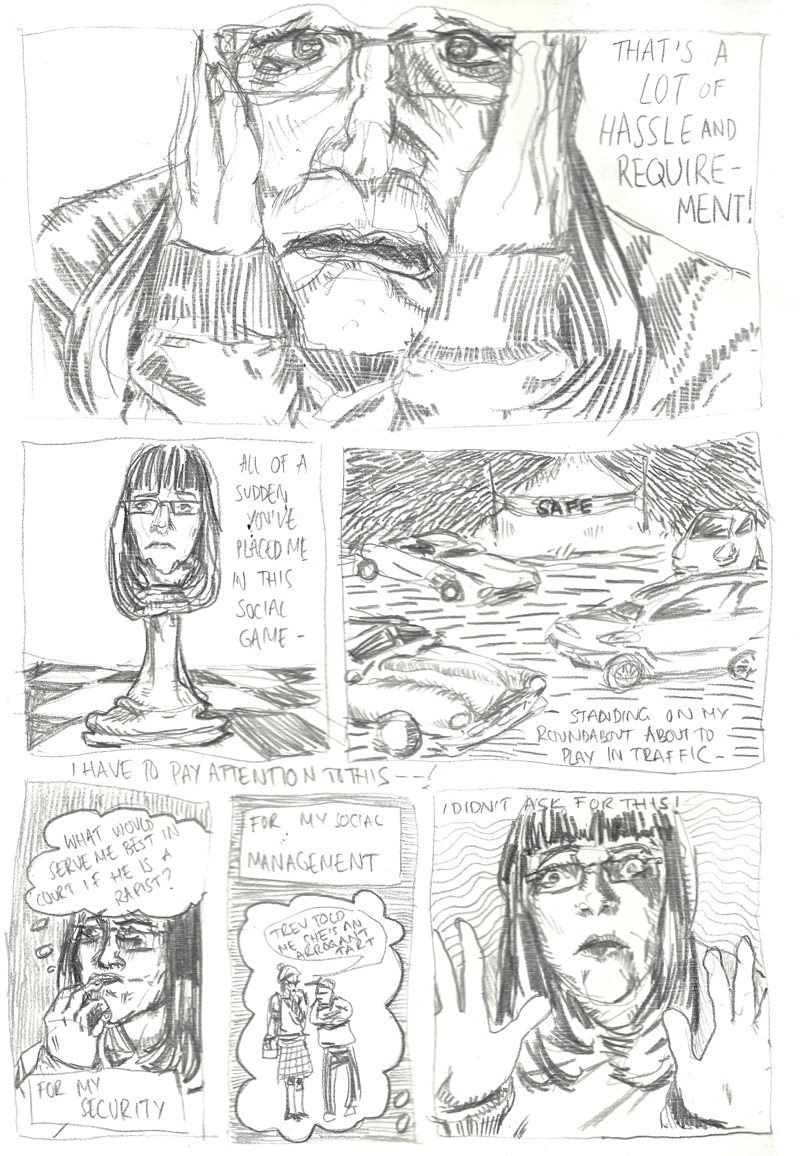
"You're Gorgeous": Invited Post

Claire Napier is a midlands-based, commissionable illustrator and comic artist whom I met through the now-defunct Feminist Fashion Bloggers group. I saw bits of her visual work on her blog, but was largely struck by her thoughtful writing, whether that be things like her musings on conventional femininity, or something out of our shared sphere entirely, like her awesome gift guide for the unemployed. So when she reached out to me about my series on compliments with some ideas about visually expressing her own complex feelings toward unsolicited compliments from men, I jumped at the chance. Enjoy!


Wednesday, October 10, 2012

Beauty Privilege: Can We Talk?


Illustration by Steph Becker


Just like me—in fact, just like pretty much every woman who has ever written about beauty in a public forum—the coauthors of Beauty Redefined have been critiqued as being both A) too pretty to understand the challenges surrounding looks bias, and B) so unpretty that it's no wonder they're writing about body image and self-esteem issues, the poor jealous things. What's that I hear you saying? Something along the lines of: But those statements are totally contradictory? Why yes, they are. That is, they're contradictory in their sentiment, but they're identical in their value, which is: Whatever this woman—or any woman—is saying about appearance must be evaluated by her own beauty, or lack thereof.

Lindsay and Lexie at Beauty Redefined have some excellent talking points at their post on this matter, and if I could cosign the entry, I would. Their entry also got me thinking about one of the more elusive aspects of beauty privilege and looksism, which is: It’s really difficult to talk about.

I mean, we can talk about beauty privilege—or negative beauty bias—in the abstract, and we can talk about things we witness. But you think it's difficult to prove something like the subtler forms of ageism or racism or sexism? Try just discussing looksism. Not only is looksism even more amorphous than plenty of other "isms," but think of how you sound if you talk about it openly: It can seem hopelessly narcissistic to own up to one's "beauty privilege," and hopelessly affirmation-seeking to talk about suffering at the hands of looksism. Unlike privilege that comes from being white, able-bodied, male, thin—and even, to a lesser degree, being heterosexual or middle class—beauty privilege is something that's both physically evident and seemingly impossible to deconstruct from a personal point of view, which is a key way that privilege (and lack thereof) comes to be understood and taken seriously.

I'm guessing that as a woman who is nominally attractive but in no immediate danger of launching a thousand ships, I've received some benefits from looking the way I do but have been spared both the grander forms of beauty privilege (I'm fairly certain I've never been hired as set decoration) and the major drawbacks of beauty (nobody assumes I’ve coasted by on my looks). But here's the thing: I'll never really know to what degree I've experienced beauty bias, in either direction. Few of us do. It could be that the small perks I've been attributing to being a nice-enough-looking lady—say, getting slipped a free cookie now and then at the deli—are just people being kind, and that they'd do the same if I were homely, or a man. I'm sure that is indeed the case sometimes, but I've been smacked down by my own naivete in this regard enough times to know better than to get all Pollyanna here. (One of the free-cookie men suddenly stopped giving me cookies after I stopped by once with a male friend. It was the illusion of availability that he liked—and once that fell to the wayside, so did my supply of white chocolate-macadamia treats.) We can have our hunches, but for the most part that's all we have.

I think of the "click" moments I've heard time and time again of women discovering, without a doubt, that they were feminists; much of the time it's an instant recognition of and reaction to sexism. I'm left wondering what sort of "click" moment it would take for a woman to discover, without a doubt, that she was receiving or being denied a form of beauty privilege. Receiving privilege is particularly difficult to tease out, in part because privilege functions by being unspoken, and unrecognized. (Sitting at the front of the Montgomery city bus in 1954 wasn't what we'd now term "white privilege"; it was the law. Beauty privilege may be encoded in a handful of circumstances, but for the most part it's not.) And since looks are painted as being an ineffable part of a woman's essence—particularly in the case of women considered conventionally beautiful—it becomes even murkier than other forms of privilege. How can you have a "click" moment about something that's supposedly transcendent?

I don't write a lot about beauty privilege, and this isn't the only reason why (mostly I just feel like there are more interesting things to write about). But yes, it's a reason. Not only is there a fear of being called a narcissist if I write about whatever forms of privilege I might have experienced, there's a fear of being called delusional if any given critic doesn't find me...privilege-worthy, shall we say. Maybe this fear is rooted in my personal reality of being an attractive-enough but not stunning woman. Or maybe it's rooted in the reality of being a woman, period. (And, as it happens, I've been called both a narcissist and delusional just for writing about appearance at all, so there you have it.) As much as women are punished for not measuring up to some amorphous beauty standard, we're punished just as much for thinking we're "all that."

“When we dismiss someone’s words due to our assessment of their appearance, we’re minimizing them to their body,” write Lindsay and Lexie at Beauty Redefined. That’s absolutely true, yes. Yet unlike Beauty Redefined, a good portion of The Beheld is expressly written from a first-person perspective. Much as I’d like my words to speak for themselves, I can’t say it’s necessarily wrong to take the looks of people writing personal essays about appearance into account when reading their work. My experience of beauty is undoubtedly different than, say, Charlize Theron's, just as Charlize Theron's experience is beauty is different than it would be if she wore her Monster look 24/7. Readers who assume after looking at a photo of me that they know something unwritten about my perspective might not be entirely wrong—but as the disparate evaluations of my looks from various commenters has shown, they can't all be "right."

We’re so used to viewing women as objects (I include women in this) that we may forget they are subjects too, particularly when discussing looks. Most of the time we talk about beauty, we understandably talk about it in terms of how we look at people, not about the subjective experience of looking beautiful, or plain/cute/weird/misshapen/hot/ whatever. Certainly we don’t usually talk about it in terms of how we believe we’re seen. And if we want to understand the labyrinth of beauty in a richer manner, that might be the most revealing perspective of all.

Monday, October 1, 2012

Invited Post: Pretty/Funny


Eve Plumb, Lisa Ferber, and Lisa Hammer in The Sisters Plotz and Their Afternoon of Will-Reading and Poetry


When I interviewed artist, writer, and “highly productive bonne vivante” Lisa Ferber last year, she shared how two of her childhood heroines were Lucille Ball and Gilda Radner, because they managed the supposedly impossible feat of being both funny and pretty, and how as an adult she came to admire Fran Drescher for the same reasons. Lisa’s no slouch herself in the humor department—she writes and stars in a hilarious web and film series called The Sisters Plotz, directed by Lisa Hammer; its most recent installment, The Sisters Plotz and Their Afternoon of Will-Reading and Poetry, will air on Manhattan’s MNN Lifestyle Channel October 3 at 2 p.m., and on MNN’s Culture Channel October 7 at 10:30. It will also be live-streamed on MNN.org during those times. (And if you need further incentive to watch, yours truly has a small role in it. I even sing!) So I’m particularly delighted to have her guest post today about critic Nikki Finke’s Emmy live-blogging feat in which she claims that—well, read on.

I snapped today when I read Nikki Finke’s much-talked-about critique of the Emmys, specifically her thoughts on Julie Bowen’s win for Outstanding Actress in a Comedy Series. I’ll put Finke’s entire tirade here to spare you the trouble of clicking through (but if you must, it’s here): “Listen-up, Hollywood: Beautiful actresses are not funny. They don’t know how to do comedy. (As Bowen demonstrated with her acceptance speech that repeated the phrase ‘nipple covers’ 3 dozen times. To zero laughter.) Only women who grew up ugly and stayed ugly, or through plastic surgery became beautiful, can pull off sitcoms or standups. Bowen isn’t a comedienne just like Brooke Shields wasn’t and a zillion more. Because it’s all about emotional pain and humiliation and rising above both by making people laugh with you instead of at you. So stop casting beautiful actresses when you should be giving ugly women a chance. (Tina Fey always points out she looked like a troglodyte when she was younger.) This also applies to handsome men, by the way. Now argue amongst yourselves.”

Finke knew what she was doing; hits for her piece would go up by declaring something so controversial. And she’s already had responses with people ranting about her and posting photos of funny women, talking about what a fool she is. That’s all great and helpful. My response is that I’ve never understood why the funny vs. beautiful dichotomy even exists—and I’m questioning how we created a world in which it does. (Okay, and also that Brooke Shields is hilarious. When I saw her on Friends as the obsessed soap opera fan, I thought, “Yes, Brooke! You went from underwear model to blasé movie actress to Norma Desmond! You will not let people tell you who are!” Only someone who is unwilling to let herself grow would look at Brooke Shields and decide that a woman who used to parade around in her panties for a living can’t decide to start letting her wit do the dazzling…while still looking movie-star perfect.)

Beauty is mesmerizing, transportive; it makes tongues wag and it makes times slow down. Beauty says, “I am here as an object for you to admire,” and while it contains power, it’s a power that turns its owner into an object of projection and fantasy. Comedy is refreshing, jarring, true, smart. Comedy says, “I am powerful, in a way that means I am going to call it like I see it, and sometimes you will feel taken aback.” The ability to deliver a comedic line is a form of confidence that a person has—or doesn’t have. The ability to show up at an event and know that a certain percentage of people will stare at you is a confidence a person has, or doesn’t have. The difference is that beauty, though a quality that dazzles a room, invites people to make up who you are and fill in the blanks; comedy shuts that down. When a beautiful woman demonstrates a sense of humor, it goes one step past showing she’s smart and gets right to, “I’m not just smart, I’m questioning and I’m making observations. I am an active participant, not a shell.”

The idea that a woman can only be funny if she has suffered is an interesting one, for humor can be a sign that someone is able to find happiness at all times, and it is often developed as a survival mechanism for those dealing with hard times. But the implication—and this is not just Finke, it’s the reason she and others have this issue in the first place—is that beautiful people don’t have everyday problems and therefore can only be funny if they’ve suffered the plight of the underdog. What’s particularly disturbing about this implication is that a beautiful, funny person has to keep proving their pain—has to keep apologizing. “I’m still hurting! I’m not just enjoying being funny and beautiful! I hope that makes you feel better about your sucky life and limitations!” Why do we need to know that Tina Fey wasn’t attractive when she was younger? Why did Joan Rivers constantly make fun of her own appearance, then pick relentlessly on gorgeous Liz Taylor when Liz was struggling with her weight, and then resort to frightening plastic surgery? Do we need to see a funny, successful woman apologizing constantly for her wit and success in order to feel that all is right with the world? Must every beautiful funny woman pull out “awkward teenage photos” to prove “but I’m one of you! Really!”

The beautiful vs. funny issue comes down to the recurring problem of women not being allowed to embrace all forms of their power. A beautiful woman, out of politeness, has to pretend she doesn’t notice she is being watched, even though of course she should be aware of it, for reasons ranging from self-protection to understanding why she might receive special treatment, either preferential or jealous. A funny woman proves consistently that she is aware of herself in the world, and is insightful about human behavior and motivation—and when this is combined with prettiness, it leads to a viewer wondering, “Wait, so are you aware that each hair toss drives people wild too? How much of this are you picking up on?”

The division between beauty and humor hasn’t always been as sharp as it is now, and throughout film history there have been women who have shimmied through the cracks. On the late ‘80s/early ‘90s hit Designing Women, a rare woman-focused show where attractive ladies were not trying to cut each other’s throats for men—though they all did date and had some lasting relationships—beauties Dixie Carter and Delta Burke both owned their physical beauty and their comedic strengths. In The House Bunny and Legally Blonde, Anna Faris and Reese Witherspoon, respectively, win our hearts as women who discover that underneath their pretty exteriors they really are smart…and they are hilarious doing so. But the shining era of beautiful, glamorous, hilarious women in film was the 1930s. Myrna Loy, Constance Bennett, Carole Lombard, Jean Harlow, Kay Francis—heck, just watch The Women (the 1939 original, please) and you’ll see why I get so frustrated with how far we’ve regressed from when a film like this allowed each lady to shine.

So what changed? The foundational problem some members of our culture, like Finke, have with funny, pretty women is that they’re just too much of a threat—and in 1939, most women weren’t really seen as threatening in the least. Carole Lombard could be beautiful and hilarious in 1936’s My Man Godfrey because the biggest threat her dizzy socialite character could possibly pose would be selecting the wrong “protégé.” Fifty years later, women had gained in status, income, and independence—so quick, call off the funny ladies! You can see the unimaginative screenwriter’s dilemma: “Wait, she dazzles me and I project my fantasies onto her, but she also sees the world in a way that shows an ability to question everyday behavior and call bulls**t when she sees it. Should I objectify her, or go to her for wisdom? Can’t she make this easier for me?”

I’ve dealt with a rare type of snarky man who can’t laugh at a woman’s joke, and I smell it right off. I see humor as play; I see it as a way to connect, to loosen the atmosphere, and most men respond to this. But there are exceptions. When I was 20, I worked at a food counter in the stock market. All the men were sweet and friendly to me, but there was this one smarmy fellow who would never laugh at my jokes. My delivery is sweet and friendly, and occasionally dry, but I’m never trying to be “one of the guys.” When I delivered the food, I would banter, and the men would banter back, and it was fun. But this one fellow just couldn’t laugh, because I was a cute girl in his age group and therefore my purpose was to be an object he could look at as powerless. He would look at me in the sleaze way, but my jokes were not welcome. One day, I’d had it up to here with him. So when I showed him the day’s menu and he said to me, “Is the fish fresh?” all I could think was, He’s toast. So I put my hand on my hip and said, “Yeah, I shot it this morning.” Dude was so shocked that he burst out laughing, and I walked away thinking, “That’s right. Who’s your daddy now?” But it was only because I was finally saying, “Enough already—you’re going to deal with it,” that I broke him out of his attempt to make me feel that my attempts at showing smarts were unwelcome.

I currently write and star in a web and film series called The Sisters Plotz, featuring Eve Plumb and Lisa Hammer. We style ourselves in a vintage, feminine way with an indulgent dose of camp-glamour. Eve and Lisa are two seriously pretty women. Am I about to tell them to disempower themselves by perhaps wearing less flattering outfits or messing up their hair a little bit because I’m trying to decide if they should be funny or pretty? Maybe we should all make jokes pretending we think we’re fat or we should pick on some part of our face or body, because that will make people love us? Um, no. Right now I want to live the dreams I had when I was growing up. This is the one chance I get to be in the world, and I understand that there will always be acts of cruelty or even just idiocy that I don’t understand. But I want to live in a world where women are allowed to be funny and pretty and smart and free and strong and glamorous all at the same time—or none of these things if they don’t want to be—and I know that there will always be people who just don’t agree that I’m allowed to enjoy this type of privilege. But that’s all right. My red lipstick and I are ready.


__________________________________________________________________
Lisa Ferber paints and writes witty character portraits influenced by her fascination with humanity. Her works display an appreciation of the beauty and quirks of human behavior, as well as a compassion for its foibles. Her paintings have shown at National Arts Club, Mayson Gallery and other venues, and sell to private collectors. Her films have screened at the Tribeca Grand and the Bluestocking Film Series, and her film "Whimsellica's Grand Inheritance" won the People's Choice Award at the "It Came From Kuchar" festival. Her plays have been performed at notable theaters such as LaMama, DR2 Lounge/Daryl Roth Theatre, and her play "Bonbons for Breakfast" was a New York magazine "notable production." To learn more about her projects, please visit LisaFerber.com

Thursday, August 16, 2012

Invited Post: The Ripple Effect

Mara Glatzel from Medicinal Marzipan has long been one of my favorite body image bloggers, in part for her worldview and in part for her graceful, inspirational prose. But what strikes me most about Medicinal Marzipan is its honesty: Glatzel shares her vulnerabilities as well as triumphs in the route to wellness (including a recent post that gave me one of my own biggest "aha!" moments in the past several years about my own eating concerns). 

I was pleased to learn that Mara has developed a tool for helping others find their own place on the vulnerability-triumph spectrum, with Body Loving Homework, which she describes as "one part Ebook, one part digital anthology, and one part self-study coaching program—designed to help you find clarity around what you deserve out of your life and your daily experiences." When I sampled a few of the 100 writing prompts in the book, my responses ranged from joy (apparently my answer to "My body remembers" is a hint racy) to discovery (I think of myself as pretty calm, so imagine my surprise when several of my answers to prompts involved the word panic). I asked her to guest post here about incorporating self-acceptance into our daily lives, and the place where self-image and body image intersect. 


If you’re anything like me, you know exactly what it feels like to go through the motions: saying yes, piling on the additional work, doing the emotional housekeeping, working out the logistics, and taking everyone else’s needs into account.

You’re probably really good at it too—a skill cultivated and honed over the course of your life.

I used to think that taking care of others was what I was best at, what I was put on the planet to do.

I used to think that just because I was good at it, I was relegated to going through the motions the rest of my life.

This conveniently fit in with other beliefs that I held about my life—feelings of being unworthy, unlovable, unforgivably damaged—because, through taking really good care, I was able to make myself useful in a way that didn’t require me to necessarily stick my neck out.

I was kind.

I made dinner.

I cleaned up communal physical space.

I put down whatever I was working on, attending instead to the emotional crisis at hand.

I do not intend to set up a paradox here, as in: when I hated myself, I took care of everyone else, and when I learned how to love myself for who I was, I only took care of myself.

For me, it wasn’t one or the other. It was in the appearance of a choice in the matter. It was knowing that I was worth loving not only for my caretaking abilities, but also for the rest of me as well.

When I learned how to love myself, truly love myself, and believe in the fact that I had more to offer the world than laundered socks and mended hearts—I was able to believe, also, that I was more than what I had been permitting myself.

When I was single or momentarily attached, I used to joke that I was a “starter wife”—the kind of girl who picks up broken, sad partners, and uses her love to shine them up like a little penny, gently reinforcing their strengths through the repetition and constancy of my adoration.

Until the day that they got so shiny, they wanted to hop into someone else’s pocket.

In these moments, I was left alone, heartbroken, but, when I was truly honest with myself—at least partially to blame. I had avoided infusing myself into these relationships, because I deeply feared that doing so would scare my partner away. I had internalized messages during my youth—messages of being too big, too loud, too passionate. I had been told by my experiences that people stayed around longer if you made your needs as brief and palatable as possible, and then went about your day becoming exactly who they need you to be.

I remember the exact day when I realized that I could, instead, choose to be myself.

I realized that if I was myself, and it didn’t work out, at least I knew ahead of time instead of wishing and praying that my real self wouldn’t pop up unexpectedly and drive someone away.

For me, self-acceptance has been the slow integration of who I was presenting as and who I was inside. It was the process of becoming who I already was. It was putting all of my faith in the idea that if I could permit myself to be myself that I could love that person—even when I was afraid to do so. 

However, as will naturally occur when you begin to change one aspect of your life—suddenly, the impact spread, and I was astounded by how pervasive my self-hatred had become.

I found unexpressed sentiment and choked on words in every facet of my life—work, relationship, family. I found that in fact I really hated where we had chosen to put that new bookshelf or that in my heart, I wished we had painted the bathroom blue instead of red. I was surprised, as these feelings weren’t even large, big scary to divulge feelings—I was saying yes and keeping quiet in all aspects of my life.

And, at first, I thought I was doing all of this out of some sort of damaged self-esteem around my body, but, over time, I realized, it wasn’t my body—it was my most basic sense of worth and deserving. It was who I was, deep inside, that was hurting and needed to be freed.

What I thought was about the size of my hips, was actually about the cultivation and maintenance of healthy boundaries within the context of my relationships.

What I thought was about whether or not someone thought I was attractive, was actually about speaking my needs out loud, in the presence of another.

What I thought was about my body—was about how I was living my life.

The human body is a convenient scapegoat. 

Contentious by nature, degraded by the media, and a highly personal battleground, our bodies carry more than their fair share of the pain, hurt, and rejection that we experience in the world. For example, it was much easier for me to hate my body than realize that I needed to dramatically upgrade my ability to create and maintain healthy boundaries.

In many ways, hating your body is easy. You’ll never be alone. You will always have others to join you in your self-hatred, commiserating over the size of their thighs or how this was the week that they are going on a diet or he didn’t reject me—he rejected my body. As in, things that you can fix or have control over.

When it is about your body, it is a problem that society tells you you can fix—head to the gym, hop on a diet, indulge in some plastic surgery. Even if you wouldn’t resort to some of those options, they are out there, filling up the social consciousness with feelings of safety and well-being. Whether or not you choose to access them—the option is there.

You can change your body. You can make yourself prettier. You can buy new, sexy clothing.

You know how to do that, and on many levels—it feels safe.

What about when it’s not about your body? What about when it is about your basic ability to connect with other human beings, relax into intimacy, or be both yourself and yourself in the context of a couple?

That feels much less safe.

This is the messy zone, the dark closet that we shove all of our odds and ends in, in order to keep the rest of our house tidy and presentable. The answers here are not cut and dry. They do not apply to everyone. You cannot read about them in the self-help section of your favorite magazine.

They come from learning to listen to the voice inside your body, the small part of yourself that lets you know what you’d most like and what your wildest dreams are.

I had been keeping myself small—occupied by the an overflowing to-do list of laundry and groceries, wrapped up in the melodrama of my own creation, and concerned with the well-being of those around me first, and my own needs—last, always.

It wasn’t that learning to love myself dramatically altered who I was. I haven’t stopped taking care, but I am confident now that I am choosing to take care and that the people who I choose to take care of are worthy of my most profound love and consideration.

Learning to love myself has permitted me the ability to realize that I was worthy of anything that I put my mind or heart to. It was the quiet process of choosing, every day, that who I am is important. That my words matter. That my actions are an extension of my heart, and that they should be respected as such.

That I am worthy of my own love and the love of those around me, and not because I’ve cooked them dinner.


_________________________________________

Mara Glatzel is a self-love coach + author of Body Loving Homework: Writing Prompts for Cultivating Self-Love. She works with women who are ready to create the lives they want — and deserve. Her blog, Medicinal Marzipan, has inspired thousands of women to heal their relationships with their bodies, and treat themselves with relentless compassion. Catch up with her on Facebook or Twitter, or join her body-loving mailing list for secret swapping and insider news.