Showing posts with label men. Show all posts

Wednesday, February 3, 2016

Men's Fashion, Eugenics, and Cultural Capital


Members of the Men's Dress Reform Party, 1937.


Here’s a party whose caucus I’d love to watch: The Men’s Dress Reform Party. While researching the history of men and makeup, I ran across a mention of this odd-duck British party in the 1930s whose sole purpose was to agitate for loosened clothing restrictions on men. They paraded about in shorts, open-collared shirts, and color-coordinated socks; if a member wore a tie, he might fasten it inches below his Adam’s apple.

The idea was that the dark, heavy clothes men were expected to wear were unhygienic (it was difficult to wash a suit before widely available dry cleaning—indeed, that’s part of why suits are traditionally dark, to mask dirt), and ugly to boot (we’ll get to that). Men’s clothing was a health hazard, they claimed, which fell into line with its parent organization, The New Health Society, a group devoted to educating people about nutrition, “intestinal stasis,” and “helio-hygiene.” (I visualize them as a predecessor to Gwyneth’s Goop team.) So they fought back, urging employers to let workers wear freer dress, organizing ersatz holidays in which men were to wear whatever they pleased, and throwing rallies at which members were instructed to “Come as you are and feel your best,” which for some meant togas, for others singlets and jeans, and for H.G. Wells, meant “ordinary evening dress.”


Western Argus, Kalgoorlie, Australia, July 14, 1931


It seems odd at first that this would be an organized group instead of a looser assemblage, but its goals were political. They’d seen how women had begun to fling off repressive roles, a movement reflected in their clothes; why not do the same for masculinity? J.C. Flügel, an influential psychologist at the time and a proud MDRP member, claimed that the institutionalization of the suit had led to a “a remarkable repression of Narcissism among men,” which he saw as undesirable, as it left all the fun of self-ornamentation to women. Unleashing men’s sartorial fancy, he argued, would loosen their superego, the restrictive, repressive force in the human psyche—which would ultimately lead to greater freedom.

What’s interesting about the MDRP is its split between a vision that even today seems progressive (a lessened emphasis on traditional masculinity) and a cause that seems abhorrent. Part of the MDRP’s cause revolved around eugenics: If the “right” men were to showcase their appearance, they would be more attractive to the “right” women, and more “right” babies (that is, white babies born into the professional class) would be created. Eugenics was widely accepted in mainstream science and medicine then, but even contextualized, it’s clearly troublesome for all sorts of reasons, with fascism topping the list. Yet even within this odious framework, I appreciate their commitment to at least thinking through the evolutionary logistics. Evolution is often cited as a reason women wear makeup: It’s ornamentation that catches the eye of potential mates. It’s a perfectly fine theory until you question why it’s women, and not men, who wear makeup (for the most part), when both sexes have an evolutionary need to attract the other. So the MDRP’s eugenics mission was wrongheaded, but at least it bothered to be consistent with its own internal logic and wasn’t just cherry-picking its theories to justify a sexist vision.

Eugenics is tied to class, not just race, and the MDRP has an interesting fabric here too. The party claimed to be for people of all classes, but the fact was that most of its members were middle- and upper-class, and that they weren’t advocating for more accessible clothes, but more fashionable ones. (In fact, clothes were about to become way more accessible, with the invention of fabrics that invited ready-to-wear clothes—which actually wound up accomplishing the MDRP’s goals, even though they had nothing to do with it.) But the MDRP’s biggest reinforcement of class is something that’s familiar today. The suit that the MDRP was fighting against was the very thing their grandfathers had fought for: a uniform of sorts that would theoretically allow for meritocracy to flourish, since it was more difficult to display wealth through the suit as opposed to the ruffles of the aristocracy. The ruffles were seen as oppressive; eventually, the suit that replaced it became seen as the same.

Today it would look like the MDRP’s vision has won out, at least in America (though remember, the MDRP was British) with leisurewear accepted in plenty of professional workplaces and shorts no longer seen as the province of little boys. But the suit remains, and it remains as a symbol of class. Most of the time I see a man in a suit, he’s either in the upper echelons of certain professional worlds (financiers, government officials), or he’s in a position of servitude (security, hospitality). By agitating for the loss of the suit, the Men’s Dress Reform Party wanted to revert to the days of male self-ornamentation as a display of cultural capital. The suit remains, albeit changed—and changed in a way that has shifted its meaning to be about a display of, not an eradication of, cultural capital. In that way, regardless of the MDRP’s place as a mere footnote in history, they were unexpectedly successful.

Wednesday, March 19, 2014

Nerd Crushed: Where Are the Average-Looking Female "Sex Symbols"?


Around the time I started “casually” walking by the home of a man who gave me my one and only skydiving lesson, I realized one of the factors that makes me find someone attractive: If I watch a man do something he’s good at and loves to do, it's likely I’ll develop a little crush on him. It’s not a sexual crush necessarily, nor is it a crush that I’d actually act on—in fact, much of the time the object of my crushdom is someone I know full well I’d have no interest in otherwise. Most of the time the crush doesn’t persist past the moment (the skydiving instructor was an outlier, because, I mean, the dude jumps out of planes on purpose). My minute-long crushes are usually an acknowledgement that watching someone at their best makes them attractive, regardless of their attractiveness overall.

So of course, midway through watching the premiere of the rebooted Cosmos, I’d developed a crush on its host, astrophysicist Neil deGrasse Tyson. His barely-contained eagerness to share the secrets of the universe, his slightly jumpy demeanor, the liquid pools of his warm brown eyes—if he hadn’t had me there, he’d have gotten me with his tear-jerker anecdote about being hosted for the day as a 17-year-old kid from the Bronx by his hero, Carl Sagan. 

Now, I may understand the drive behind my own mini-crushes, but I also know that my predilection has led me to some highly unlikely crushes; I had a photo of Tom Brokaw hanging in my locker in seventh grade. But I’m used to those crushes being seen as sort of idiosyncratic—let others have their obvious Clooneys and Pattinsons, I’ll stick with the unexpected, thanks. So when I searched for what other viewers were saying about deGrasse Tyson, I didn’t think I’d find that just as we’re not alone in this universe, I wasn’t alone in my crush. Neil deGrasse Tyson, according to Twitter, is everything from a “science crush” to a “nerd crush” to a “celebrity crush.” He’s “superhot” and “handsome,” making us “hot and bothered,” what with his “sci-sexy” “sexy voice” and general “hotness.” In fact, he was once listed in People’s annual Sexiest Man Alive list as the Sexiest Astrophysicist, is routinely listed as a “nerd sex symbol” in headlines, and has been asked about his sex appeal to the point where he even has the crushworthiest response possible ready at hand: “When you tell people something that's intellectually delectable, they can feel sensually towards it. But I think at the end of the day, the object of their affection is the universe." (Swoon!) Point here is: My NDT crush isn’t idiosyncratic, offbeat, unexpected, or unlikely in the least. The man isn’t just a little crush of mine; he’s a bona fide sex symbol, regardless of whether it’s qualified by the word nerd.

I think it’s splendid that so many people are freely acknowledging what most of us already know from our own experience: Sex appeal isn’t strictly tied to conventional good looks, and average-looking people can become immensely attractive in our eyes if we find their other qualities appealing. I mean, Neil deGrasse Tyson is nice-looking enough, but I doubt he’d be seen as “handsome” or “superhot” were it not for his other gifts. (Sure, there’s an argument there about the dangers of labeling everything appealing as “sexy” and why a good astrophysicist can’t just be a good astrophysicist in peace—but really, it’s the quieter sort of sex appeal that has made us humans keep propagating the species, so I’m all for it.) I mean, who among us hasn’t experienced an unlikely flutter of the heart or loins in watching someone blossom before our eyes in a single moment? A headline proclaiming an utterly normal-looking man as a “sex symbol” of any sort means that we as a culture are eager to see beyond the surface when it comes to human appeal.

But when I tried to think of a woman who is widely seen in the same light, I came up short. Sure, there are plenty of well-known women who are seen as “nerd crushes” because they speak of their nerdy interests (like Mila Kunis) or are involved with nerd culture in the sense that they go to Comic Con. Then there are the women who have been christened as “the thinking man’s sex symbol,” like Tina Fey, Sarah Silverman, Susan Sarandon, and Rachel Weisz, all of whom may be excellent performers and writers, and all of whom are also pretty much exactly the definition of the beauty standard, even if they’re not as cheesecake-perfect as sex symbols who don’t usually garner the prefix of “thinking man’s.” Sarah Palin of all people is actually the closest I can think of, in that she's a well-known woman viewed as attractive in a field where you don't have to be a professional beauty to succeed—but besides the fact that her sex appeal became a tool of ridicule, she was literally a beauty queen, hardly landing her in the same camp as Neil deGrasse Tyson. (Also, she’s Sarah Palin, but whatevs.) Google turns up a few other women labeled “thinking man’s sex symbol” who aren’t entertainers—writer Jhumpa Lahiri, Sheryl Sandberg—which come closer to the spirit of the deGrasse Tyson phenomenon, but they’re acknowledged as sex symbols on a far smaller level. The point: Call her a nerd crush or the thinking man’s sex symbol—if she’s a woman, she’s still got to be pretty damned good-looking to get the title. I mean, when The Wonder Years child star Danica McKellar went on to be an advocate for girls in math, she was doing book promotion in lingerie. 

Just as we’d be unwise to blame individual men for patriarchal beauty standards, we can’t say that the lack of widely acknowledged atypical female sex symbols is a reflection of men’s abilities to see beyond the physical. Men are just as capable as women of finding someone attractive for reasons that have little to do with visual attraction, and I’ve heard plenty of individual men share their crushes on somewhat unlikely targets: soccer player Abby Wambach, economics blogger Megan McArdle, Broad City’s Ilana Glazer, poet Nikki Giovanni, and tennis player Martina Hingis before the makeover. An ex once sheepishly told me he had just a wee little crush on Angela Lansbury as Jessica Fletcher, you know?

Still, collectively we’re slow to recognize the possibility of a female “sex symbol” who doesn’t possess the hallmarks of a traditional sex symbol. And to be clear, on its face this isn’t necessarily a bad thing. I mean, the flipside here is that anytime a prominent woman does anything nifty, she’s suddenly a “sex symbol.” Congresswoman Nancy Pelosi: the Hill’s sex symbol! Doesn’t Alice Munro look hot as a Nobel laureate? By no means am I arguing that we should sexualize women’s accomplishments just so we can have a female equivalent of a Neil deGrasse Tyson. But the thing is, we already do sexualize accomplished women, assuming she’s conventionally attractive. What’s missing is room for a wider public acknowledgment of the enormous swath of qualities that make accomplished women attractive. We give it to the gents, and on an individual level we give it to women too. But when it comes to our culture—or hell, just Twitter—christening an utterly average-looking woman a sex symbol of any sort, we shy away from the possibility.

Basically, this is a version of the same old song—I mean, news flash, women are expected to look conventionally pretty. It’s just interesting to me that we as a culture are willing to go to greater lengths to extend the definition of attractive to include skill and charisma when we’re talking about men, but not so willing when we’re talking about women. Or are we? I’m hoping I’ve got a major blind spot here. Are there famous women I’m overlooking who are widely known as “sex symbols” despite not matching the definition of conventional beauty? I’d like to learn that I’m mistaken.

Monday, December 3, 2012

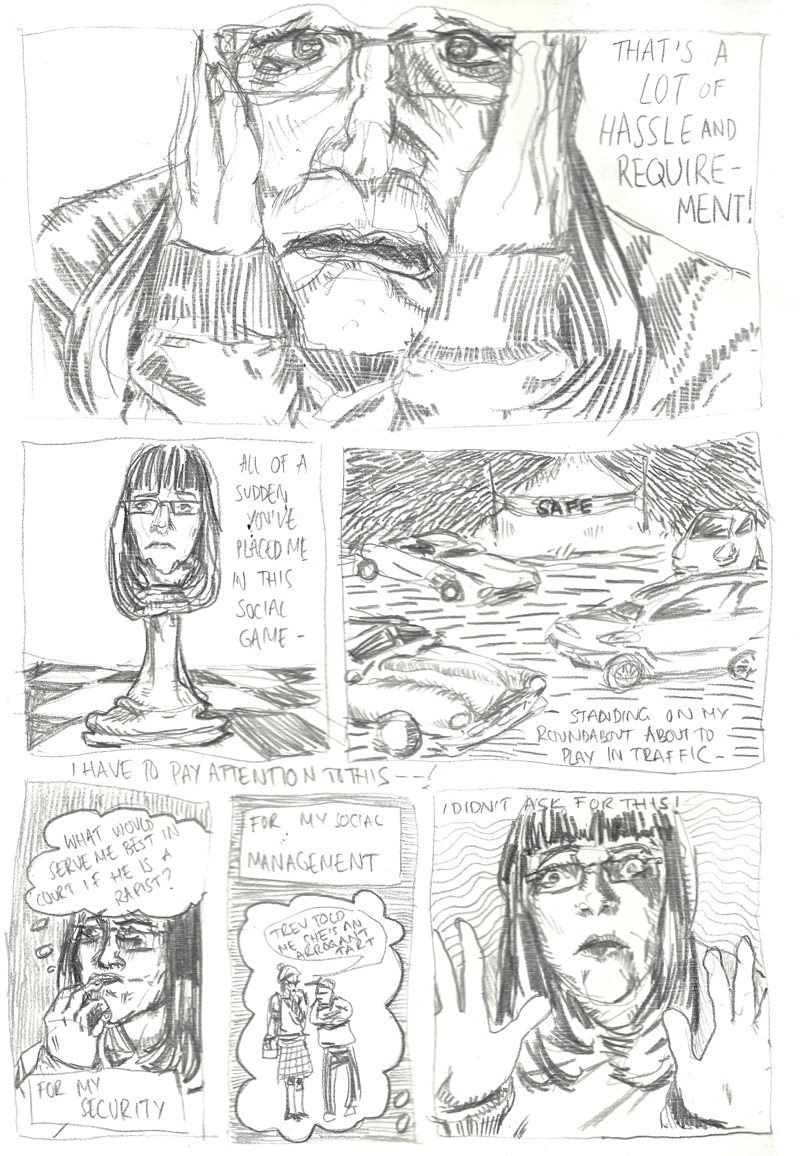
"You're Gorgeous": Invited Post

Claire Napier is a midlands-based, commissionable illustrator and comic artist whom I met through the now-defunct Feminist Fashion Bloggers group. I saw bits of her visual work on her blog, but was largely struck by her thoughtful writing, whether that be things like her musings on conventional femininity, or something out of our shared sphere entirely, like her awesome gift guide for the unemployed. So when she reached out to me about my series on compliments with some ideas about visually expressing her own complex feelings toward unsolicited compliments from men, I jumped at the chance. Enjoy!


Wednesday, November 28, 2012

Yer Cheatin' Heart: The Relationship Between Beauty and Betrayal


The Fête of the Order of Cuckoldry Before the Throne of Her Majesty, Infidelity, France, c. 1815


Looking at appearance and infidelity vis-à-vis the Petraeus household made me curious about what role beauty actually does play in betrayal. Most of us know from casual observation that it’s fully possible for a person to cheat with someone who isn’t as physically attractive as that person’s primary partner—but is there any sort of pattern there? Are people likelier to cheat with someone who’s conventionally better-looking than one’s partner?

I was surprised/relieved to find that there weren’t any studies available that delved into that particular question. (Not sure how that would work in a lab setting anyway: “Please send photo of mistress to...”?) But there’s a wealth of research looking at other intersections of appearance and infidelity. Some of the more interesting findings:


1) Women reported feeling more threatened when “the other woman” was particularly attractive—but only in cases of emotional infidelity. In sexual infidelity, the other woman’s appearance had no effect on the wife/girlfriend’s feelings about the betrayal.

I was surprised by the findings of this study at first. On the surface, our culture tends to equate beauty with sex appeal more than it connects beauty and lovability. (The frowsy girl in movies never gets laid, but someone’s gonna see her heart of gold, right?) So wouldn’t a woman feel more threatened by an attractive rival when the betrayal was sexual more than emotional?

But with a closer look, it makes perfect sense. Sexual infidelity can be as meaningless as a drunken, regrettable one-night stand; emotional infidelity implies not a fleeting crush but something with a deeper current that develops over time. In other words: Someone cheating sexually could just want one specific part of a person (ahem)—but someone cheating emotionally is entranced with the entirety of the third party. And in a culture that likes to make-believe that a woman’s value as a person lies in her beauty and feminine charms, it’s logical that a beautiful woman—i.e. a valuable woman—is going to pose a greater threat in situations of emotional infidelity. When your partner becomes emotionally invested in another person, it stings regardless of who that person is. But when it’s someone whose value is evident, the threat is greater because your own value diminishes comparatively. With sexual infidelity, the value of the person isn’t called into question as sharply as it with emotional infidelity, so a beautiful “rival” poses less of a threat.


2) Women are more likely than men to end a marriage after their own infidelity—and the more attractive the woman as compared to her husband, the likelier she is to do so.

To put it plainly, attractive women are likelier than men to use infidelity as an opportunity to “trade up,” in the language of this study. The lesson here seems clear: Beauty increases a woman’s “market value,” while infidelity (including the person’s own infidelity) lessens the value an individual gets from her or his partner. Put the two together and it’s not hard to see how a woman might feel as though the algorithm of the relationship has changed after infidelity, to the point where ending the relationship makes sense in a way that it might not if she weren’t confident of her “market value.” By the way, I’m putting that in quotes because it makes me a little queasy not to.


3) Women were twice as likely as men to endorse “the other person makes me feel attractive” as an acceptable reason for infidelity.

Endorse is a strong word here but it’s the word used in the study so I’m borrowing it here; the participants weren’t necessarily saying infidelity was hunky-dory under any circumstance. With that weakened use of endorse in mind, take this in: 20% of men endorsed cheating if the other person made them feel attractive, while 42% of women said the same. In addition, women were 6% likelier to endorse infidelity when the cheating party wasn’t attracted to their spouse. (In fact, the only reason for cheating that men endorsed significantly more than women was “Opportunity presented itself,” with 32% of men signing on.)

Read cynically, this confirms the wretched stereotype of women as hopelessly vain, forever needing to be fawned over and then getting huffy enough to cheat if that fawning stops. But I interpret this rather as a sad comment on what all these studies are driving at: Plenty of women still internalize their value as lying in their looks. Feeling beautiful under someone else’s gaze can be intoxicating—and so validating that it might trump other values one might hold dear. Bathing in that gaze is often construed as such a foundational condition of a relationship that it might be easy for some women to quietly substitute in that feeling for commitment and fidelity. Indeed, so much advice given to women about how to “catch his eye” is geared toward maximizing physical attractiveness that if you squint hard enough, catching his eye can appear to be the grand prize that women are supposed to shoot for—not the relationship itself. Little wonder that under that paradigm, plenty of women might be willing to excuse infidelity with “but he makes me feel beautiful.” Plus, since attractiveness is often seen as the way one “earns” sex (only the beautiful get to do the nasty, you know), it makes sense that having your appearance highly valued by another lays the groundwork for beauty’s payoff.


4) Men married to women they believe to have a high infidelity risk are likelier than other men to use “mate retention tactics” to keep their wives from straying. Women, on the other hand, were no more or less likely to deploy such tactics regardless of whether they thought their husbands might cheat. 

You’ve gotta love these “tactics” too: punishing the woman for whatever it is that makes him think she might stray, putting down competitors, submission and debasement, and “concealment of mate,” whatever that means (the study didn’t say). Of course, that’s better than the tactics used by men who perceive their wives to be more attractive than they themselves are: emotional manipulation, derogation, sexual threats, and violence against rivals. And once again, women who perceived their husbands to be more attractive than they themselves are weren’t more likely to use those tactics.

These tidbits are just randomly dispiriting until you look at another finding of the study and see exactly how dispiriting it really is: There was no correlation between how hot a guy thinks his wife is and how likely he thinks she is to cheat on him. Yet a woman’s perceived beauty and her perceived risk of infidelity are not only punished, but are punished in much the same way. (Not all the “mate retention tactics” measured in the survey were negative ones; love and care were considered tactics, for example.) So basically: Women are groomed to maximize their attractiveness, in part because that’s supposed to snag you a higher-quality mate. Yet getting into a relationship with a man who thinks you’re better-looking than he thinks he is carries risk. Talk about feeling cheated, eh?


*     *     *


These findings are hardly conclusive, largely because some of them relied upon hypothetical infidelities, and also because the conclusions drawn from the studies are rather oblique. (Plus, I’m skeptical of beauty studies to begin with.) Intellectually, what I gather from them is what popped up plenty of times above: As long as we see women’s value as lying largely in their appearance, there will be a relationship between beauty and betrayal, even if that relationship isn’t as straightforward as some people would make it seem.

Personally, though, I take something else from this data: Since there’s no pattern here as far as actual behavior, there’s little use fretting about one’s own appearance in conjunction with infidelity. I know that when I’ve been cheated on, my instinct (after seething rage) is to wonder why I alone wasn’t enough for my partner. And, yes, to wonder whether the betrayal happened because I ceased to be attractive in the cheater’s eyes. (I didn’t say it was a healthy instinct, people.) But looking at all these studies, they’re...fuzzy. Weird little conclusions come up, none of which explain the only thing I’ve really cared about when I’ve been betrayed—or, for that matter, when I’ve had the poor judgment to betray a partner myself: Why. The why of betrayal sears and smolders, and at least in my case, it never fully burns out, even years later. I don’t feel anger when I think of my high school boyfriend telling me he kissed his ex during a snowball fight, but the why still flickers, even if the only emotion it provokes in me is nostalgia for the time when that was the most complicated thing I could imagine happening in my intimate life.

These studies don’t provide a why. And as satisfying as it would be to have something concrete we could turn to in times of the heartbreak of betrayal, it’s fitting that no why emerges. Can we ever know why? If “opportunity presented itself” is one of the more popular reasons for cheating, there really isn’t a why. It might be cold comfort to see that beauty isn’t really a part of the why—or it might not be comfort at all, depending upon your relationship with beauty, and with infidelity, for that matter. But only when we learn to take our own perspective on appearance out of the equation can we begin to see “opportunity,” disappointment, and the chaos of love and desire—the unsatisfying but undeniable components that are likely a part of the why—as the real flame-throwers here.

This is part two of a three-part series on appearance and infidelity. Part one is here; look for part three next week.

Monday, November 19, 2012

The Petraeus Affair: Infidelity, Beauty, and Scapegoating


The sex lives of public figures bore me. Rather, the sex lives of public figures interest me no more than that of, say, my dentist. My view on sex is generally pretty solipsistic: If it’s not me having the sex in question, I don’t particularly care about it, and I don’t understand why anyone besides those directly affected would.

So I didn’t pay much attention to the David Petraeus scandal—at least, not until I read this excellent piece by Meghan Daum that questions the mandate of beauty in high-profile women. The article draws upon Petraeus’s wife, Holly, and the flurry of nasty comments in the “chattersphere” about how one could hardly blame Petraeus for sleeping with his attractive biographer, given that Mrs. Petraeus dared to look like a middle-aged woman who doesn’t pay homage to the beauty industry at every opportunity. "If it's no longer shocking that a powerful man would have an affair with a younger, worshipful woman,” writes Daum, “it is a little shocking that the wife of that powerful man, nerdish as he is, would thwart the beauty industrial complex quite so vigorously.”

Daum’s larger point—that we need to eliminate the double standard dictating that accomplished women like Olympia Snowe, Dianne Feinstein, and Nancy Pelosi must pay attention to conventional beauty standards while their male counterparts can eschew them—is one that needs to be made, repeatedly, until things change. (Remember the hubbub when Hillary Clinton had the audacity to speak at a news conference without makeup?) But what’s interesting to me is something Daum acknowledges in her article: Save for a smattering of comments-section trolls, nobody is publicly suggesting that Holly Petraeus’s low-key, glamour-free looks are to blame for Petraeus’s infidelity. Yet the piece hinged upon that very idea, and the piece gained traction because we all quietly understand the game of pin-the-blame-on-the-gray-haired-woman. Save for an ugly little post from Mediabistro, a bizarro article about how all the women involved in the scandal could use a makeover, and the aforementioned comment-section trolls, the only mention of Holly Petraeus’s looks I could find by poking around online comes from...well, Meghan Daum, and people rightfully echoing her point. Few people are trying to suggest that Holly Petraeus’s gray hair is responsible for her husband’s dick falling into another woman—but we get the idea anyway, even when it’s not spoken aloud.

If we’re collectively too kind to snark at a pained woman who has been publicly humiliated, we’re not above raising our eyebrows when the betrayed wife is conventionally beautiful. “If Tiger Woods could cheat on Swedish model Elin Nordegren, what chance do other women have?” cried the Examiner. “Beauties and the beasts,” blared the New York Post after Tony Parker cheated on Eva Longoria. There’s a certain freedom to say it when a beautiful woman has been betrayed, because we’re ostensibly championing the woman; we’re reassuring her that the dude must be cray-cray to cheat on her, because she’s hot, and it’s too bad that her insurance policy of being good-looking had a loophole for infidelity. A loophole that an estimated 22% of married men have exploited at some point, sure, but never mind the 1-in-4 odds at play, right? Those odds are “supposed” to fall in the favor of the Eva Longorias of the world—at the expense of the Holly Petraeuses—and though both parties gain our sympathy, only one of them garners a head-scratching “huh?”

There are all sorts of problems with that mind-set, starting with the insulting idea that good looks are all that wives can count on to keep their husbands faithful (note that while plenty of pieces on Holly Petraeus highlight her striking accomplishments on behalf of military families, none of them suggest her husbands is nutso for cheating on her because of those accomplishments). But deconstructing the idea doesn’t answer the fundamental question of why we’re so eager to tie appearance to infidelity.

I can’t help but think that maybe we want beauty and cheating to be linked. Because if they’re not, the statistics on infidelity are just too depressing. I remember confiding in a friend after a man I loved cheated on me. She was sympathetic, but a part of her response continues to flit around in my mind years after the fact: That’s just how men are, she said. She wasn’t trying to say it was “natural,” but rather that in her experience, men were simply eager to cheat, so I couldn’t take it personally. Let’s say for a moment that she was right—that men just cheat, end of story. It’s awful to think that a man might cheat on you because someone more attractive came along. But it’s worse to think that he cheated just because. Because then the logical fallout is that since he cheated just because, every man cheats, so you’d better learn to either adopt a laissez-faire attitude about the whole thing or get used to losing your dignity on a regular basis, because this is just how it’s going to be.

Accepting that notion would undermine the entire idea of monogamy, which, in this culture, is how we construe commitment. So we refuse it, and we seek a scapegoat for infidelity—and what better scapegoat than something that has already instilled in plenty of people a sense of insecurity, futility, and self-abasement? Beauty, along with its surrounding pressures and expectations, comes in mighty handy here. It makes me think about how often beauty and appearance are used as a scapegoat for other issues, and indeed how rigid we are with the narrative arc of women’s relationship with our looks (woman feels bad about body, woman works to come to peace with it, all is well—which is a fine tale, except it sets an expectation that women are displeased with their bodies, leaving little room for those who might not fall prey to that narrative).

It’s not often that I’m going to argue in this space that beauty is irrelevant; the entire thesis of this blog is that personal appearance becomes relevant to pretty much everything. And that’s not what I’m arguing, not exactly, not least because none of us have any way of knowing exactly why David Petraeus slept with Paula Broadwell—or why any person, anywhere, has cheated on someone they’re ostensibly committed to. (It’s something you often hear from philanderers themselves: I don’t know why I did it, I don’t know what came over me, The whole thing was stupid.) But I will argue that beauty is more relevant to the discussion of infidelity, and to how we make sense of infidelity, than it ever is to infidelity itself, which is why, as Daum points out, “assiduous gym rats with nary a gray hair get cheated on.”

In fact, there’s further evidence of this in the Petraeus case: Since I only paid cursory attention to the story yet kept seeing photos of Jill Kelley everywhere, I assumed that she was Petraeus’s lover. It actually wasn’t until I started researching this piece that I saw a picture of Broadwell, his actual paramour. As a long-haired Lebanese-American socialite usually photographed in bright, tailored dresses, Kelley has more photogenic glamour than an academic from Bismarck who favors a severe hairstyle. Bluntly put, Kelley looks the part of the stereotypical homewrecker more than Broadwell does—which is, I’m guessing, a large part of why her visage, not Broadwell’s, has become one of the iconic images burned into the public mind in regards to this affair. We want a fall gal, and Kelley makes a good one (especially given that she committed adultery as well, just not with the main figure involved here).

The sooner we stop gaping, wide-eyed, when we see men have affairs behind the backs of their beautiful wives, the sooner we can truly start leaving the low-maintenance betrayed wives like Holly Petraeus alone. And the sooner we can do both of those things, maybe we’ll come just a hair closer to understanding why we place such importance on an institution so many people flout—with lovers beautiful and plain, glamorous and mousy, younger and older. Perhaps with practice we’ll even come a little closer to fixing it.

Monday, November 12, 2012

On Veterans Day

"Nicky," Here Are the Young Men, Claire Felicie, 2009–2010

When I write here of beauty, most of the time I’m actually writing of convention—of what we as a culture have given our stamp of approval in the realm of beauty. The point isn’t any person’s actual appeal; the point is the standards and parameters we create around beauty.

But the way I experience beauty in my day-to-day life is personal, not sociological. When I register someone as beautiful—that is, when a person shows up on my radar as you should continue to look—it’s because of a quality the person has. A flicker in the eyes, a smirk, the way the person moves. That sounds vague because it is vague, it has to be vague, because if it were charted and fully understood, it might lose its properties of fascination. Beauty’s ineffability is part of what makes it register to us as beauty.

It's that elusive transcendence—which may or may not be beauty—that comes to mind with Claire Felicie’s remarkable photographs of soldiers taken before, during, and after their tours of Afghanistan, titled Here Are the Young Men. If you saw these photographs absent of context, some of them might have that sort of unclassifiable but intriguing quality about them to you; others wouldn’t. But when you learn that these were taken before, during, and after a life-changing experience that most of us will thankfully never know for ourselves, other qualities leap forward. Aversion, deadening, patience, cynicism, hatred, weariness, reluctance: The photos reflect something more complex than a mere loss of innocence. The phrase “the fog of war” refers to the shrouding of facts, evidence, and ability to determine the best course of action that something as extraordinary as war brings. I think of it here because of these men’s faces: You can’t look at them and draw any sort of universal conclusion. Some men look like the grew into themselves during their tour, a sort of adultness settling across their face. Other men, afterward, are unable to look into the camera. There’s no one way to know how war will change any individual, or any nation.

These photos also call into focus the fluctuating gap between what we really see and what we expect to see, both 
overshadowed by our knowledge that predetermination will change what we see. As Heather Murphy writes on Slate’s photo blog, “[T]here is something else in that third picture; a dullness to the eyes, a stiffness to the jaw. Isn’t there? What’s interesting about this project is that you can convince yourself that someone changed dramatically from middle to right, only to compare right to left and talk yourself out of it. It must just be angle or lighting, you say.” Yet Murphy reaches the same conclusion I do: “But even after you’ve concluded that wrinkle isn't really any bigger, it's undeniable that there is a difference. … It's not about the obvious clues like a frown or matted hair, but something far more nuanced.”

This can be applied in a far broader context: How our assumptions regarding people’s experiences color how we visually perceive them. Those broader applications are worth looking at, but today, for once I’m not thinking of how to make these questions bigger. I’m thinking of the soldiers—the veterans—and their before, during, and after. Whatever any of us may think of the war in Afghanistan, these people were there fulfilling their duty—as many of our parents did in Vietnam, our grandparents in WWII, our great-grandparents in the Great War that made the eleventh day of the eleventh month a global call for peace, and a global remembrance of those who served. I don’t want to glorify war or its participants by commenting upon Veterans Day. But an honoring needn’t be one of glorification; it can be an honoring of experience. And today, we honor just that.

Thursday, July 5, 2012

The Dating Game: Compliment Week*, Part III


Am I the only one who's just ever so slightly creeped out by this song?

I've been putting off writing about male-to-female compliments because, quite honestly, it’s touchy. I crave hearing compliments within my relationships, but I also know that when I’ve gotten them, I still feel dissatisfied. In fact, the compliments given to me by men I’m not dating tend to be the ones that stick. This is somewhat in line with research indicating that women are likelier to respond with a “thank you” to compliments from men than they are to those given by other women. The author of that study speculated that it was because compliments can indicate social status, and since generally speaking men are seen as having more status, women may treat compliments from them as coming from a social superior? Or something. Honestly, I think it’s more that when a guy friend compliments me, what I read into it is that he sees me first and foremost as his friend, but that sometimes I might do something with my appearance that reminds him, Oh yeah, you’re also a nominally attractive woman—and that he’s comfortable enough with our relationship to say something approximating that without it becoming weird. I take it at more face value than I would with a partner, or with a female friend, because I know from my own experience that giving compliments to other women has a different sort of function.

So when it comes to male-to-female compliments, I feel able to hear and accept them from male friends and acquaintances and not get all angsty about it. Not so for men I’m dating. Naturally, my interest was piqued when I came across this study examining the role of compliments in heterosexual relationships. (Unfortunately, the study didn't look at same-sex relationships; I'm very curious about how compliment patterns might differ between female friends and female partners.) The general body of research on this is minimal, but here’s what stood out:

  • Compliments between romantic partners frequently differ from compliments given to friends. The role and intent of compliments are always contextual, and nothing provides a broader context than culture. Intimate relationships are a sort of “microculture” that’s reflected in the form and content of compliments. In Japan, a statement like “Those earrings are pure gold, aren’t they?” would be taken as a compliment (according to compliment scholar Robert Herbert), whereas in the United States it would be more likely to be seen as a question. The form (roundabout) and content (wealth and taste) tell us something about cultural values in Japan. Similarly, in a relationship’s microculture, “There’s nowhere else in the world I’d rather be than in your arms” becomes a compliment despite not resembling one structurally; these emotion-based compliments were the number-one type recalled by participants of both sexes. Whereas compliments among friends are often roundabout ways of expressing “I like you,” in romances there’s freedom to say exactly that, and to still have it experienced as a compliment by the receiver.
  • Women are likelier than men to be aware of the presence—or absence—of compliments. But listen to the flipside: Both sexes equally value the role of compliments in relationships. I’m not entirely sure what to make of this. I’m guessing it has something to do with the traditional role of women as the gatekeepers of emotion, which would lead women to be more sensitive to all sorts of emotional indicators. Alternately, women’s heightened awareness of the role compliments serve with female friends and acquaintances might lead them to a similarly heightened awareness of compliments in their partnerships.
  • The more compliments, the better. The study found a correlation between relationship satisfaction and the number of compliments given and received—and also a correlation between relationship satisfaction and feelings about the number of compliments received. It’s unclear which comes first: Are we happier with compliments because we’re happier with the relationship, or are we happier with our relationships and therefore more likely to give and receive—or at least, remember giving and receiving—compliments? Whatever the case, it seems like it wouldn’t hurt to tell someone you love that, oh I don’t know, the brightness of her cheek would shame the stars as daylight doth a lamp, or whatever floats your boat, really.

*     *     *

So this research is interesting and all, but it doesn’t really get to the heart of why compliments in romances can feel so fraught with tension. These studies look at how the interplay of compliments works within relationships, but in truth, my conflicted reactions to looks-based compliments has little to do with the relationship and more to do with my own insecurities surrounding my appearance. It shouldn’t be that way: By dint of being together, presumably people in relationships find one another attractive. But in my experience—and that of many women I’ve talked with about this—there’s frequently a gnawing sense that maybe that assumed attraction isn’t...enough. Compliments become laden with tension: Does “You look pretty” carry less weight than “You are beautiful”? Does “You are beautiful” become diminished if it follows “Do I look okay”? Does a dropoff in compliments mean that our partners are less attracted to us, or that they’re comfortable enough to express admiration in other ways, or that they don’t want us to think they only find us beautiful when they explicitly say so? Or does an unflagging stream of compliments mean that they’re uttered by rote and don’t “count”?

In truth, only the rare compliment can ever “count,” because the very thing we seek in a compliment—validation—is a host of ambiguities and contradictions. Validation, by definition, relies upon one party affirming something about the other that has not yet been confirmed, and the thing being affirmed must already hold some water. That is, you can’t validate something that neither party really believes is true, or even that only one party believes is true; if you tell me I’m an excellent cook but I believe I’m just doing the bare minimum, I might be pleased by your compliment but I won’t feel validated by it, because there’s no preexisting belief to be affirmed. Similarly, when someone confirms something we already know to be true, validation isn’t in play—I don’t feel validated by being seen as a woman, but a transgendered woman may well feel validated by being called ma’am. With beauty, most of us hover between these poles: We might think under the right light that we might not look half-bad, but we’re not necessarily entirely sure of it. In order for an act to be one of validation as opposed to confirmation or presentation, we need both the possibility of the quality being true and the possibility of it being untrue. In other words, if you’re seeking romantic validation in a compliment, chances are you’re never going to get it.

Not that that stops us—or rather, not that that stops me—from searching for validation in compliments anyway. I’ve dated men all over the compliments scale, from one who actually stopped and sighed while I was brushing my teeth to tell me how beautiful I was, to one who told me early on that he didn’t “do” compliments. Nowhere in there have I ever really found a comfortable place to exist with compliments. With the stingy men I treat each compliment like a rare jewel; with the overkill guys I become exasperated and begin to suspect their words are building a pedestal I don’t want to be on. And with the men who have a moderate, sincere, and appreciative attitude toward compliments, I usually just wind up feeling frozen. I'm not proud of this, and I don't think I've taken out my compliment complex on the men I've been involved with, but I admit it seems like there's no way for a partner to win here.

Yes, yes, it's me, not you, sure. Yet there’s an inherent paradox in compliments that can make them difficult to receive from those we love. The moment a compliment escapes the giver’s lips, a division is created: It’s a reminder that we are being looked at instead of being experienced as a part of a cohesive unit. A looks-based compliment is a reminder of the impossibility of merging with another person—and whether or not merging is actually your goal in a relationship, the whole "the two will become one flesh" bit is pretty much the basis of marriage in the western world.

More importantly, a looks-based compliment can be a reminder of the existence of our own feminine performance—our beauty work, our sleight-of-hand that supports the overall impression of beauty. If the end goal of feminine performance is looking beautiful, sexy, pretty, cute, and then we’re complimented for meeting that goal, it can be hard to shake the feeling that perhaps it’s the performance being complimented, not us. The first response I usually have après-compliment is not to feel pretty but rather to feel as though I need to keep on looking pretty. That is, my knee-jerk reaction is not to experience a compliment as an affirmation of who I am but of what I do. Continuing the performance is the only way to not reveal ourselves to be frauds, even if the fraudulence is benign and socially engineered; we’re not actually beautiful, we just look it right now. By calling attention to the end goal of the performance—a proper signaling of our femininity—compliments pull us out of the assumed nonchalance that makes feminine performance. Even if the goal has been successfully reached, part of the goal of feminine performance is to keep up the illusion that there’s no performance taking place.

No wonder, then, that so many women report ways of defending against compliments: One woman reports scrunching up her face whenever her boyfriend tells her she looks beautiful; another bats her eyelashes “absurdly” when complimented on her eyes; another says she feels “caught” for not being able to follow the compliment script when, in truth, she feels unsure of how to react when a partner says she looks lovely. The gap between the safety of love and the precarity of being seen as an image is a space of uncertainty—and in relationships that already host a good deal of uncertainty, that gap can easily become toxic.

I take heart, though, in one of the findings of the partnership compliment study: The number-one topic of compliments between partners was neither appearance nor skill nor personality, but emotions. Not You look amazing but You make me feel amazing. When I first read that this sort of statement was considered a compliment within the bounds of the study, I hedged—that’s a statement of love, not a compliment, right? But that’s exactly what compliments are: an expression of admiration, appreciation, or plain old liking—and perhaps, with the people we choose to really let in, an expression of love. And it’s not like I—or the women I’ve talked with who wrestle with looks-based compliments from their partners—value our appearance above those expressions of emotion. But framing these statements—which, in good relationships, have flowed easily regardless of the number of You’re so prettys that spill forth—as compliments helps put that urge to hear You’re so pretty in proper perspective.

In fact, it’s exactly that—understanding the true significance of any compliment—that might shoo away that urge for good. According to a study published in the Journal of Personality and Social Psychology, when people with low self-esteem went beyond merely hearing compliments from partners and instead described the meaning and significance of them, they started to feel better about the compliments, their relationships, and indeed themselves. In fact, once people with low self-esteem did this sort of reframing, they started to behave as people with high self-esteem do.

Now, I’m not sure where I’d fall on the self-esteem scale, but when it comes to my looks, it’s not like I’m always standing on solid ground. I’m hoping that the next time I long to hear a looks-based compliment from a partner, I’ll be able to remember what I’m really looking for: the meaning and significance of things like You’re so pretty, not the words themselves. That is, I’m looking to hear I am attracted to you. I want to be near you. I choose you; you are special to me. And with the right person, the reminders of these facts—for with the right person, they will be facts—should be just that, reminders. You’re so pretty, with luck and patience, can be put aside, where it belongs.


*"Week" is to be taken loosely, mkay? And with that, Compliment Week has finally come to a close. Part I, about the ways women use compliments in relationships with other women, is here; part II, a cursory look at compliment scholarship, is here.  

Friday, November 11, 2011

Beauty Blogsophere 11.11.11*

What's going on in beauty this week, from head to toe and everything in between.


From Head...
Thin Mint lips: Girl Scout Cookie Lip Smackers! But what's with this "Coconut Caramel Stripes" flavor? You already yanked the rug out from under me with that "Samoa" jazz. Caramel Delight 4-eva!

...To Toe...
This little piggy went to fashion week: Fashionista's slideshow of models' feet on the runway is a lightly grody reminder that fashion ain't always glamorous (and that you're not alone in having fit problems).

Pediprank: Indiana governor Mitch Daniels went in for surgery on a torn meniscus and wound up with a pink pedicure. Dr. Kunkel, you old dog you!


...And Everything In Between:
"It's angled, like a diamond baguette": The rise of the $60 lipstick in the midst of a recession. Not sure about the "pragmatic" part of the term "pragmatic luxury," but what do I know? I just drink red wine, smack my lips together, and hope for the best.

Dishy: The flap surrounding the Panera Bread district manager who told the Pittsburgh-area store manager to staff the counter with "pretty young girls" was reported as a racist incident, since the cashier he wanted replaced was an African American man. But as Partial Objects points out, it may have been more motivated by sexism. To that I'd add that it's not just sexism and racism, but the notion of the "pretty young girl" that's at the heart of the matter here.

Give 'em some lip: American Apparel is launching a lip gloss line, with colors that will be "evoking an array of facets of the American Apparel experience." Names include "Legalize L.A.," which references the company's dedication to immigration reform, and "Intimate," an echo of the company's racy advertising aesthetic. Other shades on tap include "Topless," "Pantytime," "In the Red," "Jackoff Frost" and "Sexual Harassment in Violation of the Fair Employment and Housing Act Govt. Code 12940(k) Shimmer."

Music makers: Boots cosmetics line 17 commissions up-and-coming musicians to write and perform songs that align with the ethos of 17 products. As in, "You Might Get Stuck on Me" for their magnetic nail polish.

"Let women of sixty use 'beautifiers,' if they think they need them. But you, who are young, pretty, and have a complexion like a rose-leaf—you should avoid such things as you would a pestilence." 

99% marketing: For its 132nd birthday, Ivory soap is unrolling a new ad campaign, which hinges upon it being A) nongendered, and B) soap. Revolución!

Baby fangs: Intellectually I should be against about the practice of yaeba, in which dentists in Japan artificially enlarge their lady patients' incisors to create a childlike appearance. But as someone who is genetically blessed with noticeably sharp and semi-crooked incisors, I'm basically all, I am gonna be huge in Japan.

Vaniqua'd: The active ingredient in Vaniqua—you know, the drug you're supposed to take if you have an unladylike amount of facial hair—is also an effective treatment for African sleeping sickness. Of course, the places where African sleeping sickness strikes can't afford to buy it. But hey, our upper lip is so smooth! (via Fit and Feminist) 

La Giaconda: The Mona Lisa, retouched.

Beauty survey: Allure's massive beauty survey reveals that 93% of American women think the pressure to look young is greater than ever before. Am I a spoilsport by pointing out that every person who answered that question is also older than they ever were before? (Of course, the "hottest age" for women according to men surveyed is now 28, compared with 31 in 1991, so there may be something to it.) Other findings: Black women are three times as likely as white women to self-report as hot, and everyone hates their belly.

Gay old time: Jenelle Hutcherson will be the first openly lesbian contestant of Miss Long Beach—and she's going to wear a royal purple tux for the eveningwear competition. The director of the pageant encouraged her to sign up, and Hutcherson has been vocal about how she's reflecting the long tradition of diversity and acceptance in Long Beach. (Thanks to Caitlin for the tipoff!)

Miss World: In more urgent beauty pageant news, British women protest Miss World, and somehow the reporter neglects to make a crack about bra burning.

The freshman 2.5: Virginia debunks the "freshman 15," and then Jezebel reveals that the whole thing was an invention of Seventeen magazine, along with the notion that every single New Kid on the Block was supposed to be cute.

Ballerina body: Darlene at Hourglassy examines the push-pull between embracing and dressing large breasts (which she does beautifully with her button-front shirts designed for busty women) and her love of ballet. "By the end of the performance I wasn’t paying attention to anything but the movements. There was nothing to distract me from the dancers’ grace and athleticism. Would I have been distracted by large breasts on one of the dancers? Definitely."

(Still taken from SOMArts promotional video)

Subject/object: Prompted by this intriguing Man as Object exhibition in San Francisco, Hugo Schwyzer looks at the possibilities for desiring male imperfection. He's the expert here, both because of his research and his male-ness, but I can't help but wonder how much men have internalized the notion of male perfection. I have zero doubt that the focus on the body beautiful has impacted men, and certainly the tropes of masculinity are a reasonable parallel to the tropes of femininity. But there's always been more room—literal and metaphorical—for men of all varieties to be considered sex symbols. Everyone gawked when Julia Roberts paired up with Lyle Lovett, but even then there was talk of how he had "a certain quality." Save someone like Tilda Swinton—who, while odd-looking, isn't un-pretty either—when have we ever spoken of women in that way?

Am I the only one who thinks gigolo should be pronounced like it's spelled?: Tits and Sass has been looking for voices of male escorts, and lo and behold, Vin Armani to the rescue!

"Did my son inherit my eating disorder?": There's been some talk about how a mother with food issues can transfer that to her daughters—but Pauline wonders if she's passed down her eating disorder to her son. A potent reminder that boys internalize ED factors as well.

What you can't tell by looking: And along those same lines, Tori at Anytime Yoga reminds us shortly and sweetly that eating disorders of all forms come in a variety of sizes. This is enormously important: I'm certain that there are many women with eating disorders who don't recognize it because they don't think they fit the profile.

In/visible: Always glad to see celebrities acknowledge that looking they way they look actually takes work, à la Jessica Biel here: "My signature style is a 'no-make-up make-up' look, which is much harder than people think." Well, probably not most women who do no-makeup makeup, but whatevs.

Touchdown: This BellaSugar slideshow of creative makeup and hairstyle from NFL fans in homage to their favorite teams is a delight. I could care less about football itself (I finally understand "downs," I think) but I think it's awesome that these people are showing that there are plenty of ways to be a football fan, including girly-girl stuff like makeup. (IMHO, football fans could use a PR boost right about now. Seriously, Penn State? Rioting? You do realize your coach failed to protect multiple children from sexual assault, right?)

Face wash 101: Also from BellaSugar: There were college courses on grooming in the 1940s?! 

She walks in beauty like the night: A goth ode to black lipstick, from XOJane.com. 

Muppets take Sephora: Afrobella gives a rundown of the spate of Muppet makeup. Turns out Miss Piggy isn't the first Muppet to go glam.

Love handle: The usual story is that we gain weight when we're stressed or unhappy because we're eating junk food to smother our sorrows—but Sally asks about "happy body changes," like when you gain weight within a new relationship.

Locks of love: Courtney at Those Graces on how long hair can be just as self-defining as short.

_____________________________________

*Numerology field day! More significantly, Veterans' Day. Please take a moment to thank or at least think of the veterans in your life—you don't have to support the war to support soldiers. It's also a good time to remember that not all veterans who return alive return well: The Huffington Post collection "Beyond the Battlefield" is a reminder of this, particularly the story of Marine widow Karie Fugett, who also writes compellingly at Being the Wife of a Wounded Marine of caring for her husband after his return from Iraq; he later died from a drug overdose.

While most combat roles are still barred to women, there are plenty of female veterans—combat, support, and medical staff alike. Click here to listen to a collection of interviews from female veterans of recent wars, including Staff Sergeant Jamie Rogers, who, in When Janey Comes Marching Home, gives us this reminder of the healing potential of the beauty industry: "I went [to the bazaar near Camp Liberty in Baghdad] often to get my hair cut. They had a barber shop and then they had a beauty salon. It was nice to go in and it was a female atmosphere. It was all girls. You could put your hair down, instead of having it in a bun all the time, get it washed. It was just something to escape for a while, get away from everything. And it was nice to interact, and the girls were always dressed nice and always very complimentary: 'You have such beautiful...' and I don't know if it was BS, but it felt good that day. That was a good escape."

Friday, November 4, 2011

Beauty Blogosphere: 11.4.11

What's going on in beauty this week, from head to toe and everything in between.

Clockwise from top left: eyeshadow app or police brutality?; the tiny tiny woman who lives inside Beyoncé;
fears of a clown; what did ever happen to Baby Jane?

From Head...
All made up: Meet the man responsible for all those makeover apps. Here's to hoping he wasn't behind the Beyoncé matroyshka effect that serves as the pièce de résistance in writer Lindsay Goldwert's photo collection of makeup apps gone wrong.


...To Toe...
Tootsie: Another reason to show off your pedicure with bare feet: You won't be mistaken for a mama cannibal. (Not that cannibalism would do anyone any good anyway.)


...And Everything In Between:
Land of smiles: Thailand is well-posed in the beauty industry because of its biodiversity and the growth of the call for natural products—it's expecting a 10%-15% increase this year alone. Here's to hoping a beauty boon can help offset some of the damage caused by recent massive flooding.

Avon not calling: Between corruption charges in its Asian arm and tumbling sales, Avon hasn't been doing so hot, and the New York Times questions whether it's time for CEO Andrea Jung to hand over the reins.

Occupy skin cream: A small skin-care line is urging us to "occupy" the beauty industry by supporting small lines started by women "who were fed up with products that didn't work" instead of the Citibanks of the beauty industry like Estee Lauder and Revlon. 

Lipstick philanthropy: The Helena Rubinstein Foundation, after nearly 60 years and $130 million in charitable distribution, is closing its doors.

A peek inside cosmetics law: Apparently product names can takes years to clear, trademark-wise? Wondering how Lancome got the Bureau of Consular Affairs to approve Shimmer Mocha Havana.

Can men handle being ogled? Well, women have been handling it with aplomb for centuries; surely the old boys are up to the challenge?

Apple man: Did Steve Jobs have disordered eating? Certainly his habits point toward yes—an apples-and-carrots diet for weeks on end, for example—but reading about his peculiarities makes me wonder how exactly we defined "disordered eating." Does suffering need to be a component?

"How do you spell 'Ms.'"?: Wonderful oral history of Ms. magazine, collated by the daughter of one of the founders. A personal note: Ms. was the first magazine to issue me a paycheck, making the 23-year-old me just about die when I found myself sitting in a real-life honest-to-God meeting with Gloria Steinem, who is just as awesome as you'd expect her to be. This article, in the same issue of New York, about the feminist blogosphere ain't bad either. Ladybloggers represent!

Boxing day: Speaking of Ms., they're the ones who bring us this piece about the Amateur International Boxing Association recommending its female competitors wear skirts, to distinguish them from the men. I think this is bollocks (though at least it's not the Lingerie Football League, which Fit and Feminist beams her laser focus at this week), but there's also a part of me that thinks the fact that women aren't otherwise distinguishable from men sort of proves that "not bad for a girl" might be on its way out? High hopes, people, high hopes.


East meets west: The communist-era Prague metro is now a "virtual drugstore."

Prague officially the land of the future: Commuters in Zlata Praha can buy shampoo, razors, and other goods at the "virtual drugstore" in certain metro stations by scanning codes with their smartphones; the wares are then delivered to their door by mail.
 
Skweez me: Karen Duffy reviews shapewear, and isn't afraid to name names. (Spanx may have the highest brand equity, but it's far from the highest quality, it seems.)

Fair fashion: One of the earliest makeup lines for women of color, Fashion Fair, is revamping its image.

Bathroom bounty: British women have £964 million of unused skin care products in their bathrooms. Unsurprisingly, the number of failed products dwindles with age, making me want to act like a 60-year-old and clean my bathroom shelves already.

Equal-opportunity eating disorders: Adios Barbie on the LGBT community and eating disorders: Gay and bisexual men are at increased risk for eating disorders, while lesbian and bisexual women suffer at the same rate as hetero women.

Calling all angels: Beauty Redefined questions Victoria's Secret tagline, "We are redefining what it means to be sought after." I'm not sure which is more upsetting: the possibility that the tagline is wrong because VS is obviously not adding anything new to the conversation, or the possibility that the tagline is right and there's more redefinition to come.

How little is enough? Verging on Serious examines the Minimum Effective Dose—of exercise, of makeup, of blogging, all of which are dear to my heart, and all of which I do just enough of to be able to live my rightfully slothful life.

By the numbers: I'm usually a tad wary of "here's what I weigh" information, though I understand the arguments in favor of transparency, and enjoy My Body Gallery. In any case, the way Already Pretty presents her measurements is done in such a way as to show why the measurements tell us nothing, even when they're all laid out as they are in her post. "This post shows how little you know about someone just by looking at them, and how body stats actually provide scant additional, relevant information.... And even though you’ve now got a whole bunch of details about my body, you still don’t know everything. ... You know the stats, but you don’t know the story." 

About face: The Jaunty Dame follows up her inspirational "photo philosophy" post with photos not just of herself completely bare-faced, but with her Halloween-ish alter ego, reminding us that we all "perform for a live audience nearly every day." Is your costume comfortable?  

Girl army: Virginia questions the underlying message of the potential Army ban on French manicures and ponytails: "So what does it mean when the strongest woman in the US military agrees that displaying overt signs of femininity might impact a female officer's perceived strength as a leader?"

Nose jobbed: Dress With Courage looks at the connection between body dysmorphic disorder and nose jobs. Much of the talk about BDD surrounds the body, but in fact it's a fixation on any part of one's physical presence. Sadly, I'm unsurprised by the findings Elissa expounds upon here—43% of rhinoplasty patients have BDD.