Tuesday, May 24, 2011

Thoughts on a Word: Vainglorious

Sarah Frye Valencius creates clothes that serve as a uniform for the creative mind: “I want to design unfussy, non-body-conscious clothing for women who care about fashion but can’t afford to be distracted by it all day,” she says. Minimizing fuss and maximizing concentration, her work incorporates features like playful pocket and closures, always with an eye toward clean, elegant lines. (You can follow one strain of her style inspiration at French Spy Movie.) Given that one of the goals of my mirror fast is increasing opportunities for reaching a flow state, is it any wonder I’m eager for her work to hit New York? Her ready-to-wear line will debut this fall—but it’s the name of her just-launched custom clothing website, Vainglorious, that prompted me to ask her to do a guest word post.


It’s rare you happen upon the word vainglorious anymore. A tantalizing word, even if its meaning isn’t readily apparent.  There is something in all those vowels, the exotic v, the sexy s, the righteous glory tucked in the middle, that elicits an emotional understanding. The first time I read the word vainglorious  I was compelled to say it aloud. I wanted to feel all those shapes in my mouth—archaic, ornamental, indulgent.

Vainglory is derived from the medieval Latin words vāna (empty) and glōria (boasting).The entry for vainglory in my dusty, trusty, 1936 Webster’s Unabridged reads as follows:
noun. glory, pride or boastfulness that is vain; vanity that is excited by one’s own performances; empty pride; undue elation of mind
Originally, vainglory was part of the Eight Deadly Sins (which were, by the way, gluttony, lust, avarice, sadness, anger, acedia, vainglory, and pride) but Pope Gregory the Great found the list a bit redundant, and in the 6th century vainglory got folded into pride. This same pope also shook up the sins’ traditional order of severity, naming the new pride-combo-sin as offense numero uno, for being the greatest crime against love.

So if vainglory is such a dangerous thing, what happened to it? Why isn’t vainglory a word hissed in girls’ locker rooms, or thrown at crowing politicians? It’s as though getting bumped off The Deadlies was the equivalent of becoming a Hollywood has-been, and vainglory went the way of avarice and acedia—so last century.

But that little Latin vāna soldiered on, becoming vain and finding favor with English speakers via Old French.  It maintained its meaning of “empty” until the late 13th century, when it started also being used to describe “conceit”. Did the ostentatious finery of the Baroque period prompt this expansion of vain’s applicability? I wouldn’t be surprised.

The use of vain to describe self-obsession has had impressive staying power over the past 700 years, and it maintains the stigma of sin, even if unofficially. Vain characters rarely go unpunished in western tradition. It’s the driving motivation behind many a storybook villain, most blatantly the Wicked Queen in Snow White.  It was also Madame Bovery’s vanity that had her questing for the fine clothing and jewelry which would be her downfall. My favorite childhood film, Death Becomes Her, features Meryl Streep and Goldie Hawn’s comic efforts to stay young and beautiful that leave them literately shattered by movie’s end.

Perhaps the most memorable appearance of vanity in the past fifty years is Carly Simon’s infectious tune “You’re So Vain”, a '70s slander song whose subject's identity has been much speculated on over the years. Simon’s refusal to name names may speak to the staying power of vanity as a slur. It also made it a hit. Pop music has been singing about “you” since its inception, a neat trick that offers the listener a choice of identifying as the singer or the song’s subject. When the Beatles howl “I Wanna Hold Your Hand,” you could just as easily imagine singing the lines to your crush, as you could John Lennon singing directly to you, wanting to hold your hand. That’s part of the appeal and discomfort of “You’re So Vain”—if you don’t have a narcissistic someone in mind as you sing along with the radio, it starts to feel like she might be singing about you. An ingenious lyrical maneuver on Simon’s part—she bends the accusation back on itself, trapping you with the line: You probably think this song is about you, don’t you? (Don’t you?)

Maybe Pope Gregory was onto something when he said vainglory and pride were the deadliest of sins. A vain woman is easily more scorned than a lusty Lothario, an angry bus driver, or a slothy college student. It just rubs us the wrong way. When we tease apart those twin sins of pride and vanity, pride is obviously the more forgivable (the proud papa, proud employee, or proud fiancé). The vain are rarely humored like the proud are.

I’d go as far to say that we have a fear of vanity. What else could send our words stumbling when we receive a compliment on our appearance after we put so much effort into it? One of the first feminine acts we teach our girls is how to demure...right after we’ve instructed them on the value of being beautiful. Why are we guarding ourselves so closely against vanity accusations? I think there’s guilt that lies deep in our puritanical bones, for all the hours we spend primping and all the dollars we lay down at the cosmetics counter. We feel guilt for wanting to be beautiful, trying to be beautiful, and the audacity for thinking our efforts might work.

The mind is a clever thing and has no trouble justifying our labors of beauty as “fixing imperfections” rather than conceiving of them as acts of vanity. The latter is a sin but the former is expected of us. It’s perfect pro-American-consumer-Calvinistic behavior—fed by advertisers, reinforced by magazines, handed down from mother to daughter, and passed around like a gossipy note from girl to girl. The scorn of vanity and the contempt of ugliness form a double-edged sword that cuts us however it falls. 

All Is Vanity, C. Allan Gilbert, 1892

It’s fascinating that we live in a culture that expects us to worship the mirror, but not (god forbid) what it reflects. We line up like doomed queens and await the mirror’s judgement. But we aren’t asking “Who’s the fairest?” We are asking “What’s wrong with me?”  And the mirror answers so readily: dark circles, fine lines, large pores, furry brows, zits, yellow teeth, thin lashes, sagging jowls. We know what to look for and we know the correcting products available.  It’s not considered vanity to work on these crimes against beauty; self-hate is your saving grace. But if you dare admire what you see, you are surely damned as Dorian Grey. The only vanity allowed is the table and mirror you sit at. 
Walk the walk, don’t talk the talk. Put on heels, swing your hips, and pucker those lips. Celebrities, the current standard of beauty, are well trained in this dance. When stopped on the red carpet they know exactly how to slide out of questions about their beauty. Just once I want Angelina Jolie to say: “Yeah, I am beautiful and it’s fucking awesome.” And then I want Brad Pitt to say: “Damn straight.” Wouldn’t that be refreshing? I think that’s why I find characters like Amanda from Ugly Betty or Santana from Glee so delicious. I can’t get enough of them. It’s not just their vanity I love, it’s their vainglory.

Of course vainglory extends beyond proclaiming one’s hotness. Its boasting and folly applies to all types of inflated ego and self-promotion or, really, any pursuit of grandeur. Considering we are neck deep in the Internet Age—masters of Facebook, Twitter, Tumblrs, blogs, and experts in self-branding—I think we are ripe for a return of vainglorious to our lexicon.  I also think it’s time we stop beating ourselves up in front of the mirror. If you are going to spend so much time and money on beauty, you might as well take a little pride in it.

And so we are at the beginning again. I saw that beautiful word, vainglorious, boastfully bursting off the page. And I thought: Yes. Perfect. Glorious. This will be the name of my fashion endeavors. Even though my dresses were conceived in the most humble manner, my effort and doubts puncturing the fabric with every stitch, I am proud of the finished product. I’m getting better with each thing I make and I am going for it—going for the glory. And when a woman puts on one of my designs, I hope she is too.

Monday, May 23, 2011

Month Without Mirrors 5.23 Update: Amsterdam


I've been in Amsterdam for the past week, and since this is not a travel blog I will not go on about bicycles and tulips and the best rijsttafel you could ever wish to have (Cilubang on Runstraat, for the record). What I will tell you is that in early April, when I decided I'd do a month-long mirror fast sometime soon and the month of May presented itself as the obvious choice, I thought, No, wait, I can't do it in May, because I'll be going to Amsterdam for a week.

This wasn't the kind of glitch thinking that got me confusing graham crackers and anonymous Adonises (Adonii?) with my reflection. I put thought into this. Obviously I couldn't go to Amsterdam without looking in a mirror, because in an unfamiliar environment I'd need the assurance that I look okay in order to get through the day and feel okay. I remember a whirlwind party night in Spain 10 years ago; the first thing I did upon stumbling back to my hotel room was take a photo of myself in the bathroom mirror. I was having the time of my life but needed an anchor after the frenzy of nightclubbing in an exotic locale. Looking in the mirror wasn't enough; knowing that I'd taken photos of me and my new amigos throughout the night wasn't enough. I needed tangible proof that I was still me, that I still had a center amid all the unfamiliarity. The photo wound up being not of me in the mirror but of the floor tile—this was before digital cameras, and after plenty of cuba libres—but I kept it anyway, because I knew what it meant at the moment I snapped it.

So I'm a reasonably seasoned traveler, but I still crave the security blanket the mirror provides. Knowing that the incidence of confusion and disorientation will be higher than usual when visiting a country I haven't been to before, I don't think it's illogical that I wanted to stick with one aspect of my usual routine in order to maximize my comfort. But I couldn't stop thinking about the mirror project, and impatience won out over unease. I told myself that being in a foreign city while under the mirror restriction would be an interesting experience; how would I function without this particular touchstone, this crutch of self in the midst of the unfamiliar?

Here is how I functioned: I drank beer. I went to the flower market. I ate aged gouda, and strolled along canals, and watched Dutch people in ponchos ride their bikes in the rain. I slept in and lazed about, I got swept along in the hordes of Amsterdammers who were celebrating the city's triumph in a football rivalry, I spent long nights in bruin cafes with my gentleman friend. I saw the works of Rembrandt and Vermeer, and saw the streets they painted. I stood very still in the hidden quarters of a teenaged girl whose diary I read long ago. I watched the city wake up on a Sunday morning, ate a stroopwaffel smothered in coffee caramel, and got the thrilled shiver I always get when I hear European police sirens.


In short, I was gezellig, the untranslatable Dutch state of sharing a warm, relaxed conviviality. You might say that in some ways, I was experiencing a level of flow.

Things I was not experiencing: anxiety over whether I looked "too American." Worry over whether the misty air was making my hair frizzy. The search for the perfect canal with the perfect light to take the perfect picture of myself with my traveling companion, as looking at photos of myself is also verboten this month. Primping before dinner: a dusting of powder is all I could do without bringing out the hand mirror, which, when there's a whole Golden Age city to be explored, suddenly seemed like a waste of time.

The Netherlands were a particularly good place for me to be traveling during a mirror fast. I talked with a sociologist there about how Dutch women on the whole experience less appearance-related anxiety than American women; certainly the women there were dressed much more low-key than they are in New York. The constant bicycling, the rainy weather, the Calvinist tradition, the practical nature of the Dutch, the social equality of women: All these add up to a culture in which getting dolled up isn't exactly a national pastime. So I didn't feel dumpy in my travel uniform: sensible rubber-soled shoes, jeans, hoodie and raincoat, hair pulled back into a bun. (I did, however, feel dwarfish.)

But I can't attribute my relaxed state to Amsterdam alone. Something shifted before I set foot on the plane. In fact, something concrete shifted that very morning: I wore glasses for the flight. I never wear my glasses out of the house, and have convinced myself it's because I'm light-sensitive (which I am), but really it's because I'm so self-conscious in them that I'm miserable the second I walk out the door. But on a long flight glasses are definitely preferable, as I prefer to nap away my time—so I wore glasses. And when it turned out that the world does not stop, point, and laugh when I did so, I wore them again to a nice dinner.

In fact, I wore them to the rijsttafel dinner I mentioned. Rijsttafel is the Dutch Indonesian traditional dinner of a bevy of small plates; the entire affair takes hours, and every single dish was a delight. It was a celebration dinner—part early birthday celebration (me, 35), part toast to a successful talk at an academic conference (my gentleman friend). He, too, is bespectacled. After hours of nibbling on curried cauliflower, soy beef, coconut pork, saté vegetables, and fried banana, I leaned in for a kiss. Our spectacles clinked. We laughed.


It would be a nice ending here if I could say that in that moment I felt more beautiful than I ever had. That wasn't the case; I felt dorky (do couples with glasses practice?), but sincere, and happy. I felt open and tender, like I did the first time I ever kissed a boy and didn't know what I should be doing. I felt intimate, cozy—gezellig, if you will. I felt warm and satisfied. I felt present, and quiet, existing in the eyes of someone I care for, and he existing in mine. I did not feel beautiful. It did not matter.

Friday, May 20, 2011

Beauty Blogosphere 5.20.11

The latest beauty news, from head to toe and everything in between.

From Head... 
Who's buying color cosmetics? The buried lede on this piece about makeup purchases is that women ages 35 to 44 buy more color cosmetics than other groups. Still, the only product you see specifically targeted to that group is skin care, usually anti-aging skin care. 

Women, fear, and makeup: Courtney at Those Graces (a most excellent feminist beauty blog) has a knack for seamlessly integrating her love of the pretty with her love of the fuller self—and in this illustrative post on how you can subvert cosmetic companies' goals for you and your money, she shows how you can take private joy in the face of the beauty industry.

Not worth killing for, folks!

Lock 'em up: One of the hazards of the human hair industry is that it's a prime target for thievery. It's such a bizarre industry to begin with that this made me giggle when I saw that it was a new theft trend, but a beauty supply store owner was killed over $10,000 worth of dead skin cells, which is no trivial matter.


...To Toe...
Just in case leg makeup isn't enough for you: I try and try to remember what the ever-wise Virginia Sole-Smith says on beauty work: "You don’t have to buy into anything you don’t want—you can pick and choose. But we have to respect women who pick and choose differently." It changed my attitude toward plastic surgery and I no longer make assumptions about women who make that choice. But. Mud masks for your legs? WhohastheTIME, people? (Maybe if "Uh-Oh!" weren't in the headline I'd feel better.)  

Yes, it is a terrible idea, but that's not the point I'm making here.

...And Everything in Between: 
Jane, where's the sass? Listen, I think it's great when women can be frank about their beauty concerns. I also think it's great that Jane Pratt has a new project at XOJane.com. But there is ZERO self-examination in her heralding note of why an erroneous comment about how old she looks left her "shaking and crying," which is troubling. Teen girls don't always know that we all have appearance anxiety, so they need to hear it. XOJane's audience is presumably older and presumably past the shock of knowing that other women may be troubled by looking older and probably wants a little more introspection/insight as to why an overheard comment might send one into paroxysms. C'mon, Jane! We know you can do better!
   
The Benefit twins: Interesting profile on the twin sisters behind Benefit Cosmetics. Apparently they developed BeneTint for a stripper who wanted something to make her nipples appear pinker. 

If a tree falls in the forest but it can't look into the mirror...: My west coast no-mirror compatriot Kjerstin's blog is always a great read, and I particularly enjoyed this take on the existential issues that not seeing your own reflection brings. I'm sure I'll be referencing it later as well, but you should read it now!

The ghosts at Estee Lauder:
Not the grande dame's ghost, but rather the cemetery that the company agreed to care for when it acquired its operations base on Long Island. A bit of local cemetery lore.

 
Hey there, dollface! Apparently Revlon made (or at least lent its name to) dolls in the 1950s: "So beautiful her name just had to be Revlon." And...they're back! 

Beauty culture exhibit: So jealous of L.A. folk who get to go to this "Beauty Culture" exhibition. (via Beauty Schooled, another East Coaster who is going waah about its distance from us...)

Yet another reason to love Amy Poehler: Her "retouch" markings on this photo of herself for New York magazine.

Thursday, May 19, 2011

My First Barbie


A true tale.

My best friend growing up not only had Barbies; she had a custom-made Barbie house that her handy father built for her. And the car, and Ken, and Strawberry Shortcake too, which made for some weird perspective play as a seven-year-old because she was almost as tall as Barbie, but I digress. And while I knew I would never get a custom-made Barbie house of my own, at the very least I wanted my own property to bring over to Lisa's so that I wasn't forever at her mercy of which Barbie I might get to play with that day.

So I asked for a Barbie, and was denied. So I begged for a Barbie, and was denied. I may have cried, but even at that age such behavior seemed beneath me; I always preferred reasoning over cheap emotional tactics. Proof of this is in my first will, circa 1982, which I slipped under my bedroom door for my parents to find after they had unjustly banished me to my room for the afternoon; then and there I decided to waste away in my room for eternity, in order to show them. I hastily wrote my goodbyes, then thought to retrieve it to crayon in a codicil: "Leave everything to Lisa"—even in despair, I was practical. 

Pragmatism must be an inherited trait, as shown when my parents turned the tables on me—wily, they are!—and said I could have a Barbie, if I paid for it myself. This didn't faze me; I'd never bought anything with my own money before, so all the pennies and nickels I'd picked up off the ground were burning a hole in my piggy bank. There may have even been a stray dollar in there, ferreted away from a clandestine handoff from an aunt or two. The Barbie—branded by Mattel as, fittingly enough, My First Barbie—cost seven dollars. I presented fistfuls of change to my parents, who then—listen up, Generation Y!—took the most convenient route of purchase, which was to place a call to the JCPenney's Catalogue toll-free number and issue the order to a live operator.

Then, we had to wait a few weeks for delivery, during which time my anticipation of the Barbie grew exponentially. I bragged to Lisa about how soon I wouldn't have to play with her Barbies anymore; I'd have my own Barbie and my Barbie could be friends with her Barbies just like we were friends and the whole thing seemed fantastic in a mathematical sort of way.

The JCPenney's Catalogue didn't deliver to your home, mind you (that cost extra, and my funds were depleted); you had to go to the JCPenney's and pick up your package. My mother and I took our tan hatchback through the drive-through service window for expediency, and my mother thrust the package into my lap as quickly as humanly possible, as though it were coated with flesh-eating toxins that only targeted adult skin.

A word about my parents: My feminism was handed down to me the way some families hand down, say, the Baptist faith, and in fact I've been accused of using feminism as my religion. That may be true, and while I like to think I'm an autonomous creature who also happens to be a feminist, the fact is that growing up in a feminist household engrains certain things into your mind. We actually were Methodist in a loose sort of way, and when your mother sings hymns in church with a female-gendered spin—"Praise her! Praise her our heavenly mother!" rang my mother's dischord in our small South Dakota town—it lets you know that this feminist stuff is to be taken seriously. My hyphenated last name is theirs; my strict usage of "letter carrier," "firefighter," and "police officer" is theirs; I still have the "Ankle-Biting Feminist" pin I wore to an ERA protest march in 1980.

So is it any surprise that my parents' wariness of Barbie went beyond the fiscal implications? For those of you who missed my mother's guest post here: Ours was not a household in which beauty per se was elevated. So to have a daughter pleading for Barbie—the embodiment of everything my parents were trying to tell me I didn't need to be—must have been anathema to them. And I don't know what they thought would happen once I'd acquired one, but here's what did:

I stared at the brown-paper-wrapped package on my lap for a moment, and it hit me: All my money, all the times I'd bent over to pick up a penny or tucked away those secret dollars instead of frittering them away at the corner candy store—every cent I'd owned was in that box. And I no longer had the money. True, I hadn't worked for it, but it had been mine, and it wasn't any more. I'd bet it all on Barbie.

This truth seemed unbearable. Not that I no longer wanted the Barbie: I did, and I played with her, and enjoyed our time together until I decapitated her and split her chin in the process, as all little girls do to their Barbies eventually. I just knew, as she sat in my lap, still unwrapped, that I'd never get my money back. I couldn't ever spend that money on anything else—I mean, I hadn't planned on using it to get to Cuba, but now the option was gone. Every option was gone. It was just me and her from now on.

My investment failure increased exponentially when, during the transaction's debriefing, I had to sit through my mother's extraordinarily embarrassing presentation titled Barbie Isn't Like Mommy. "Mommy has hair there, and Barbie doesn't. Mommy's waist doesn't look like that; Mommy's breasts look different [she may have referenced nipples but my memory is fuzzy on this point]; Mommy's feet can be flat and don't have to wear high heels." It was a worthy effort on her part, yet her audience was already dejected, jilted. I was in no mood to listen to prattling about Barbie's lack of pubic hair. I had already internalized how she was just a piece of cheap—or rather, extraordinarily expensive, given my debt-to-income ratio at the time—plastic.

Last month when I spent nearly an entire afternoon fretting about whether I should spend the $80 for one of life's greatest pleasures—a qi gong massage—my gentleman friend pointed out that I rarely spend money on nice things for myself. (Full disclosure: I did recently buy an amazing, outrageously priced pair of sunglasses that I will wear to the grave if I have anything to say about it.) And in general, he's right. My spending money overwhelmingly goes toward eating out and travel, not items, though I don't believe this makes me any less materialistic. And I rarely feel deprived by my spending habits. I don't know how much I learned about Barbie vs. Mommy on that day, or even what I learned about beauty standards. But in the drive home from the JCPenney Catalogue pick-up window, I learned a lot about, as Virginia Sole-Smith terms it, the price I was willing to pay for pretty.

Wednesday, May 18, 2011

Charlotte Shane, Prostitute, East Coast

Now in her late twenties, Charlotte Shane has been a sex worker for nearly a decade; she started out in the web cam world, then moved on to fetish and escort work through an agency. She currently works as an independent prostitute with a roster of regular clients. Her compulsively readable blog, Nightmare Brunette, came to my attention after she penned a fantastic piece in Salon. “We’re taught from an early age to keep an eternally vigilant (and critical) eye on our appearance, and it takes a strong, studied will to refuse to pose the questions many of us have had running in our head since puberty,” she writes. “There’s something almost merciful about finally having the clarity of a number, and once you’re an escort, you’ve quite literally put a price on your sexual powers.” She also contributes to sex worker blog Tits and Sass. We talked about what her clients see when they look at her, the similarity between prostitution and the military, and why it might not matter what she looks like. In her own words:

Alone, Toulouse-Lautrec, 1896

On Looking Closely
The way someone usually becomes dear to you is not because of how they look, and that’s true for me and my clients as well. It could be I’m just lucky, but my clients love imperfections—they pore over them. I have a huge scar, and they’re always like, “Oh, I love your scar.” They’ll kiss it. They love it because it’s human. I’m sure there are men who hire escorts and they just want the most attractive thing they can find. They want things, and a person is a thing for them, and they want the thing to be announcing its attractiveness. But I don’t think most men want that. You know those articles that are always so hysterical about men watching porn who don’t want real women now? Do you know any men like that? The men I’ve spent time with usually genuinely love women. There are some neurotic guys with strict preferences, or they’re afraid or women or whatever. But usually they seem really delighted to be around a female. They like the way bodies naturally arrange themselves, and they like finding out about how our bodies are different from one another. But the idea that a man is going to get between your legs and see your labia and be like, Eww, I’m outta here—who does that? Why would you ever want that person around you? I’m sure that if I had particularly large labia that I’d have men poring over that.

There are certain signifiers that people look at, and they won’t look too closely beyond that. That’s one of the sad things, actually, that people don’t look very closely at other people. But if you’re in a situation like I often am, where I’m the only person they’re looking at—just by virtue of asking for money in that situation, you’re kind of asserting your appeal. Sometimes that’s a self-fulfilling prophecy: Most of these men are not coming in thinking, I can’t believe I spent so much, she’s obviously not worth that, I’m going to be disappointed. They’re excited; they’re happy to be there and they respond positively. Part of that is the context: If I were wearing dirty jeans and had a messy ponytail, those guys are not going to be walking by me on the street going, Oooh!

Kelly was my stage name when I was working on web cam, and when I’d see myself on camera and I’d be like, Kelly looks really hot! She was another person. I’d have massive amounts of makeup on, because under the lights and on a camera, you have to wear a lot. And I’d be wearing a wig—not a particularly nice wig, either. But I thought she was a total babe. My most astonishing moment was going to the bathroom in the middle of the night and taking off the wig. I looked like a transvestite: melted amounts of massive makeup, my hair all flattened out because of this wig. That was instructive in terms of understanding that whatever the dominant aesthetic is at the time, you can approximate that. Lots of people are going to respond positively, whether or not it’s a look being performed by someone I would say is actually beautiful or actually sexy.

On How She Looks
When I was thinking about this interview, I wanted to say that how I look is irrelevant. But obviously that’s not true. If I were considered conventionally ugly that would not be irrelevant. It’s more like there’s a base level of attractiveness, and if you satisfy that, what you bring beyond that becomes irrelevant. I don’t think what I bring to the table on a date is my looks; I don’t think that’s what I’m there for. Maybe if I were better-looking, I would be there for that. I’m attractive enough for my looks not to be a disappointment, but I don’t think that anyone would see me for how I looked alone and want to pay me just for that.

I’ve only had one client who regarded me in that way, when I was working at an agency about five years ago. He and I just didn’t get along. It wasn’t that he was mean or that I was rude—it’s just that sometimes you connect with somebody, and sometimes you can’t. The third time I saw him, he told me something like, Well, the only reason I’m here is because of how you look. He didn’t put it in a cruel way; it was like he knew we weren’t connecting on a deeper level, but he liked the way I looked anyway. It made me like him more, because it was clarifying, and in some ways it let me off the hook, because I wasn’t doing a very good job with him—I wasn’t my shiniest or brightest. And that idea of being liked solely for the way you look can be true for anyone. One of my friends—who has been doing this much longer than I have—is a firm believer that no matter who you are, what you look like, and what your asking price is, there’s somebody in the world who will pay it. There’s somebody who will find you irresistible. Which I think is absolutely true.

This will sound terrible, but sometimes when I’ve met other women who do this work I’m surprised that they’re not better-looking. That sounds like this really terrible judgmental thing—but really it’s that in my mind, everyone who would do this is basically a supermodel, and that I’m a visitor to this world. I always feel like a woman who’s in this line of work is not me: I have stretch marks, I have scars, I could rattle off all the things that are wrong with my face. But when I meet other women who do this type of work I’m always anticipating to be blown out of the water, even though that’s not really what this work is about.

The weird thing about this work is that you start to think that every single male is attracted to you. Which is not a good way to operate in the world. I take male attention for granted, when a lot of times it might not be there. But I’m not that type of woman who thrives on keeping that kind of attention. I think for a lot of women it’s unwelcome, but for some it’s a part of how they navigate their life. It’s how they relate to and play with or use public space. I’m not like that. But I was in the airport yesterday, and I was thinking, “Oh, everyone’s looking at me,” because that’s how I feel after meeting a date. It’s sort of in a cocky way; it’s not in an ashamed way. Then when I would break my avoiding-eye-contact stare and start to look at other people, I’d see, “Oh, he’s not looking at me,” or maybe I’d see he was looking if I wasn’t looking too closely at him. And that’s a weird attitude! That’s not how I am all the time. But when I first started interacting in person, I did feel very powerful. It was this knowingness I had, this new boldness that might attract attention.

On Quantifying Appeal
In our culture, the majority of messages directed at women or created using women say: You’re valuable for how you look. So of course you want to feel like you have value in the world. I think it’s natural for most women to say, “I want to know how much I’m worth in this world”—and that means, “I want to know how much my looks are worth.” There aren’t as many messages that are like, “We need you right now to be curing our diseases and protecting our environment. We need you for defense.” I think a lot of men join the military not just for money for college but because they feel like they need to contribute something, and that’s where they’ve been told their value might be. So for women, we’re told we contribute by being attractive. How attractive am I? Am I attractive enough? Should I be more? Could I be more? There’s a desire to quantify your appeal.

I don’t like to talk too much about money because I worry about glamorizing this work—but I charge a lot. It’s ridiculous, given that I’m just basically a normal person.  The pricing isn’t particularly logical, and it’s certainly not like I did a rigorous calculation of my value. I mean, I’ve made a list of where I think I’m strong and where I think I’m weak, in terms of giving somebody what they want. Even then looks aren’t a part of it—I mean, I might say, “I’m too careless with my makeup,” but usually it’s more like, “I’m not as punctual as I want to be.” But I always charged more than the average—not a whole lot more, just a little. You can tell from your volume of business if you’re undercharging; some women don’t mind undercharging because they always want to be busy and have a lot of options, but if I find myself really busy I’m like, “I’m undercharging.” That’s why I kept jacking up the price—and curiosity, too. Like, would somebody actually pay this for me? Seeing what you can get away with, I think that’s really what it is.

Tuesday, May 17, 2011

Thoughts on a Word: Pretty

When I first met Mary Duffy, our conversations quickly turned to stuff that could keep me going for hours: What does it mean to be beautiful, or to witness beauty? What does it mean to be a "pretty girl"? Is there such a thing as objective beauty, or does the idea of such a thing remove the essence that makes something beautiful? Many of the ideas from those conversations have found their way onto this blog—and now you get to hear from her, in today's guest post. Mary Duffy lives, bikes, and writes in Philadelphia, and you can follow her on Twitter @maryfduffy.


The first time I think hard about the word pretty, is a few years ago, when my all-girl old-time band, Gerle Haggard, is working on an Elliott Smith song I picked for us to cover. Something about Smith's song, “Twilight,” has a hint of the southern old-time lyrics I love, and I know it's going to sound great. As we work out the arrangement I sing the first chorus: “She's a pretty thing, she knows everything, but I'm already somebody's baby.” It's that very lyric, “she's a pretty thing,” that has been hinting at the plainspokenness I think translates “Twilight” from indie folk to the old-time genre. “Pretty” in song lyrics may be a feature of my thinking on the subject, whether it's Roy Orbison singing “Pretty Woman” or Sondheim's “Pretty Women” in Sweeney Todd.

What is pretty? Pretty is superficial. Pretty is a judgment we can make in one second. “Yeah, she's pretty” is the tightfisted compliment women dole out when they envy somebody's appearance but can't admit it. Women? Me. It's the compliment I will grudgingly give out when someone asks me what I think of an attractive woman we know. Pretty is not a compliment, it's a concession: She is pretty. 

Pretty was something I envied. I envied women I thought to be easily, instantly attractive, women whose features require no hard work. Beauty may be in the eye of the beholder, but Pretty is easy on the eyes. And despite the titles of the songs, I think of the word pretty, and I hear “girl,” like those psychiatric association tests. “Pretty?” “Girl.” Pretty girls were pretty, and my definition has a hard time escaping the tautology. Pretty: a state of being I could never attain, not being pretty myself. Pretty girls had a kind of surface of perfection that made them impervious to the slings and arrows of adolescence, was how it seemed. Pretty is a word for girls, rather than women.

Who is pretty? And what was a pretty girl in my girlhood? I have in mind an amalgam of many girls in middle and high school. I have an amalgam in mind because I realize the Pretty Girl looked like all the other pretty girls, precisely because she was pretty. 
 
She had lank, honey-blond hair. She wore makeup, and silver spoon rings, preppy clothes. She didn't have those little red dry-skin pimples on her legs, her legs which were not pale, either, but all a very nice even tan. I could never understand how generations of people with ostensibly Northern European ancestry—with last names like Murphy, Bauer, Andersen—managed to breed this crop of girls who could tan so well. I eventually figured out what a tanning bed and bronzer was. Likewise, I couldn't understand why they all had this very odd sort of honey-blond brownish hair, until I figured out that not only women who wanted to cover up gray bought hair dye. 
 
Somewhere in that time period a woman complimented my complexion, and I haven't forgotten it to this day. Which means that prettiness occupied a very big place in my young mind, at least for a while, at least until my slightly older but still young self got preoccupied with whether I was “hot,” or “sexy.” But where does that leave me with pretty, now that I'm not really a girl, and have maybe finally forgiven all the pretty ones for being “pretty.”

Just a couple of weeks after we met, a friend played a different Elliott Smith song for me, “Pretty (Ugly Before).” It's a love song, of course, and in sharing our musical tastes with each other, he played this one for me. The chorus of it goes, “I feel pretty, pretty enough for you / I felt so ugly before, I didn't know what to do.” Shakespeare it's not, but it's as true as pop songs get. Until I heard that, pretty was the purview of some very ordinary teenage queen bees whose names I barely remember today. For Smith, pretty and ugly could be feelings, not congenital conditions. I felt ugly before, too. And how can I forget West Side Story? Sondheim again: I Feel Pretty.

Pretty is a pedestrian kind of beauty, one I can't understand having ever wanted to attain, or couldn't, until I looked up the definition. Flowers are pretty, girls are pretty, and sometimes we speak of something being a pretty story, a pretty picture. Wrapping this piece up, I finally look at what the dictionary says about pretty, and it makes me wished I had looked up the definition back when I wanted the boys to think I was pretty: (adj) Attractive in a delicate way without being truly beautiful or handsome (n) An attractive thing, typically a pleasing but unnecessary accessory. It's easy to be pretty and it's easy to like pretty things, and it's natural to want to be liked by everyone, easily. But I wish someone had reminded me that it also meant “without being truly beautiful or handsome.”

Monday, May 16, 2011

Beauty Blogosphere 5.16.11

The Beheld, like all blogs hosted on Blogger, has been experiencing technical issues—recent posts have disappeared; I'm still hoping/waiting to get them back. In the meantime, please enjoy my usual Friday roundup on this Monday.


And let's kick things off by agreeing to refer to Crystal Renn as a model, not a plus-size model, shall we? Daily News style writer Lindsay Goldwert lays out the history in this piece chronicling Renn's explosive rise as a "plus-size" model: "It's undeniable. The smaller she gets, the more famous she gets. But she can't get too bony—or else she'll lose her former plus-size allure, which made her a star in the first place. So why not put the whole plus-size argument to rest?" If we're ever going to have true body diversity we need to stop thinking women come in two sizes, plus or "straight," as it's called in the modeling world. Hell, even pantyhose comes in three sizes!


What else is going on in beauty this week, from head to toe and everything in between.

From Head...
Locks of lit-love: Snippets of hair from esteemed writers, via The Hairpin, which is absolutely correct when they note that Walt Whitman could've used a deep conditioner.

The day Selma Hayek became a plush toy: "Better still, Hayek circled the table so that each editor could touch her skin." WOW am I glad I'm not a celebrity hawking my own makeup line. (Though all of you are welcome to touch my hair if you wish.)

No more dirty hair: Alexandra Spunt of No More Dirty Looks, one of my shampoo-free compatriots, washed her hair. Egads! Amusing writeup here. 


To Toe...
Cyber pedicure: Now you (well, your six-year-old niece) can put on a pretend pedicure. Okay, I admit I don't get the point of ANY video games, unless it's Tetris on your cell phone for the occasional subway diversion, ahem. But what is the reward of a pedicure that lives in the cloud, not your feet? I mean, I get that girls are supposedly more into elliptical games like The Sims instead of the shoot-kill-race games, but this is just odd.

...And Everything in Between
Stop saying skinnyfat: I've always hated this term but could never quite identify why. Luckily, I didn't have to, because Ragan Chastain did it for us all!

Food as rebellion: Tori at Anytime Yoga puts a fine point on something I've experienced: Knowing that there's a certain cultural power in eating "bad foods" and claiming that power because WE ARE BODY-LOVING FEMINISTS DAMMIT, but internalizing shame about it regardless.

On beauty and acceptance: Interesting post at The Blog of Disquiet on the uses of beauty and the ways we choose to include or exclude the world by the choices we make surrounding beauty and appearance.

"I remember sexy": Brittany Julious at This Recording on sexiness and bodily agency--it's also a nice complement to all the "slut" talk happening around Slutwalk. 

On makeup as a green light: This writer is upset because a man smiled at her when she looked "like crap," and though unless the piece is satire (please?) it's basically a screed of misanthropy, I'm interested in some of her reasoning. "A woman might spend hours, nay, days during any given week with straightening irons, makeup.... For women such as myself, this process is how we prepare, how we ready ourselves to be acknowledged." A slightly maddening take on the way we believe we can control our image--and the dissonance that happens when we find we can't.

More maddening material from excellent sources: This SNL clip on "Tina Fey honoring women writers" was cut from the last time she hosted--and thankfully. It's supposed to be a comment on prizing women's looks about their talents--looking at great female writers and giving crass voiceovr commentary on their looks--but it just comes off as mean. It's "funny" to refer to Liz Lemon as unattractive, because Tina Fey is obviously pretty. The joke falls flat when you're making jokes about talented female writers like Eudora Welty...who look like Eudora Welty.

Beauty inflation: A professor of "Economics of Sex and Love" argues that because we can select the best pics of ourselves to put on online dating sites, that this creates "beauty inflation" in which we price ourselves out of the dating market. Besides the sort of gross leanings here, I call invalid on this theory because most people I know who do online dating put up representatively pretty pictures of themselves, not necessarily the "best" pictures, for fear of letting someone down. No word on whether overuse of "[insert clever headline here]" leads to irony inflation.

The house that beauty built: Johnson & Johnson (Neutrogena, Clean & Clear) heiress buys one of the most expensive townhouses in Manhattan. Its previous owner? Beauty.com founder Roger Barnett.
30 for 30: Fashion blogger Megan at Another Zoe Day's "30 Days to 30" is chronicling the 30 days leading up to her 30th birthday on May 30. Lots of us have turned 30—but she's doing it only weeks after uprooting her cozy expat life in Berlin (with a job, boyfriend, apartment, and routine) and moving to Brooklyn (apartment-less, job-less, boyfriend-less, and craving a greater sense of center as she embarks upon this next decade). It's a neat spin on the "Turn Your Life Around in 30 Days!" type of stories you see in the ladymags, and I'm looking forward to reading more.

Drugstore markup: Drugstores need to mark up their goods; that's how they turn a profit, and I'd rather have a markup on lipstick than on cold medicine. But it also seems like they're literally banking on their ladycustomers being willing to pay whatever they price their goods at, doesn't it?

Splitting hairs: Luckily, the U.S. Justice Department intervenes from time to time to make sure we're not paying more than is strictly necessary, as happened when Unilever (Dove, Suave, Tigi, Pond's, etc.) acquired Alberto VO5. Without antitrust law coming into play, Unilever would have had undue control over bargain shampoo, meaning they could have made them not quite as bargain. Thanks, U.S. Attorney General!

Latina cosmetics leader dies: Mirta de Perales, one of the first Hispanic women to find success in the U.S. cosmetics market, died last week at age 88. Exiled in 1962 from Cuba, where she was wealthy and well-known as a salon owner, with $5 in her purse when she was afraid her business would be seized from her (which is exactly what happened), she started from scratch in Miami as a beautician, eventually becoming a major player in the Puerto Rican and U.S. Latina beauty market.

Thursday, May 12, 2011

Month Without Mirrors 5.12 Update: Who, and What, I See in the Mirror Other Than Myself

Note: This is a reposting of an entry that was deleted by Blogger during their recent malfunction. Apologies to those wonderfully loyal readers who may have this show up in their RSS feeds twice.

Girl Before a Mirror, Pablo Picasso, 1932

Whenever I'd try to quit biting my fingernails as a kid, inevitably my fingers would find their way to my mouth somehow. In the split second between noticing that I was biting my nails and ceasing to do so, I'd flinch, like I was smacking my brain on the wrist. The flinch was as involuntary as the biting—after all, nail-biting is a bad habit, not a conscious decision in which I'd sit there and weigh whether or not I should bite my nails. I'd feel that mild jolt of "oops! not doing that anymore!" and stop, and that would be that.

Naturally, I've had a few of those moments so far during my month-long abstinence from mirrors. Most of them have been what you'd expect: emerging from an elevator to find a mirror directly ahead, turning the corner and seeing my reflection in an open shop door. I feel the flinch, avert my eyes from my image, and all is well. No big deal. What's concerning me are the times I'm feeling that reflex when there's no mirror involved.

The first time I felt that flinch when there wasn't a mirror around, I'd followed a link that brought me to a pair of Lululemon yoga pants. I mention the brand because Lululemon is associated with a very particular sort of lifestyle: not just yoga, but Yoga of the Upper East Side. Yoga of juice cleanses. Yoga of shiny ponytails anddesigner seaweed. Yoga of silent retreats with Tibetan singing bowls and raw foods buffets. Yoga of maybe thinking you could live on air? Basically: Lululemon embodies a sort of lifestyle that I have a love-hate relationship with, and I look upon the people who successfully embrace that lifestyle with a wary admiration. I like how I feel when I'm being all green-juice-proud-warrior, and those shiny-ponytail ladies tend to look fantastic (hence the admiration). I also know I just don't have the time or dedication to be a true yogi—and that it's also not that far of a trip to crazyland for me if I get too into "pure living" (hence the wariness).

So I was looking at these pants, but was really looking at the model's butt, and then reflexively stopped myself,because I'm not supposed to be looking in mirrors.


The second time, I was waiting to cross the street and saw an arrestingly good-looking young man walking toward me. I looked away, then looked back at him, and my gaze settled on his face. He was handsome and chiseled and also probably 15 years younger than me—which, for the record, would make him barely out of his teens. I'm not prone to double-taking men on the street—it's rude, and I'm in no rush to "turn the tables" of the street dynamic that's more often directed at women. But there he was, young and handsome and muscular and narrow-hipped and with all the time in the world in which to be a good-looking man, blithely walking through the street traffic as though he knew that somehow he would be protected from harm.

And I flinched when I saw this broad-shouldered young man who was totally unknown to me, because I'm not supposed to be looking in mirrors.


Now, it wasn't that I saw myself in these two people: I'm under no illusion that I have a perky yoga butt, nor that I have the sort of presence that routinely causes people to double-take on the street as I did with the young man. It was that in each case, I was treating others the way I sometimes treat myself when I gaze into the mirror. With the Lululemon model, I was taking her apart, zeroing in on one single part of her. And it doesn't matter whether I was looking at her rear end with admiration or admonishment. "Love your body!" wisdom often goes that if you look in the mirror and focus on the parts that you like, you'll feel better about your body. Yet this well-meaning exercise keeps the focus on parts, not the whole; on two dimensions instead of more. I saw a part of her as a possession—an object—that I'd like to own.

As for the young man: Sure, I was ogling him, but that wasn't the link between him and the mirror, as I don't normally ogle myself. (Just a wink here and there, I assure you.) It was that I imbued him with all sorts of qualities that I had no business presuming he actually possessed. He became successful, a heartbreaker, carefree, hopeful. I saw very little of him (how could I; I saw him for mere seconds) but plenty of a type, a set of signals I encoded with something that he wasn't necessarily presenting. I saw him as an object.

Note that each of my flinches weren't about "oops, I just objectified that person"—we all do it occasionally even when we know better, no true harm done. They were specifically a knee-jerk reaction about "oops, I'm not supposed to be doing that because I'm not looking in mirrors." Objectification and the mirror are so tied together for me, however, that my animal brain was unable to untangle the two. And it's worth noting that I never had this flinch when I saw myself being looked at. I had other reactions to that, as I described yesterday. But I didn't recognize anyone else's gaze as being forbidden, only my own.


*   *   *   *   * 


Like all of these reflexive pullbacks, my third instance of flinching lasted less than a second. The buildup to that second has lasted twenty-five years, perhaps more.

You must understand that these moments aren't conscious thoughts; I'm reporting them to you in words because they're the best tool I have to communicate what I experienced in these instants. But words are tools of reason, and each time I've had a no-mirror flinch with no mirror in sight, there was no reason involved, only instinct. When your heart speeds up upon believing you see a crush from afar, you don't consciously think, Wait, that person has a corduroy jacket like him, could that be him? Instead, your heart leaps, your head reels, your eyes get bright and focused. The thought process comes afterward, when you realize that wasn't your object of affection; that it was a stranger, and your heart leaped for naught. It was a malfunction, a result of your body and mind being on high alert to see this person. Your limbic system reacts before your conscious brain can catch up and let you know you're being irrational.

So: The third time I flinched, I was at home, alone, at night. A slight pang of hunger hit me. I went for my usual late-night snack, graham crackers with almond butter. This is something I eat probably three times a week, if not more: It's treat-like but not sugary, satisfying but not heavy. It's perfect. And I've been eating graham crackers with almond butter at least three times a week for about a year and a half, okay? I eat a lot of these miniature sandwiches. Yet familiarity alone does not quell my food-based anxieties: At least once a week—even though I know the information—I look on the side of the graham crackers box to check how many calories are in one serving.

I turned the box on its side to look at the nutritional information, then withdrew my hand from the box as though it were a hot iron. Because I'm not supposed to be looking in mirrors.

Wednesday, May 11, 2011

Month Without Mirrors 5.11 Update: Using Mirrors and Strangers as Emotional Divinity Rods

Three days into my mirror fast, I had an appointment at which I wanted to look nice. I put on my favorite dress, applied makeup with my little hand mirror, and marched to the subway. I had no idea whether my face possessed the bright-eyed sparkle that makes me feel pretty when I see it in the mirror, or whether it was one of those days when my skin looked haggard, exposed, tired. I knew I looked presentable, but that was all I could be reasonably certain of.

On the subway, I busied myself with reading, a handy activity especially now that adjusting my hair in the window glass is verboten. At one point, though, I looked up and saw the man sitting across from me looking squarely at my face. I held his gaze for a moment, then looked away.

In other words, I had a thoroughly unremarkable silent exchange with a stranger. Happens a dozen times a day in this city.

Louis Stettner, Subway Series, 1946

Here's what made this different for me: I found myself utterly clueless as to what he was thinking, and therefore how to feel about it. Was he checking me out with approval, or was he thinking I looked jowly? Did he find my lipstick too bright, or believe I resembled an old friend of his, or decide that I'd be prettier if I wore my hair down—or were his eyes simply roaming the car and settling on me for a moment? Did I need to avoid his eyes for the rest of the ride; should I offer a friendly smile?

Had I looked in the mirror earlier that day and formed a self-assessment of how I looked, I'd have chosen one of these options without even considering the others. I'd have done it so quickly I wouldn't have realized there were other reasons someone's eyes might have landed on mine. When I stripped away the mirror, though, I had to see that I'm rarely reacting to other people's actual appraisal of me. I'm not even reacting to my interpretation of their appraisal. I'm reacting to my appraisal of myself, using perfect strangers as my proxy.

If I look in the mirror and assess that I'm particularly fetching one day and I later see a stranger looking at me, I assume he's looking at me with approval. If I'm having a "bad face day" and I see someone looking at me, I feel defensive, like, Why are you looking at me? Essentially, my perception of what strangers see becomes a barometer—not of how I actually look, which doesn't change significantly from day to day, but how I feel I look. In other words, I'm farming out responsibility for how I feel to total strangers, when in truth it's been decided before I've even left the house.

I wouldn't have ever thought I did that, but my unmoored reaction on the subway (and other times this week) showed me that I've been assigning a lot to these small, otherwise meaningless interactions. Not feeling like I had an accurate reading of whether that fellow was looking at me with approval, disdain, lust, curiosity, attraction, or repulsion left me feeling adrift. I had no anchor to hold onto, no private feeling of, "Well, I do look nice today" or "I wish he would stop staring at the enormous pimple on my chin." Without having any idea what he might be seeing, I had no idea how I should feel about him looking at me.

No wonder I have complex reactions to street encounters.

*   *   *   *   *

Reclining Bacchante, Trutat, 1824–1848

You may at this point be wondering if I am truly so narcissistic as to believe that any stranger who looks at me not only has thoughts about me, but has extensive reactions to my appearance. No, I'm not that narcissistic, I hope; I know full well that chances are they are thinking about fantasy baseball, or whether Boston Rob will win Survivor, or what's for dinner. I'm also not so delusional as to think that under normal circumstances I can accurately detect what, if anything, strangers are thinking about the way I look. In fact, that's the whole point: Even when I make a snap decision about what a stranger's glance—or lingering stare—might mean, in truth I have no idea. My interpretation is what matters here, not their actual thoughts (or, more likely, their lack thereof).

Some might say that this signals a healthy internal barometer—that instead of relying upon reactions of others to feel beautiful, I rely upon my own assessment. That might hold weight if my self-assessment didn't fluctuate so wildly from day to day—which it does, far out of proportion from the minute ways in which my actual appearance varies. Hell, it might hold weight if that self-assessment were tied to how I actually look instead of some other combination of factors. One of the biggest surprises I had upon losing nearly 20% of my body weight several years ago was that my number of "fat days" didn't significantly change. A little bit, yes—but I wouldn't even say that they went down 20% along with my body mass. A common refrain among body-image and eating disorder experts is "fat is not a feeling"; nothing drove this home for me more than looking in the mirror, seeing that I didn't have any weight to comfortably lose, and still having a "fat day." No, fat isn't a feeling. It just plays one in your mind.

What I see in the mirror serves as either a confirmation or refutation of how I'm feeling. If I'm feeling pretty, with rare exception I'm going to look in the mirror and see a matching image. If I'm feeling lousy, I might look in the mirror and see only flaws, or I'll exhale a tiny sigh of relief that at least nothing on my face has rearranged itself without my consent. But it doesn't actually reassure me; it can't, because the feelings I'm looking to soothe or affirm aren't on my face or body to begin with.

I'm using the mirror as a divining rod of my emotional and mental state. To be sure, not every encounter on the subway requires use of a more reliable instrument; in fact, most don't. Certainly this one didn't. But until I develop a better tool than the mirror to deduce how I'm feeling—and, when necessary, how to act upon it—I'll feel adrift when I needn't. What will happen when the waters are rockier?

Tuesday, May 10, 2011

Thoughts on a Word: Sexy


"What is a sexy woman? Very simple. She is a woman who enjoys sex," wrote a woman whose most famous product many mistakenly blame for our occasionally uneasy relationship with sexy—the godmother of Cosmopolitan, Helen Gurley Brown. I'm with her, though: I like sexy. Sexy can be innocent; sexy can be democratic; sexy can be deliberate or unknowing or shared or solo. Sexy has little to do with appearance. It has to do with sex, which most of us can do, and all of us can think about. If I'm feeling terrifically unsexy, I can dance around to The Troggs in my living room wearing a BUtterfield 8-style slip for a 10-minute cure. When I don't feel beautiful, however, the remedy is more elusive.

We started using sexy to merely mean "engrossed in sex" in 1905, a mere four years after the official end of the Victorian era. It inched closer to meaning erotic with its broadening use: Feminist Charlotte Perkins Gilman used the term when discussing the "perverse dress practices" of Ourland, the gender-dystopia she created in 1915, placing her among the first to apply the word to how we style ourselves.

With this early semi-endorsement from a feminist, then, it's no surprise that from its inception, sexy has been used unisexily, describing men as well as women. Etymologists point to Rudolph Valentino as the first person to be described as sexy, in 1923. Women still took the lead, naturally—but looking at literary sexys from the first half of the century, sexy people were still relatively rare. References to sexy things abound during this era: questions (Vanity Fair, 1930), books (The Nation, 1908), eau de toilette (Consumer Reports, 1940), cartoons (Finance, 1947), plays (H.L. Mencken on Noel Coward, 1928), voices (Billboard, 1943), dreams (Psychoanalytic Review, 1919), films (New Outlook, 1924, and songs (The Unitarian Register, 1938).

For more pictures of the world's first sexy person,
check out this beautiful photo book, curated by Donna Hill.

Still, sexy people popped up now and again, notably in the works of authors Myron Brinig (1941, describing a man) and Meyer Levin (1933, describing a woman). Even Gertrude Stein was described as sexy in The New Yorker in 1936—but these three are some of the only literary instances I found of sexy being used to describe individual people, not situations or things; the common thread here is that all are Jewish Americans. Which makes sense: Generally speaking, sex itself is treated more liberally in Jewish culture than in Christianity. After all, rabbis may marry, priests cannot; Talmudic literature endorses marriage while frowning upon celibacy, whereas until relatively recently, Christian marriage was viewed as a sort of second-best option to celibacy ("Renounce marriage and imitate the angels" wrote John of Damascus—or, hey, imitate Jesus, the original bachelor). It only makes sense, then, that the application of sexy to people might have originally gained traction from Jewish culture.

Sexy may have been the verbal word on the street, though, because critic Gilbert Seldes sure came down hard upon sexy in 1950's "The Great Audience," his takedown of the Hollywood Production Code. "The word commonly used in describing movies and movie actresses is sexy; the word commonly used to describe living people of strong sexual enterprise is passionate. Since the movies are forbidden to display sensuality, sexy is a proper adjective; it implies an as-if state, not an actual one," he writes. "Sexy refers to the superficial and the immature aspects of the relations between men and women, to the apparatus of seduction and not to the pains or pleasures if seduction succeeds; to provocation, not to satisfaction." It's a fair point—more chat, less kiss!—but from a contemporary view this is amusing, given that the Code yielded material we now reference as incredibly passionate, if veiled. (Sleeper car in North by Northwest, anyone?)


"Only one bed...that's a good omen, don't you think?"

It's around here, then, that sexy might have begun to lose its plot—it hasn't unraveled completely, but I'd argue it may be inching toward misappropriation. Like many a word with potential for a generous application, sexy often takes on a narrowed meaning. (You will not be shocked to learn that a Google image search for sexy brings up a bevy of big-breasted white women in bikinis.) So Allyson's take on sexy at the excellent style blog Decoding Dress rings uncomfortably true. She examines sexy through the lens of Plato's Forms: What the essence of sexy is versus what our senses tell us are reasonable approximations of sexy. By seizing the essence of sexy—which is, after all, sex—instead of its avatars, one is able to have agency over sexiness, which explains the realization Allyson comes to about her presence as a woman who felt sexy in a particular outfit: "[The connection between feeling aroused and having an appearance that arouses another] is about power. The man who whistled at me, my spouse, and any other observer who experienced arousal were the objects of that power. My own experience of feeling sexy was that of being power's subject, the wielder of power [emphasis mine]. That power connects our experiences and is, in fact, the substance of them; without the power to arouse, sexy isn't happening." I've argued here before that the power of pretty is a false power, but Allyson successfully illustrates here how appearance can subvert the traditional subject/object relationship. In other words: A miniskirt, worn with the right intention, can be powerful.


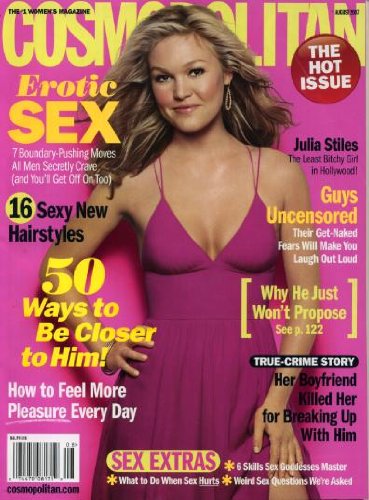
Which brings us to the second half of the 20th century, and Helen Gurley Brown. The chapter "How to Be Sexy" in Sex and the Single Girl is part concrete advice ("Being able to sit very still is sexy") and part democracy of the sort I champion (see introduction). Her take on sexy is notable because Cosmopolitan was instrumental in making sexiness seem both normal and compulsory for women. (I once went to hear Cosmopolitan editor Kate White speak about coverlines, during which she addressed two of my personal favorites: "Sexy Sex" and "Erotic Sex.)

Cosmo's in/famous sex tips generated alongside tips on being sexy, which led to the now-ubiquitous sexy tips in the unlikeliest of places. We now know how to be sexy doing yoga, getting cancer, designing websites, becoming a better Christian (why let Gertrude Stein have all the fun?), motorcycling, visiting New York, upping your FICO score, knitting, being a dog, and being the daughter to a former presidential candidate.


Of course, Dirty Sexy Politics has little to do with sex (I hope/assume; I haven't read it), which begs the question of our contemporary application of sexy to things that have nothing to do with sex. Once sexy became the norm, its scope expanded indiscriminately: A 1970 issue of the journal Nuclear Industry "introduces tough, non-sexy questions about nuclear power," and everything pretty much went out the window from there. Sexy began to mean anything generally appealing; Webster's now recognizes it as such.

I have no problem with this, except: The more we continue to divorce sexy from sex, the further we stray from its essence—or, as Plato-via-Allyson writes, its Form. Instead of broadening sexy when we apply it to McCaindom or nuclear power, we narrow its application to people. Just as Paris Hilton's rendering of hot has made me turn away from the word and see it as the province of the tanned and hairless when it needn't be (as commenter Nine recently wrote on my "hot" entry, "I find the word pretty egalitarian in terms of not being tied to mainstream beauty standards"), the more we make sexy meaningless, the more we allow it to become seized by those who lay the loudest, splashiest claim to it. When Victoria's Secret hinges a campaign on issuing an annual list of "What Is Sexy," we push sexy further away from its essence and more toward its signals. Then, suddenly, instead of anyone being able to be sexy, we have to qualify certain people as "ugly sexy" (or "Sexy Ugly," if you're Lady Gaga), not plain old sexy. People like Willem Dafoe, Tilda Swinton, Sandra Bernhard, Steve Buscemi, all of whom made Nerve's list of the uglysexiest people around: These are some downright sexy people, folks, even if they're not what we think of as pretty (though in my estimation they're hardly ugly). Why do we need the nasty little qualifier of ugly?

Don't get me wrong—I'm glad that we have a term for people whose magnetism and inner heat, not their perfectly crafted features, is what draws us to them. It's just that we had a perfectly good word already.