I wasn't going to comment on President Obama's "best-looking attorney general" comment directed toward Kamala Harris, figuring that everyone else on the internet would do so (and heaven forbid there be redundancy on the internet!), but at the gym a debate about it came onto the little TV screen and something caught my eye: The defenses of the comment were along the lines of, It was a joke, or it was a compliment, or they've worked together for years, they're friends, for chrissakes, or But Obama is an advocate for women. The specifics varied, but the essence was: Obama is on women's side, particularly this woman's side, so why is anyone up in arms about this?
What that line of questioning ignores is what actually happens in the anatomy of a compliment. It takes for granted that if you're saying something nice, it can't be sexist, or at least not the bad kind of sexism. And while it's true that the speaker of a compliment may have genuinely positive intentions, as we see here, the space between speaker and receiver is far from linear. Because this is what most men—even the genuinely well-meaning ones, the ones who, say, make their first act of presidency a decidedly feminist one—can understand in a scientific context but not in a personal one: The act of observation changes that which is being observed. The minute I know I am being looked at, even in a complimentary way, I change. Perhaps my walk changes; maybe I sway my hips a little more. Perhaps my shoulders hunch, or my gaze becomes averted. Maybe I take it in stride and wonder why, weeks later, I suddenly become flustered and lose my train of thought when talking with the observer. Maybe I feel just the slightest twinge of apprehension every time I talk to the person I know has looked at me, has evaluated me; maybe I don't feel it at all, but rather just experience its effects in dragging my feet in returning a voicemail, or in looking forward to the glint I might notice in the observer's eye when he looks at me, or in noticing the next time he compliments my coworker and wondering whether I should feel relieved that I'm not the specimen of the day—or insulted that this time, it wasn't me.
In other words: I cease being as efficient at whatever the task at hand is. When it's a partner telling us we're the best-looking blogger/cook/shoe saleswoman/attorney general in the country, efficiency isn't the point. When it's a colleague—when it is the President of the United States—it is.
The evaluation itself is besides the point in the ways it might affect me, or any woman—I mean, sure, most of would rather hear that we look smashing than that we look dreadful, of course. But the effect of both comments might wind up being more closely related than the speaker ever intended. Compliments of this sort are called "benign sexism," a term I like in that it shows that even allies can engage in it, but in truth it is anything but benign, even when the effect winds up being satisfactory. It's just that instead of being the stab of hurt that something like, "Hey, fatty" might bring, it's a slower effect, one we might not even notice until it's too late.

Showing posts with label compliments. Show all posts
Showing posts with label compliments. Show all posts
Friday, April 5, 2013

Monday, December 3, 2012
"You're Gorgeous": Invited Post
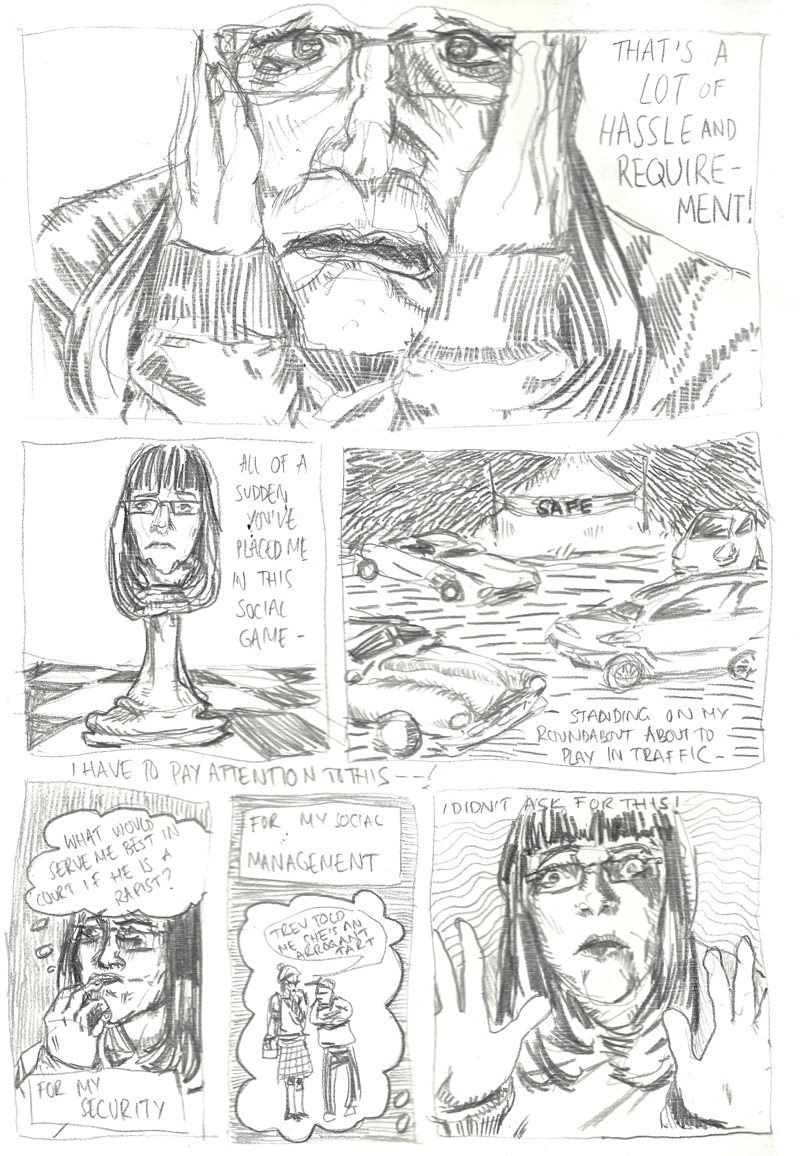
Claire Napier is a midlands-based, commissionable illustrator and comic artist whom I met through the now-defunct Feminist Fashion Bloggers group. I saw bits of her visual work on her blog, but was largely struck by her thoughtful writing, whether that be things like her musings on conventional femininity, or something out of our shared sphere entirely, like her awesome gift guide for the unemployed. So when she reached out to me about my series on compliments with some ideas about visually expressing her own complex feelings toward unsolicited compliments from men, I jumped at the chance. Enjoy!



Thursday, July 5, 2012
The Dating Game: Compliment Week*, Part III

Am I the only one who's just ever so slightly creeped out by this song?
I've been putting off writing about male-to-female compliments because, quite honestly, it’s touchy. I crave hearing compliments within my relationships, but I also know that when I’ve gotten them, I still feel dissatisfied. In fact, the compliments given to me by men I’m not dating tend to be the ones that stick. This is somewhat in line with research indicating that women are likelier to respond with a “thank you” to compliments from men than they are to those given by other women. The author of that study speculated that it was because compliments can indicate social status, and since generally speaking men are seen as having more status, women may treat compliments from them as coming from a social superior? Or something. Honestly, I think it’s more that when a guy friend compliments me, what I read into it is that he sees me first and foremost as his friend, but that sometimes I might do something with my appearance that reminds him, Oh yeah, you’re also a nominally attractive woman—and that he’s comfortable enough with our relationship to say something approximating that without it becoming weird. I take it at more face value than I would with a partner, or with a female friend, because I know from my own experience that giving compliments to other women has a different sort of function.
So when it comes to male-to-female compliments, I feel able to hear and accept them from male friends and acquaintances and not get all angsty about it. Not so for men I’m dating. Naturally, my interest was piqued when I came across this study examining the role of compliments in heterosexual relationships. (Unfortunately, the study didn't look at same-sex relationships; I'm very curious about how compliment patterns might differ between female friends and female partners.) The general body of research on this is minimal, but here’s what stood out:
- Compliments between romantic partners frequently differ from compliments given to friends. The role and intent of compliments are always contextual, and nothing provides a broader context than culture. Intimate relationships are a sort of “microculture” that’s reflected in the form and content of compliments. In Japan, a statement like “Those earrings are pure gold, aren’t they?” would be taken as a compliment (according to compliment scholar Robert Herbert), whereas in the United States it would be more likely to be seen as a question. The form (roundabout) and content (wealth and taste) tell us something about cultural values in Japan. Similarly, in a relationship’s microculture, “There’s nowhere else in the world I’d rather be than in your arms” becomes a compliment despite not resembling one structurally; these emotion-based compliments were the number-one type recalled by participants of both sexes. Whereas compliments among friends are often roundabout ways of expressing “I like you,” in romances there’s freedom to say exactly that, and to still have it experienced as a compliment by the receiver.
- Women are likelier than men to be aware of the presence—or absence—of compliments. But listen to the flipside: Both sexes equally value the role of compliments in relationships. I’m not entirely sure what to make of this. I’m guessing it has something to do with the traditional role of women as the gatekeepers of emotion, which would lead women to be more sensitive to all sorts of emotional indicators. Alternately, women’s heightened awareness of the role compliments serve with female friends and acquaintances might lead them to a similarly heightened awareness of compliments in their partnerships.
- The more compliments, the better. The study found a correlation between relationship satisfaction and the number of compliments given and received—and also a correlation between relationship satisfaction and feelings about the number of compliments received. It’s unclear which comes first: Are we happier with compliments because we’re happier with the relationship, or are we happier with our relationships and therefore more likely to give and receive—or at least, remember giving and receiving—compliments? Whatever the case, it seems like it wouldn’t hurt to tell someone you love that, oh I don’t know, the brightness of her cheek would shame the stars as daylight doth a lamp, or whatever floats your boat, really.
* * *
In truth, only the rare compliment can ever “count,” because the very thing we seek in a compliment—validation—is a host of ambiguities and contradictions. Validation, by definition, relies upon one party affirming something about the other that has not yet been confirmed, and the thing being affirmed must already hold some water. That is, you can’t validate something that neither party really believes is true, or even that only one party believes is true; if you tell me I’m an excellent cook but I believe I’m just doing the bare minimum, I might be pleased by your compliment but I won’t feel validated by it, because there’s no preexisting belief to be affirmed. Similarly, when someone confirms something we already know to be true, validation isn’t in play—I don’t feel validated by being seen as a woman, but a transgendered woman may well feel validated by being called ma’am. With beauty, most of us hover between these poles: We might think under the right light that we might not look half-bad, but we’re not necessarily entirely sure of it. In order for an act to be one of validation as opposed to confirmation or presentation, we need both the possibility of the quality being true and the possibility of it being untrue. In other words, if you’re seeking romantic validation in a compliment, chances are you’re never going to get it.
Not that that stops us—or rather, not that that stops me—from searching for validation in compliments anyway. I’ve dated men all over the compliments scale, from one who actually stopped and sighed while I was brushing my teeth to tell me how beautiful I was, to one who told me early on that he didn’t “do” compliments. Nowhere in there have I ever really found a comfortable place to exist with compliments. With the stingy men I treat each compliment like a rare jewel; with the overkill guys I become exasperated and begin to suspect their words are building a pedestal I don’t want to be on. And with the men who have a moderate, sincere, and appreciative attitude toward compliments, I usually just wind up feeling frozen. I'm not proud of this, and I don't think I've taken out my compliment complex on the men I've been involved with, but I admit it seems like there's no way for a partner to win here.
Yes, yes, it's me, not you, sure. Yet there’s an inherent paradox in compliments that can make them difficult to receive from those we love. The moment a compliment escapes the giver’s lips, a division is created: It’s a reminder that we are being looked at instead of being experienced as a part of a cohesive unit. A looks-based compliment is a reminder of the impossibility of merging with another person—and whether or not merging is actually your goal in a relationship, the whole "the two will become one flesh" bit is pretty much the basis of marriage in the western world.
More importantly, a looks-based compliment can be a reminder of the existence of our own feminine performance—our beauty work, our sleight-of-hand that supports the overall impression of beauty. If the end goal of feminine performance is looking beautiful, sexy, pretty, cute, and then we’re complimented for meeting that goal, it can be hard to shake the feeling that perhaps it’s the performance being complimented, not us. The first response I usually have après-compliment is not to feel pretty but rather to feel as though I need to keep on looking pretty. That is, my knee-jerk reaction is not to experience a compliment as an affirmation of who I am but of what I do. Continuing the performance is the only way to not reveal ourselves to be frauds, even if the fraudulence is benign and socially engineered; we’re not actually beautiful, we just look it right now. By calling attention to the end goal of the performance—a proper signaling of our femininity—compliments pull us out of the assumed nonchalance that makes feminine performance. Even if the goal has been successfully reached, part of the goal of feminine performance is to keep up the illusion that there’s no performance taking place.
No wonder, then, that so many women report ways of defending against compliments: One woman reports scrunching up her face whenever her boyfriend tells her she looks beautiful; another bats her eyelashes “absurdly” when complimented on her eyes; another says she feels “caught” for not being able to follow the compliment script when, in truth, she feels unsure of how to react when a partner says she looks lovely. The gap between the safety of love and the precarity of being seen as an image is a space of uncertainty—and in relationships that already host a good deal of uncertainty, that gap can easily become toxic.
I take heart, though, in one of the findings of the partnership compliment study: The number-one topic of compliments between partners was neither appearance nor skill nor personality, but emotions. Not You look amazing but You make me feel amazing. When I first read that this sort of statement was considered a compliment within the bounds of the study, I hedged—that’s a statement of love, not a compliment, right? But that’s exactly what compliments are: an expression of admiration, appreciation, or plain old liking—and perhaps, with the people we choose to really let in, an expression of love. And it’s not like I—or the women I’ve talked with who wrestle with looks-based compliments from their partners—value our appearance above those expressions of emotion. But framing these statements—which, in good relationships, have flowed easily regardless of the number of You’re so prettys that spill forth—as compliments helps put that urge to hear You’re so pretty in proper perspective.
In fact, it’s exactly that—understanding the true significance of any compliment—that might shoo away that urge for good. According to a study published in the Journal of Personality and Social Psychology, when people with low self-esteem went beyond merely hearing compliments from partners and instead described the meaning and significance of them, they started to feel better about the compliments, their relationships, and indeed themselves. In fact, once people with low self-esteem did this sort of reframing, they started to behave as people with high self-esteem do.
Now, I’m not sure where I’d fall on the self-esteem scale, but when it comes to my looks, it’s not like I’m always standing on solid ground. I’m hoping that the next time I long to hear a looks-based compliment from a partner, I’ll be able to remember what I’m really looking for: the meaning and significance of things like You’re so pretty, not the words themselves. That is, I’m looking to hear I am attracted to you. I want to be near you. I choose you; you are special to me. And with the right person, the reminders of these facts—for with the right person, they will be facts—should be just that, reminders. You’re so pretty, with luck and patience, can be put aside, where it belongs.
Thursday, June 28, 2012
Values, Stereotypes, and Big Feelings: Compliment Week, Part II

1) Compliments reveal our values. A successful compliment must be about something that’s recognized by both the complimenter and the complimentee as having value. (That’s not to say that both parties have to personally value the thing being complimented—I’ve been complimented on haircuts I hated—rather that both parties have to recognize that it has value. Otherwise, the compliment isn’t complete.) The consequence here is that compliments can tell us a good deal about what we as a culture actually value. Studies have repeatedly found that the number-one topic of compliments given to American women (from both sexes) is appearance, so—surprise!—it seems we value women for their appearance. (Correspondingly, we value men for their skill.) But here’s the thing: Part of the way we assign value is observing where and how others assign value, which means that sometimes we generalize our values in order to make sure they’re recognized. Compliments are verbal gifts, and who wants to give a gift you’re not sure the recipient will value? So complimenting women on appearance is the spoken equivalent of giving them a nice lotion, a bar of chocolate, a bottle of wine: a gift that is valuable not only for what it actually gives its recipient (soft hands, a satisfied sweet tooth, a hangover), but because we all understand its function as a generic placeholder for sentiment.
2) Compliments based on positive stereotypes don’t feel so great to hear. When people give compliments to a member of a group based on positive stereotypes of that group, the recipient, understandably, is likely to be displeased. As in, if you’re white and start telling a black person how great black people are at sports, you’re not exactly doing anyone any favors. Now, appearance-based compliments aren’t usually directed toward a group; they’re directed toward an individual. Yet I still wonder about the implications of group stereotypes here. If you tell me you like my lipstick, we’re both acknowledging certain assumptions about women as a class: that women should wear lipstick, and that wearing lipstick is something to be rewarded. It’s also assuming that there’s a right way (and therefore a wrong way) to wear it, meaning that it might be possible for me to fail at femininity at a later date.
3) Compliments can make us feel bad. Or...good. Women who lean toward self-objectification do so because they’ve internalized the idea that, as a woman, they are there to be looked at. Is there anything that more clearly ascertains that you’re being looked at than a compliment about how you look? In this study, women who scored high on a test measuring their tendency to self-objectify reported feeling more body shame after receiving an appearance-based compliment. But! In another study, women who had that same personality trait of self-objectification reported an elevated mood after hearing an appearance-based compliment. (In both studies, the compliments were controlled and took place within the bounds of the study; subjects weren’t reporting back on real-life experiences.) With my entirely inadequate scientific background—I fulfilled all my college science requirements with astronomy—I’m going to take a leap and say that these experiences aren’t as contradictory as they seem. While I’m unlikely to brighten my mood when I’m feeling bad about my body, the body shame brought on by self-objectification isn’t quite the same thing, at least not for me. I’m guessing it’s more about the kind of body shame brought on by a hyperawareness of one’s appearance—the same sort of hyperawareness that John Berger was writing of when he wrote in Ways of Seeing: “A woman must continually watch herself. She is almost continually accompanied by her own image of herself. … And so she comes to consider the surveyor and the surveyed within her as the two constituent yet always distinct elements of her identity as a woman. … Thus she turns herself into an object—and most particularly an object of vision: a sight.” Truth is, sometimes my mood is elevated when I notice that I’m being looked at. That doesn’t mean I don’t simultaneously experience the detrimental effects of that self-consciousness.
4) When we don’t say “thank you,” it may be because we care. As sociolinguist Robert Herbert points out, we all know what the “correct” response is to a compliment. Think of the prompt parents give to their children after someone has given them an unexpected treat: “What do you say to the nice lady?” You say thank you, of course. Yet when asked how they felt upon hearing compliments, many participants in one of Herbert’s studies said they they didn’t know what to say. With the exception of women accepting compliments from men, responses along the line of “thank you” only accounted for anywhere from 10 to 29 percent of compliment responses in the study. Why, when saying “thank you” is the known proper response, do we suddenly feel like we don’t know what to say? The answer lies in the true meaning of embarrassment: We feel embarrassed because we care about the relationship we have with the person we feel embarrassed in front of. We may feel embarrassed that we didn’t say something complimentary to them first, or that we’ve done something (or worn something) that separates us from the other person status-wise, or that we’re suddenly acutely aware that the person holds us in some sort of esteem. We know full well that “thank you” would suffice, but it can also feel like “thank you” leaves something out.
In fact, sometimes a simple “thank you” does leave something out. When I first shared my experience of floundering in conversation when I tried to start a conversation with a woman by complimenting her shoes and was met with a simple thank you, I was putting the blame for the flatlined conversation on myself. And to be sure, I should work on my opening gambit. But the more I learn about compliments from a sociological standpoint, the more I see that she may have been a little tone-deaf as well. If “comment history”—i.e. conversation—is the most common response in woman-to-woman compliments, it’s clear that most of us understand the offering a compliment symbolizes. We may not be comfortable with it; we may refuse it, or turn it around, or question its sincerity, or permit it to alter how we see ourselves. But we understand its small humility, its request, its vulnerability, its expressed wish to grow closer. Sometimes we might even let the wish come true.
Tuesday, June 26, 2012
No, *You're* So Pretty: Compliment Week, Part I
In the few days since I published last week’s post about the role of compliments in female friendships, I’ve become painfully aware of how often I give compliments. It’s certainly not something I want to stop doing, but when I found myself fussing over the color of a waitress’s nail polish in the presence of a friend who had just finished telling me what she thought of the piece—rather, when I suddenly felt like my friend had caught me in some weird act of benevolent manipulation—I started to think more about what compliments actually are.
Luckily, I’m hardly the first to that table: There’s plenty of research out there from linguists, sociologists, psychologists, and anthropologists about the fine art of the compliment. Robert Herbert, an American sociolinguist, published a fascinating study about the different ways men and women treat compliments that illuminated some of my experiences around complimenting women around me. Some of the findings:
I’m intrigued by this, particularly when examining the dual function of using personal terms in compliments. The first thought here is that women are simply speaking in ways we’ve been encouraged to socialize—we’re personal, not political, remember?—and would gravitate toward imbuing compliments with a personal touch that ostensibly aids sincerity and sociability, marking compliments as a more acceptable way of saying Gee, I think you’re swell. But looking at it from another angle, making a compliment personal is also a way of hedging a compliment. “I like that lipstick,” on its face, is about what the speaker likes, not about the lipstick; “Great lipstick” is about the lipstick, plain and simple. It simultaneously takes a risk (“Here is what I like”) and pushes it away (“Remember, this isn’t about you”); it’s assertive, not aggressive. It’s indirect, in other words—a communication mode linguists frequently claim women excel at.
But it’s in studying the reception of compliments that the connection between compliments and intimacy becomes clearest. Compliments given from man to man were accepted 40% of the time; only 22% of compliments given from one woman to another were accepted.
To be clear: Not accepting a compliment doesn’t necessarily mean rejecting it. By “accepting” a compliment in this context, we're talking “Thank you,” or an agreement with the compliment (whether that be a simple “I like it too” or an inflation of it, as in “Yeah, this sweater brings out my eyes, doesn’t it?”). The other forms of compliment response—nonacceptance, nonagreement, or a request for the compliment to be interpreted—can range from returning the compliment (“No, you’re so pretty!”) to scaling it down (“Yeah, well, you should’ve seen how my hair looked yesterday”) to reassigning it (“My hairstylist is a genius”). You can see the numbers here:

With that in mind, it’s easy to see why women might “accept” compliments about half as often as men—we’re taught to be deferential and modest and bashful and all that, right? But looking at this data, it’s clear that women know full well how to accept a compliment: When it was a man, not a woman, giving a compliment, women accepted it 68% of the time. The factor most likely to influence how people respond to a compliment isn’t what sex they are, but what sex the person giving it is. I’ll look more closely at male-female compliments later in the week; for now, what interests me isn’t why we’re likelier to say thank you to a man, but why we say anything but to a woman.
Scanning down the column listing responses to compliments given woman-to-woman, we find part of the answer. One number jumps out: 85 women out of 330 responded to a compliment with a “comment history,” defined in the paper as when the “addressee accepts the complimentary force and offers a relevant comment on the appreciated topic.” That is: A quarter of the time, we respond to a compliment with girl talk.
Janet Holmes, a leading scholar in linguistics and gender who conducted another influential (and gated, grrr) study on the gendering of compliments, puts it this way: Women recognize that compliments “increase or consolidate the solidarity between speaker and addressee.” Men recognize this too; “comment history” was also the number-one response men had when complimented by a woman. Part of this is women being assigned the emotional tasks within conversation: the how-did-that-make-you-feel-type stuff that, as the supposedly nurturing sex, comes “naturally” to us—and that gives men permission to articulate emotions that they might otherwise lack. But it’s not just limited to men: Women of different social statuses were likelier than men of different social statuses to exchange compliments. The solidarity isn’t in class, or if it is, it’s our classification as women that lies beneath what might masquerade as nattering on about perfume.
That solidarity is what makes compliments effective. It’s also what makes them poignant, and, as my friend Sarah put it, at times subversive. But given that appearance-based compliments are the most popular type of compliment shared between women—this is the research talking, not me—we’re tethering that effectiveness, poignancy, and subversion to how we look. I cherish the solidarity that compliments of all sorts can bring—nail polish, shoes, and hairstyles absolutely included. I just want us to remember that what makes us pretty is not what makes us women.
Luckily, I’m hardly the first to that table: There’s plenty of research out there from linguists, sociologists, psychologists, and anthropologists about the fine art of the compliment. Robert Herbert, an American sociolinguist, published a fascinating study about the different ways men and women treat compliments that illuminated some of my experiences around complimenting women around me. Some of the findings:
- Women give wordier compliments than men: “What a great coat!” vs. “Great coat!”)
- Women employ more personal terms than men: “I like those earrings” and “You look great in those earrings” versus “Great earrings”
- Men generally don’t use the “I like/I love” construction when complimenting people of either sex; women use it frequently, most of all with other women
- American women are more likely to use “I like/I love” in compliments than British and New Zealand English speakers, and speakers of other languages (it’s rarely found in Asian languages).
I’m intrigued by this, particularly when examining the dual function of using personal terms in compliments. The first thought here is that women are simply speaking in ways we’ve been encouraged to socialize—we’re personal, not political, remember?—and would gravitate toward imbuing compliments with a personal touch that ostensibly aids sincerity and sociability, marking compliments as a more acceptable way of saying Gee, I think you’re swell. But looking at it from another angle, making a compliment personal is also a way of hedging a compliment. “I like that lipstick,” on its face, is about what the speaker likes, not about the lipstick; “Great lipstick” is about the lipstick, plain and simple. It simultaneously takes a risk (“Here is what I like”) and pushes it away (“Remember, this isn’t about you”); it’s assertive, not aggressive. It’s indirect, in other words—a communication mode linguists frequently claim women excel at.
But it’s in studying the reception of compliments that the connection between compliments and intimacy becomes clearest. Compliments given from man to man were accepted 40% of the time; only 22% of compliments given from one woman to another were accepted.
To be clear: Not accepting a compliment doesn’t necessarily mean rejecting it. By “accepting” a compliment in this context, we're talking “Thank you,” or an agreement with the compliment (whether that be a simple “I like it too” or an inflation of it, as in “Yeah, this sweater brings out my eyes, doesn’t it?”). The other forms of compliment response—nonacceptance, nonagreement, or a request for the compliment to be interpreted—can range from returning the compliment (“No, you’re so pretty!”) to scaling it down (“Yeah, well, you should’ve seen how my hair looked yesterday”) to reassigning it (“My hairstylist is a genius”). You can see the numbers here:

You, too, can rent "Sex-Based Differences in Compliment Behavior,"
Language in Society, 1990, pp. 201-224, for 24 hours!
Language in Society, 1990, pp. 201-224, for 24 hours!
With that in mind, it’s easy to see why women might “accept” compliments about half as often as men—we’re taught to be deferential and modest and bashful and all that, right? But looking at this data, it’s clear that women know full well how to accept a compliment: When it was a man, not a woman, giving a compliment, women accepted it 68% of the time. The factor most likely to influence how people respond to a compliment isn’t what sex they are, but what sex the person giving it is. I’ll look more closely at male-female compliments later in the week; for now, what interests me isn’t why we’re likelier to say thank you to a man, but why we say anything but to a woman.
Scanning down the column listing responses to compliments given woman-to-woman, we find part of the answer. One number jumps out: 85 women out of 330 responded to a compliment with a “comment history,” defined in the paper as when the “addressee accepts the complimentary force and offers a relevant comment on the appreciated topic.” That is: A quarter of the time, we respond to a compliment with girl talk.
Janet Holmes, a leading scholar in linguistics and gender who conducted another influential (and gated, grrr) study on the gendering of compliments, puts it this way: Women recognize that compliments “increase or consolidate the solidarity between speaker and addressee.” Men recognize this too; “comment history” was also the number-one response men had when complimented by a woman. Part of this is women being assigned the emotional tasks within conversation: the how-did-that-make-you-feel-type stuff that, as the supposedly nurturing sex, comes “naturally” to us—and that gives men permission to articulate emotions that they might otherwise lack. But it’s not just limited to men: Women of different social statuses were likelier than men of different social statuses to exchange compliments. The solidarity isn’t in class, or if it is, it’s our classification as women that lies beneath what might masquerade as nattering on about perfume.
That solidarity is what makes compliments effective. It’s also what makes them poignant, and, as my friend Sarah put it, at times subversive. But given that appearance-based compliments are the most popular type of compliment shared between women—this is the research talking, not me—we’re tethering that effectiveness, poignancy, and subversion to how we look. I cherish the solidarity that compliments of all sorts can bring—nail polish, shoes, and hairstyles absolutely included. I just want us to remember that what makes us pretty is not what makes us women.
Tuesday, June 19, 2012
Girl Talk

For my money, the most unrealistic part of Sex and the City was always the friendship. “Friendship porn,” I once heard it described as. People fingered Carrie’s wardrobe as being truly ridiculous, but after years of working in an industry where I’ve seen an adult woman spend a day at the office wearing a dress made entirely out of ribbon, I accepted that part of the show without question. But having a group of friends I have brunch with every weekend? Where would I find that?
So I’m interested to see that part of the critique tsunami surrounding HBO’s Girls has examined the characters’ friendships. It’s brought us everything from a feminist social history of best-friendship to a zoological history of the same. In fact, there’s been a good deal of attention paid to female friendship lately, including with the number of people who linked to this essay, which made the internet rounds when it was first published at The Rumpus. I’m glad to see these conversations happening; it’s a welcome relief from tired tropes of backstabbing women bad-mouthing one another at every opportunity.
My relief is tinged with melancholy, though. I couldn’t bear to read the Rumpus essay more than once because it hit me so hard when I read it the first time. Not because it resonated, but because it didn’t. To be clear: I have many wonderful female friends, some of whom I expect to be close with for the rest of my life. And in sheer numbers, I probably have more female friends than male friends. But in terms of who I treat as confidants, it’s slanted toward men, due to a combination of serial monogamy, the fortune to have remained friendly with a handful of men I used to date, and an incidental number of male friends. Given that I’ve usually worked in female-dominant fields, perhaps this has just been my way of adding some yang to my yin.
But there’s another reason my relationships with men move more fluidly. It may sound silly coming from a feminist who writes primarily for female audiences, but I’m talking socially, not intellectually, so here goes: I feel awkward around women. Now, that’s speaking in some pretty general terms—certainly I don’t feel awkward around every woman, or comfortable around every man. It’s more that accurately or not, I have an odd sort of faith that men enjoy being around women because of our womanness, making my sex is a built-in fortification of what I offer socially to men. We as a culture have been pretty successful at spinning stories about Man + Woman=Makes Sense, and the consequence for me has been just the tiniest bit more assurance that a man has reason to want to be in my company, even when attraction doesn’t factor into it. Then it becomes a catch-22: I’m more likely to be relaxed—and therefore more pleasant, charming, and fun to be around—if I trust that whomever I’m talking with genuinely wants to be there. So generally speaking, I probably am better company to men than I am to women, which results in a different sort of friendship.
I’m not proud of this attitude. I don’t like what it implies I think about men, or about myself. But it’s also notable for what it says of my relationships with women. I heard this quote once: “Men kick friendship around like a football, but it doesn’t seem to crack. Women treat it like glass and it goes to pieces.” Treat it like glass I do: afraid to touch it, afraid to give it the sort of handling that burnishes it and makes it uniquely yours. I’ve always hated the trope that women distrust other women, or secretly hate their friends or women in general, and that’s not what I’m saying here. If anything, I’m saying the opposite: I get tongue-tied around remarkable women because I dearly want them to like me, and unlike with men, there’s no culturally assumed “reason” for them to like me. The lack of trust here is in myself, not in other women.
So I feel like I have to work a little harder to get women’s approval. But the specific ways I’ve cultivated to gain approval—laughing a little longer at someone’s jokes, asking lots of questions, letting a gaze linger—sound suspiciously like flirting. Specifically, flirting with men. So when I’m around a woman I want to get to know better, suddenly I’m left not only being a little unsure how to be my best self, but also aware that my default “like me!” antics are conventionally feminine ways of appealing to men—which means plenty of women see right through them because they themselves have deployed the same tricks. At least, at my most vulnerable, self-doubting, and insecure that’s what I fear: that women—particularly the sort of intelligent, critical, soulful women I admire—will see through my laughter and questions and smiles and decide that whatever I bring to the table, it isn’t for them. (Perhaps that’s why I feel drawn to woman-only spaces like ladymags, come to think of it—it forces me to break out of relying upon the ways I’ve learned to communicate with men.)
At some point, though, I learned one thing I can bring to the table with women: girl talk. And yes, I mean highly stereotypical girl talk. I mean: I like your earrings, That’s a great color, Your hair looks fantastic. I used to consciously stay away from beautystuffs as small talk because I wanted to feign nonchalance about such matters; somewhere along the line, though, I recognized how well I myself responded to such conversation starters. My countenance, particularly around women, is pleasant but a little serious, meaning that something frivolous can come out of my mouth and I’m fairly certain it doesn’t make me seem frivolous. It simply lightens me, desirably so.
It’s been several years since I’ve started being more fluent in beautytalk, and between working at image-conscious magazines and running a blog that is specifically designed to examine women’s attitudes and feelings about beauty and being looked at, it’s second nature now. Compliments and questions related to style or appearance easily tumble out of me; if I’m meeting a woman cold, like if I’m at a party where I don’t know anyone, chances are that’s the first thing out of my mouth. I’m always sincere about it—compliments fall flat if they’re a lie—and at this point I wouldn’t even say that this line of conversation is intentional. But I know where it comes from, and I know what I’m hoping to elicit when I do it.
Here is my trouble: I fear that I am forgetting how to connect with women in any other way. I found myself at a dinner party a while ago with a woman whose manner intrigues me; she’s one of those people whose words seem to matter more than other people’s, so wisely does she choose them. I was seated next to her, and my first words to her were something about her shoes (which were gorgeous, so I’m not entirely to blame here). She smiled and said Thank you, as one does, and after we had each nodded acceptance of the compliment and ensuing gratitude, neither of us had anything further to say to one another. Rather, I didn’t know how to get to that further point—at least not without her doing some of the heavy lifting along with me.
I’d expected her to help me out, which isn’t an outrageous expectation on my part; that is, after all, how conversations work. But in expecting her to help me out by saying anything other than the logical, polite response—thank you—I was actually attempting to direct her attitude. Toward herself, toward me, toward womanhood itself. I was expecting her to play along—to tell me, say, some story of where she’d gotten the shoes so I could then riff off a detail of that story, and in the course of that we would have each revealed something personal that could serve as a launching point for the conversation I actually wanted to have with her. I was expecting her to speak some code of womanhood right along with me—a code that as a feminist I know better than to think is actually how women communicate. I lobbed exactly one volley in her direction and expected her to return it.
And when she didn’t, I found that I didn’t have a backup plan. The code I’d been speaking in wasn’t code at all; it had become my native tongue, at least when attempting to make small talk. For it wasn’t just that laconic seatmate and her response that’s troubling me. It’s also the times when it works too well and I find I don’t know how to better anchor the conversation; it’s the times when I see exactly how moored I feel by “girl talk” with women and I wonder how deep my own feminist blood can run if this has become the primary way I know to reach out to other women. My approach has assumed that women in my path are eager to talk about their appearance, and not only that, but that they are eager to talk about their appearance with me because we are both women. Small talk works because we presume all the small talkers share a common condition. While I believe that all women have a unique relationship to presence, style, and visibility, the route I’ve been taking to get to that relationship isn’t helping me establish better friendships with women. And that’s because of another characteristic of getting-to-know-you chatter: Small talk is, by its nature and nomenclature, unimportant. And the very thing I value about beauty talk is what it reveals about us—that is, the stuff that is important. And yes, sometimes beauty talk gets there quickly and directly; that’s exactly why I defend it and work hard in my writing to not have it be written off as cotton candy. Yet in relying so heavily upon beauty talk as a conversation starter, I’ve been failing in my central mission. I know that you can’t just jump into a conversation by asking the really meaty stuff, sure. But if I truly believe in “girl talk” as a portal to that meat, to treat it in practice as fluff is a disservice to my goal.
Perhaps that became clearest to me when I was the recipient, not the instigator, of this sort of exchange. Some time ago, I found myself having a drink with a friend of a friend. The person who introduced us was doing most of the talking, so we were both able to quietly get used to the rhythm of the other before our mutual friend departed and left us on our own. We continued the conversation to its logical point, and it was clear that we each had a good deal to say to one another, but that we were perhaps too much alike in our being better responders than presenters. The conversation was good but not fluent. During one of our fumbling, strained pauses, she looked down and said, “I like your shoes.” The only thing remarkable about these sneakers is how unremarkable they are: Cheap, several years old, a faded olive color, scuffed and beaten, I’d only worn them because the weather was in flux and they were the single “shoulder season” pair I could fine.
I knew enough secondhand about this woman and her somewhat turbulent life to know that I wanted to know more about her. I wanted to talk with her about art and expression, about motherhood and madness. I wanted to know if what she saw every day in her appointment book, her mirror, her life was what she’d envisioned for herself; I wanted to know about disappointment and relief, and where the two might meet. I didn’t ask those questions, of course; you can’t just go in and ask those sorts of things. Sometimes chatter of shoes and mascara is a portal to the questions we really want answers to; sometimes the words that don’t matter are the only way to the words that do. But sometimes those words—where did you get that and I had a pair like that once and what a great color—form a Mobius strip of the words we know don’t matter, with no apparent outlet to what we want to say but don’t know how to articulate. I am trying to step off that neverending loop. But I am not sure how.
I felt that ache, that frustration that comes when I dance around intimacy, a dance only made more frantic when I sense the other person is there with me in our pas de deux. I felt it—I saw it—but I am still unpracticed in saying whatever one would need to say to get to what comes next.
And so I looked at her and said what we both knew you’re supposed to say upon receiving a compliment, the words that, with luck and effort, could lead to chatter of other cross-weather shoes, which could lead to climate, which could lead to where we grew up, which could lead to how we each define the word home. That is, I said Thank you.
What I didn’t say—but what I hope she heard—was I like you too.
Thursday, February 9, 2012
Thoughts on a Word: Glamour (Part II)
I’ve had my chance to expound on glamour (which, of course, I did from my chaise longue with a Manhattan in hand while my protégé took dictation), but the concept of glamour is intriguing enough to warrant a revisiting—not from me, but from four women who each have their own distinct relationship with glamour. I’m delighted that each of them—author Virginia Postrel, publicist Lauren Cerand, artist Lisa Ferber, and novelist Carolyn Turgeon—took the time and effort to share their thoughts on glamour with me. And now, with you.
* * *

Virginia Postrel, author, columnist, and speaker who is currently writing a book about glamour, to be published by The Free Press in early 2013. She explores "the magic of glamour in its many manifestations" at DeepGlamour.net, a group blog.
Like humor, glamour arises from the interaction of an audience and an object. Someone or something is always glamorous to a specific audience. So there has to be something about the glamorous object that triggers and focuses the audience's desires—that makes them project themselves into the glamorous image and feel themselves somehow transformed. But those qualities are different in different contexts, and they may not even be things that are widely recognized as "glamorous."
A good way to understand glamour is to start not with fashion or people but with the glamour of travel. Think of classic travel posters and contemporary resort ads, with their images of exotic locales, peaceful beaches, or seemingly effortless transportation. What makes an image of the New York skyline, a cruise ship against the blue Mediterranean, or Ankgor Wat at dawn so alluring? Why does the sight of a jet rising against a sunset or full moon seem so glamorous?
The glamour of travel lies first in its promise to lift us out of our everyday existence. We project ourselves into this new and special place, imagining that there we will fulfill our unsatisfied longings—whatever they may be. Just getting away doesn’t make travel glamorous, however. Going every year to your family’s cabin on Lake Michigan may be fun, but it’s too familiar for glamour. A glamorous destination is at least a little bit exotic. It shimmers with the possibilities of the unknown. Its mystery not only stokes imagination. It also heightens the good and hides the bad (or the banal, like all the other tourists congregating to snap Angkor Wat at dawn). As the great studio-era photographer George Hurrell put it: “Bring out the best, conceal the worst, and leave something to the imagination.”
The glamour of travel illustrates the three elements found in all forms of glamour: mystery, grace, and the promise of escape and transformation. These elements explain why certain styles or codes seem to spell “glamour.”
Take fashion. If glamour by definition requires elements of mystery and aspiration—escape from the ordinary—then the clothes you wear or see on the street every day are not going to be glamorous. Hence we often associate glamour with the kinds of extraordinary evening wear that few people can afford and even fewer have any occasion to wear. But, depending on the audience, other forms of fashion can be glamorous. Vintage styles that represent some idealized period in the past are an obvious example. So are sneakers associated with great athletes. Even something as mundane as a business suit can be glamorous if it represents a career you aspire to but have not (yet) achieved.
The "codes of glamour" change with the audience and the times. The iconography of glamour in 1930s Hollywood films—bias-cut satin gowns, "big white sets," lots of glitter and shine—is quite different from Grace Kelly in the New Look, sweater sets, and pearls. Yet we think of both as classically glamorous.
Like humor, glamour sometimes emerges spontaneously and sometimes is actively constructed. Some things tend to stay glamorous, or funny, over time. Others cease to have the right effect. Mink coats used to be a quick way of signaling a kind of glamour. I'd argue that they've been replaced with another cliche: the hot stone massage photos you see everywhere. The massage photos also show indulgent feminine luxury, but they appeal to different longings—not so much for social status as for pampering and relaxation, a private experience rather than a social good. Similarly, I write about how wind turbines have become glamorous symbols of technological optimism, in the same way that rocket ships were in the 1950s and early '60s.
Finally, some things are glamorous without being widely recognized as such. The bridge of the Starship Enterprise is intensely glamorous to a certain audience. It elicits the same kind of projection and longing that other people feel when they think of Paris or haute couture, and it also shares the three essential elements of glamour.

Lauren Cerand, independent public relations consultant. She shares notes on living at LuxLotus.com.
A good way to understand glamour is to start not with fashion or people but with the glamour of travel. Think of classic travel posters and contemporary resort ads, with their images of exotic locales, peaceful beaches, or seemingly effortless transportation. What makes an image of the New York skyline, a cruise ship against the blue Mediterranean, or Ankgor Wat at dawn so alluring? Why does the sight of a jet rising against a sunset or full moon seem so glamorous?
The glamour of travel lies first in its promise to lift us out of our everyday existence. We project ourselves into this new and special place, imagining that there we will fulfill our unsatisfied longings—whatever they may be. Just getting away doesn’t make travel glamorous, however. Going every year to your family’s cabin on Lake Michigan may be fun, but it’s too familiar for glamour. A glamorous destination is at least a little bit exotic. It shimmers with the possibilities of the unknown. Its mystery not only stokes imagination. It also heightens the good and hides the bad (or the banal, like all the other tourists congregating to snap Angkor Wat at dawn). As the great studio-era photographer George Hurrell put it: “Bring out the best, conceal the worst, and leave something to the imagination.”
The glamour of travel illustrates the three elements found in all forms of glamour: mystery, grace, and the promise of escape and transformation. These elements explain why certain styles or codes seem to spell “glamour.”
Take fashion. If glamour by definition requires elements of mystery and aspiration—escape from the ordinary—then the clothes you wear or see on the street every day are not going to be glamorous. Hence we often associate glamour with the kinds of extraordinary evening wear that few people can afford and even fewer have any occasion to wear. But, depending on the audience, other forms of fashion can be glamorous. Vintage styles that represent some idealized period in the past are an obvious example. So are sneakers associated with great athletes. Even something as mundane as a business suit can be glamorous if it represents a career you aspire to but have not (yet) achieved.
The "codes of glamour" change with the audience and the times. The iconography of glamour in 1930s Hollywood films—bias-cut satin gowns, "big white sets," lots of glitter and shine—is quite different from Grace Kelly in the New Look, sweater sets, and pearls. Yet we think of both as classically glamorous.
Like humor, glamour sometimes emerges spontaneously and sometimes is actively constructed. Some things tend to stay glamorous, or funny, over time. Others cease to have the right effect. Mink coats used to be a quick way of signaling a kind of glamour. I'd argue that they've been replaced with another cliche: the hot stone massage photos you see everywhere. The massage photos also show indulgent feminine luxury, but they appeal to different longings—not so much for social status as for pampering and relaxation, a private experience rather than a social good. Similarly, I write about how wind turbines have become glamorous symbols of technological optimism, in the same way that rocket ships were in the 1950s and early '60s.
Finally, some things are glamorous without being widely recognized as such. The bridge of the Starship Enterprise is intensely glamorous to a certain audience. It elicits the same kind of projection and longing that other people feel when they think of Paris or haute couture, and it also shares the three essential elements of glamour.
* * *

Lauren Cerand, independent public relations consultant. She shares notes on living at LuxLotus.com.
Glamour is the word, pertaining to me, that I hear most often from other people, and, in truth, the word I think of least on my own (conceptually, I gravitate toward things that are elegant, or correct, or comfortingly archaic, and, most importantly, eschew embellishment of any kind. I'm a minimalist with opulent taste). That makes sense, though, if, to quote Scottish poet Kathleen Jamie, whom I heard read her poem "Glamourie" in Edinburgh years ago, "glamour is a Gaelic word," intended to mean a sort of enchanting trickery, "fairy magic" cast down over the eyes of the unsuspecting (sophistication also had similar implications, of a gloss for the purposes of deceptive artifice, in its early usage, according to Faye Hammill's wonderful cultural study, Sophistication, on University of Liverpool Press). Glamour certainly seems to play out that way, as a quality of perception more than direct experience. I don't think then, that I could regard myself as glamorous. I simply make a living from having a semi-public life and the fact that people admire my personal taste enough to emulate it. While I never stretch the truth, as lying takes too much time and I am always short of it, I am a private person at heart and so I can see the tantalizingly faint trail of breadcrumbs that I leave behind, twinkling in starlight, inspiring one to imagine the cake from which they must have fallen. Perhaps now and then it really was that grand. It could be our secret, but I'd never tell.

Lisa Ferber, artist, playwright, performer, and bonne vivante. Peruse her works at LisaFerber.com, and keep an eye out for her upcoming web series, The Sisters Plotz.
* * *

The funny thing about glamour is that an exact definition of the word is as elusive as the quality itself. The quality is like a special fairy dust that makes a person sparkle; you can’t put your finger on precisely what it is. I think it has to start from within. When I see today’s teenage starlets trying to pull off 1940s Old Movie Star Glamour, I just think, Um, no, you can’t just do a deep side-part and red lipstick and think now you’re Ava Gardner. But there’s this woman who works the bread counter at Zabar’s who I admire because there she is in her white bread-counter smock, but she’s probably in her 60s and always has a full face of makeup on, and sparkly barrettes in her nicely done hair, and she’s gorgeous and all dressed up to work the bread counter. Whenever I see her I have to repress blurting out, “You are my hero! You look like a movie star!”
It absolutely cannot be purchased, but I do think there is an aspect of formality involved. Glamour always involves looking pulled together. Even if the look is over-the-top, it has to come across as though there was care taken. That's part of the mystique. Glamour implies that everything you meant to do is coming across just as you want it to. It’s hard to be glamorous in a track suit, but if you really want to do it that way, you can go over the top with heels and baubles and make it eccentric, because eccentricity done right can exude glamour. I think the best glamour will teeter on eccentricity, because it’s about going just a little bit too far. All the photos I love from early 20th century photographers like Horst and Irving Penn are about going too far…giant hats, luxurious gowns...clothes that serve no practical purpose, and therein lies their glamour. Because glamour is about transcending the everyday.
When people have called me glamorous, it thrills me, because I have always felt a kinship with those old-school 1930s and 1940s women. People have always told me that I seem like I’m from another time, which I think is funny because it’s not really something I’m trying to do; it’s just how I am. I’ve painted from photos of Carole Lombard, Liz Taylor, Audrey Hepburn, Jean Harlow…all of them have that Something, where it would be impossible to imagine them ever looking disheveled or weighed down by life’s woes, though of course we know they were real women with all the problems people have.
Recently I shot the first episode of my new web series, The Sisters Plotz. I wrote it, and it stars TV icons Eve Plumb, Lisa Hammer, and me (Hammer also directs). Eve, Lisa, and I were shooting a street scene in which we are dressed like glamour girls from the 1930s, and everyone we passed on the street would smile at us and tell us how great we looked. And it wasn't just because we looked "good" or were dressed up; it's because glamour, particularly the old-school, dedicated, womanly glamour of the 1930s, has an effect on people. It says just check your troubles at the door and be your glorious self. Glamour is transportive in that sense. I think glamour means a person has a quality of being slightly outside—dare I say above?—the normal realm of boring problems. A few years ago, I was going through a tough time, and my wonderful friend Chris Etcheverry gave me this gorgeous green-tiled art-deco mirror, and he said, “I know things are hard for you right now, and you might not feel your best, so whenever you aren’t feeling so good, I want you to look in this mirror and remind yourself that you are glamorous.” And I knew what he meant is that I have something inside, that glamour is a strength from the inside that allows you to transcend life’s unpleasantries.
Glamour is a quality that makes someone look and seem Famous; it’s intriguing, it is the quality that makes people wonder who you are, and what your secret is. A person finds their own glamour—it’s not about being an 8-year-old wearing expensive clothes, rather it’s about developing yourself so that you’re a person with a Something. I was watching a biography on the fantastic Gertrude Berg, the entertainment pioneer who created The Goldbergs, and her son was saying that she always dressed a certain way and had a quality about her, where people would see her and even if they didn’t know who she was, they could tell she was somebody. That’s glamour.

Glamorous doesn’t have to be beautiful. In terms of female beauty, you can take a natural-looking girl without makeup on the beach and she might be really beautiful, but not glamorous. Glamour is, by definition, unnatural; it's about adornment and style; it’s about knowingly adorning yourself in a way that hearkens back to certain images that are cool and dreamy, otherworldly. Not everyone can be beautiful, but anyone can be glamorous, because it's something you can actually do. I like that any woman can put on really red lips, get an old travel valise and a little muff, and wear sunglasses on top of her head. (Of course men can do all these things, too, and become, among other things, that most glamorous of creatures, the drag queen.) It doesn’t matter how old she is, what color she is, whether she's rich or poor, big or small. It's the woman standing in shadow in the doorway, Marilyn standing over the subway grate, Garbo emerging from the smoke in Anna Karenina.
It absolutely cannot be purchased, but I do think there is an aspect of formality involved. Glamour always involves looking pulled together. Even if the look is over-the-top, it has to come across as though there was care taken. That's part of the mystique. Glamour implies that everything you meant to do is coming across just as you want it to. It’s hard to be glamorous in a track suit, but if you really want to do it that way, you can go over the top with heels and baubles and make it eccentric, because eccentricity done right can exude glamour. I think the best glamour will teeter on eccentricity, because it’s about going just a little bit too far. All the photos I love from early 20th century photographers like Horst and Irving Penn are about going too far…giant hats, luxurious gowns...clothes that serve no practical purpose, and therein lies their glamour. Because glamour is about transcending the everyday.
When people have called me glamorous, it thrills me, because I have always felt a kinship with those old-school 1930s and 1940s women. People have always told me that I seem like I’m from another time, which I think is funny because it’s not really something I’m trying to do; it’s just how I am. I’ve painted from photos of Carole Lombard, Liz Taylor, Audrey Hepburn, Jean Harlow…all of them have that Something, where it would be impossible to imagine them ever looking disheveled or weighed down by life’s woes, though of course we know they were real women with all the problems people have.
Recently I shot the first episode of my new web series, The Sisters Plotz. I wrote it, and it stars TV icons Eve Plumb, Lisa Hammer, and me (Hammer also directs). Eve, Lisa, and I were shooting a street scene in which we are dressed like glamour girls from the 1930s, and everyone we passed on the street would smile at us and tell us how great we looked. And it wasn't just because we looked "good" or were dressed up; it's because glamour, particularly the old-school, dedicated, womanly glamour of the 1930s, has an effect on people. It says just check your troubles at the door and be your glorious self. Glamour is transportive in that sense. I think glamour means a person has a quality of being slightly outside—dare I say above?—the normal realm of boring problems. A few years ago, I was going through a tough time, and my wonderful friend Chris Etcheverry gave me this gorgeous green-tiled art-deco mirror, and he said, “I know things are hard for you right now, and you might not feel your best, so whenever you aren’t feeling so good, I want you to look in this mirror and remind yourself that you are glamorous.” And I knew what he meant is that I have something inside, that glamour is a strength from the inside that allows you to transcend life’s unpleasantries.
Glamour is a quality that makes someone look and seem Famous; it’s intriguing, it is the quality that makes people wonder who you are, and what your secret is. A person finds their own glamour—it’s not about being an 8-year-old wearing expensive clothes, rather it’s about developing yourself so that you’re a person with a Something. I was watching a biography on the fantastic Gertrude Berg, the entertainment pioneer who created The Goldbergs, and her son was saying that she always dressed a certain way and had a quality about her, where people would see her and even if they didn’t know who she was, they could tell she was somebody. That’s glamour.
* * *

Carolyn Turgeon, author of Rain Village, Godmother, Mermaid, and The Next Full Moon, coming out in March. She blogs at IAmaMermaid.com about all things mermaid.
With glamour, I see images. I see red lipstick, I see arched brows. I see Marlene Dietrich, Jean Harlow, Carole Lombard, Greta Garbo. I see sitting in a satin bed with bonbons. I see glittery, shiny things, I see everything in black-and-white, old-timey, leopard print. Glamour takes what’s beautiful and chic and makes it over-the-top. The first time I went to Dollywood—I love Dolly Parton—I went to the museum, and it’s full of all her crazy rhinestone-crusted paraphernalia. There’s this quote there where she says that she knows people might think she’s ridiculous and laugh at her, but she was this girl from the mountains who grew up running around barefoot, so to her, this is beautiful. The rhinestones and the glitter. She doesn’t care if some people think it’s ridiculous. She’s like a little girl playing dress-up, reveling in the artifice of it. Glamour can be a little like that, a way to add fabulousness and fantasy and a little over-the-top shimmer to your regular life.
Glamorous doesn’t have to be beautiful. In terms of female beauty, you can take a natural-looking girl without makeup on the beach and she might be really beautiful, but not glamorous. Glamour is, by definition, unnatural; it's about adornment and style; it’s about knowingly adorning yourself in a way that hearkens back to certain images that are cool and dreamy, otherworldly. Not everyone can be beautiful, but anyone can be glamorous, because it's something you can actually do. I like that any woman can put on really red lips, get an old travel valise and a little muff, and wear sunglasses on top of her head. (Of course men can do all these things, too, and become, among other things, that most glamorous of creatures, the drag queen.) It doesn’t matter how old she is, what color she is, whether she's rich or poor, big or small. It's the woman standing in shadow in the doorway, Marilyn standing over the subway grate, Garbo emerging from the smoke in Anna Karenina.
Friday, December 2, 2011
Beauty Blogosphere 12.2.11
What's going on in beauty this week, from head to toe and everything in between.

From Head...
O Calcutta!: The Indian Institute of Technology is proposing distribution of nutrient-rich cosmetics to pregnant women in hopes of reducing infant mortality rates. And here I thought bindis just looked cool!
...To Toe...
Well-heeled: Because the "lipstick index" still isn't good enough, now we're wearing the economy on our feet. "Examining the trends alongside economic patterns led researchers to theorize that a shakier economic situation correlates with the popularity of similarly shaky high heels." The reporter sort of calls BS, though, thus giving me a girl crush on her. (Which doesn't take away from my girl crush on you, m'dear.)
...And Everything In Between:
They are the 1%: Step-by-step read on how the Lauder family has sheltered hundreds of millions of dollars over the years through skilled use of tax breaks. We're hearing so much about the 1% but it remains a vague idea to the 99% of us; this piece illustrates exactly how the 1% stays the 1%, and shows how it has nothing to do with our favorite bootstraps stories—like, say, a plucky daughter of Hungarian immigrants who cajoled her chemist uncle into helping her make a face cream to sell to her friends and eventually becoming one of the world's most influential cosmetics magnates. Sounds a lot more romantic than short sells on the stock market in order to maintain a neutral position under IRS rules and savings $95 million in capital gains taxes, eh?
I get so emotional: More insight into the emotions-cosmetics link, from a cosmetics marketing report being pimped out to companies. Manalive, I always like to think I'm one step ahead of companies, but that's foolish: "Beauty Attachment shows that for certain consumers, beauty is extremely important and they’d rather skip breakfast than skip their morning routine; while for others, it’s simply a utility that meets a need, like a front door key.... Simply put, some women see the aisles at Sephora and their head spins with anticipation; while others see these same aisles and become incredibly anxious." Girl, they have got your number.
Hungry lies: Lionsgate, the studio putting out Hunger Games, is being sued by a cosmetics company for breach of contract surrounding an exclusive Hunger Games nail polish line.
Not so kawaii: I didn't realize until reading this piece about Shiseido vice president Kimie Iwata that Japanese professionals were even more imbalanced than Americans: Women account for less than 1% of top-level Japanese business executives.
Everyone I Have Ever Bathed With: Unfortunately late on this, but Tracey Emin soap!
Playing dirty: Beauty/body product chain Lush is taking action against a UK politician whose environmental policies have been deemed lacking. In the States it's relatively rare to see a company so specifically target one politician, much less a "softball" company like a cosmetics purveyor. I've got to hand it to Lush—this doesn't really seem like a publicity stunt to me (or is that the point?).
Political wrinkle: Australian prime minister Julia Gillard under fire for accepting anti-wrinkle creams as gifts, even as she refused other designer wares. (Really, the buried lede here is that the prime minister has a partner, and has never been married. As an American, to me this seems like some future-world sci-fi Ursula Leguin utopia. A woman is leading the country and we all know she has sex without the legal bond of marriage?!)

Can't decide which is more awesome: Collection of historic depiction of muscular women, or collection of Ugly babies in Renaissance art. ("I love you both, just in different ways!") (Thanks to Lindsay for the tip)
Photoshopped: With a new tool that allows us to tell how much a photo has been digitally altered, is it possible that we'll someday have "retouch ratings" like we do movie ratings? "Rated three points for rib removal and jawline trimming."
Framed: Bitch magazine has two particularly interesting "In the Frame" entries this week: A photo of noted photographer Nan Goldin one month after being battered, in which her makeup contradicts the idea of the hidden, cowering victim, and then the art of Ingrid Berthon-Moine, showing women wearing their menstrual blood as lipstick. (And here I thought I was a hippie for trying out beets as lipstick, as per No More Dirty Looks.)
The importance of being intact: Oscar Wilde's restored tomb makes its debut in Paris, covered by a glass partition to protect it from "being eaten away by lipstick," as is tradition.
Paging Don Draper: South African fragrance line Alibi is designed for cheating spouses to wear to literally put suspicious partners off their scent trail. "I Was Working Late" smells of cigarettes, coffee, ink, and wool suits; "We Were Out Sailing" features sea salt and cotton rope. I am not making this up. (But they might be; I can't find anything about the company elsewhere. Hmm.)
Sweet smell of success: The odiferous history of "perfume" versus "cologne" in regards to becoming a comment on a man's sexual orientation, and what the headily scented Liberace had to say about it.
Neat and clean: Half of the men in Britain don't think it's necessary to be clean-shaven to look well-groomed. (I heartily agree, as a fan of a bit of scruff on a feller.)

This week in dead movie stars: Why Marilyn Monroe is still a beauty icon, and did you know that Hedwig Eva Marie Kiesler—aka Hedy Lamarr—invented a telecommunications process that's still used today in much of our wireless communication?
Newly inquired: If you enjoy my more academic-ish posts on here, you should definitely check out The New Inquiry. I'm proud to be associated with them, and prouder still of their profile in this week's New York Times! (Quibble: I wouldn't call any of these minds those of "literary cubs"; all parties involved are far too insightful and thought-provoking for that.)
Attention Sassy lovers: Former Sassy editor Jane Larkworthy, now beauty director at W, is featured on Into the Gloss this week. "I do think [beauty products] should be done in an accessible way, though—I don’t ever want beauty to be intimidating."
Hair mayonnaise: Hysterical beauty bit from comic Sue Funke, courtesy Virginia.
Fight for the right: This piece at Rookie about cultural stereotyping is worth reading in its own right, but of particular interest to me is the collection of vintage photos of "black and brown and yellow girl gangs in American history" on the second page, all from Of Another Fashion. The photos of beaming, well-dressed Japanese women heading off to internment camps during one of the most shameful episodes of U.S. history raises questions about expectations of femininity, and of fashion's true role in our lives: "Even during internment, these girls were determined to look cute. And though that may sound like the height of triviality, it’s not. As the late, great civil-rights activist Dorothy Height once said, 'Too many people in my generation fought for the right for us to be dressed up and not put down.'"
Honored: I love Sally's concept of "honoring your beauty," and I'll throw in that once I learned that the way to accept a compliment was to look the person in the eye, smile, and say, "Thank you," I felt like I'd learned something small but important. It also made it easier to give a compliment too; I stopped worrying that every compliment I gave was loaded somehow. There's no hidden motive. I really just like your hair.
Push it good: This post from Fit and Feminist on the myth of the noncompetitive female made me (and her, as evidenced by her Mean Girls reference) wonder why we embrace totally contradictory views of women and competition. C'mon, patriarchy: Are we all cooperative sweethearts who aren't so great at team sports because we just want to hold hands and make daisy chains, or are we vindictive bitches who love to tear one another apart? Just tell us already, my best bitches and I are getting tired of this sewing circle-Fight Club jazz.

Indian Woman With Red Bindi, Ginette Fine Art (no word as to whether model was great with child)
From Head...
O Calcutta!: The Indian Institute of Technology is proposing distribution of nutrient-rich cosmetics to pregnant women in hopes of reducing infant mortality rates. And here I thought bindis just looked cool!
...To Toe...
Well-heeled: Because the "lipstick index" still isn't good enough, now we're wearing the economy on our feet. "Examining the trends alongside economic patterns led researchers to theorize that a shakier economic situation correlates with the popularity of similarly shaky high heels." The reporter sort of calls BS, though, thus giving me a girl crush on her. (Which doesn't take away from my girl crush on you, m'dear.)
...And Everything In Between:
They are the 1%: Step-by-step read on how the Lauder family has sheltered hundreds of millions of dollars over the years through skilled use of tax breaks. We're hearing so much about the 1% but it remains a vague idea to the 99% of us; this piece illustrates exactly how the 1% stays the 1%, and shows how it has nothing to do with our favorite bootstraps stories—like, say, a plucky daughter of Hungarian immigrants who cajoled her chemist uncle into helping her make a face cream to sell to her friends and eventually becoming one of the world's most influential cosmetics magnates. Sounds a lot more romantic than short sells on the stock market in order to maintain a neutral position under IRS rules and savings $95 million in capital gains taxes, eh?
I get so emotional: More insight into the emotions-cosmetics link, from a cosmetics marketing report being pimped out to companies. Manalive, I always like to think I'm one step ahead of companies, but that's foolish: "Beauty Attachment shows that for certain consumers, beauty is extremely important and they’d rather skip breakfast than skip their morning routine; while for others, it’s simply a utility that meets a need, like a front door key.... Simply put, some women see the aisles at Sephora and their head spins with anticipation; while others see these same aisles and become incredibly anxious." Girl, they have got your number.
Hungry lies: Lionsgate, the studio putting out Hunger Games, is being sued by a cosmetics company for breach of contract surrounding an exclusive Hunger Games nail polish line.
Not so kawaii: I didn't realize until reading this piece about Shiseido vice president Kimie Iwata that Japanese professionals were even more imbalanced than Americans: Women account for less than 1% of top-level Japanese business executives.
Everyone I Have Ever Bathed With: Unfortunately late on this, but Tracey Emin soap!
Playing dirty: Beauty/body product chain Lush is taking action against a UK politician whose environmental policies have been deemed lacking. In the States it's relatively rare to see a company so specifically target one politician, much less a "softball" company like a cosmetics purveyor. I've got to hand it to Lush—this doesn't really seem like a publicity stunt to me (or is that the point?).
Political wrinkle: Australian prime minister Julia Gillard under fire for accepting anti-wrinkle creams as gifts, even as she refused other designer wares. (Really, the buried lede here is that the prime minister has a partner, and has never been married. As an American, to me this seems like some future-world sci-fi Ursula Leguin utopia. A woman is leading the country and we all know she has sex without the legal bond of marriage?!)

Reached a compromise: Historic depictions of ugly muscular babies. Vermeyen, Holy Family
Can't decide which is more awesome: Collection of historic depiction of muscular women, or collection of Ugly babies in Renaissance art. ("I love you both, just in different ways!") (Thanks to Lindsay for the tip)
Photoshopped: With a new tool that allows us to tell how much a photo has been digitally altered, is it possible that we'll someday have "retouch ratings" like we do movie ratings? "Rated three points for rib removal and jawline trimming."
Framed: Bitch magazine has two particularly interesting "In the Frame" entries this week: A photo of noted photographer Nan Goldin one month after being battered, in which her makeup contradicts the idea of the hidden, cowering victim, and then the art of Ingrid Berthon-Moine, showing women wearing their menstrual blood as lipstick. (And here I thought I was a hippie for trying out beets as lipstick, as per No More Dirty Looks.)
The importance of being intact: Oscar Wilde's restored tomb makes its debut in Paris, covered by a glass partition to protect it from "being eaten away by lipstick," as is tradition.
Paging Don Draper: South African fragrance line Alibi is designed for cheating spouses to wear to literally put suspicious partners off their scent trail. "I Was Working Late" smells of cigarettes, coffee, ink, and wool suits; "We Were Out Sailing" features sea salt and cotton rope. I am not making this up. (But they might be; I can't find anything about the company elsewhere. Hmm.)
Sweet smell of success: The odiferous history of "perfume" versus "cologne" in regards to becoming a comment on a man's sexual orientation, and what the headily scented Liberace had to say about it.
Neat and clean: Half of the men in Britain don't think it's necessary to be clean-shaven to look well-groomed. (I heartily agree, as a fan of a bit of scruff on a feller.)

Inventor Hedwig Eva Maria Kiesler
This week in dead movie stars: Why Marilyn Monroe is still a beauty icon, and did you know that Hedwig Eva Marie Kiesler—aka Hedy Lamarr—invented a telecommunications process that's still used today in much of our wireless communication?
Newly inquired: If you enjoy my more academic-ish posts on here, you should definitely check out The New Inquiry. I'm proud to be associated with them, and prouder still of their profile in this week's New York Times! (Quibble: I wouldn't call any of these minds those of "literary cubs"; all parties involved are far too insightful and thought-provoking for that.)
Attention Sassy lovers: Former Sassy editor Jane Larkworthy, now beauty director at W, is featured on Into the Gloss this week. "I do think [beauty products] should be done in an accessible way, though—I don’t ever want beauty to be intimidating."
Hair mayonnaise: Hysterical beauty bit from comic Sue Funke, courtesy Virginia.
Fight for the right: This piece at Rookie about cultural stereotyping is worth reading in its own right, but of particular interest to me is the collection of vintage photos of "black and brown and yellow girl gangs in American history" on the second page, all from Of Another Fashion. The photos of beaming, well-dressed Japanese women heading off to internment camps during one of the most shameful episodes of U.S. history raises questions about expectations of femininity, and of fashion's true role in our lives: "Even during internment, these girls were determined to look cute. And though that may sound like the height of triviality, it’s not. As the late, great civil-rights activist Dorothy Height once said, 'Too many people in my generation fought for the right for us to be dressed up and not put down.'"
Honored: I love Sally's concept of "honoring your beauty," and I'll throw in that once I learned that the way to accept a compliment was to look the person in the eye, smile, and say, "Thank you," I felt like I'd learned something small but important. It also made it easier to give a compliment too; I stopped worrying that every compliment I gave was loaded somehow. There's no hidden motive. I really just like your hair.
Push it good: This post from Fit and Feminist on the myth of the noncompetitive female made me (and her, as evidenced by her Mean Girls reference) wonder why we embrace totally contradictory views of women and competition. C'mon, patriarchy: Are we all cooperative sweethearts who aren't so great at team sports because we just want to hold hands and make daisy chains, or are we vindictive bitches who love to tear one another apart? Just tell us already, my best bitches and I are getting tired of this sewing circle-Fight Club jazz.
Monday, November 28, 2011
On Failure and the Contradiction of Beauty
When I was 16, I failed my driver’s license test. The details are fuzzy, but it involved a collision with a curb, and a generous interpretation of LEFT TURN YIELD RIGHT OF WAY TO ONCOMING TRAFFIC. The instructor had me turn back immediately. I didn’t have a chance to parallel park.
I sobbed the entire way home, my mother doing her best to soothe her despondent daughter, who wasn’t having any of it. The minute we got home, I went to my mother’s bathroom cabinet and swallowed two of her antihistamine pills. One was enough to make me fall asleep for hours. Two, then, would do even better. I slept all day, woke up for dinner, took another pill, and slept some more. Failing my driver’s test was, without exaggeration, one of the worst things that had happened to me in my life.
I mention the pills because as childish as taking them was, it seemed like the only way I could handle a truth I discovered for the first time that day: You can be a smart, level-headed, "good" girl, and you can still fail. I possessed the sort of intelligence that meant while my critical thinking was frequently lazy, tests, papers, and good grades came easily, despite conspicuously infrequent study sessions and lackadaisical homework habits. Failure simply wasn’t on the radar. I’d been disappointed, sure—not getting the lead in school plays, my French class partner not asking me to the winter formal—but I hadn’t failed before. But there I was, “did not pass” circled on top of my driver’s license application.
Failure is acutely uncomfortable. It’s something we don’t speak freely about, preferring to move on to how to not fail next time, or perhaps to inspirational quips about how our failures aren’t measures of us as people—which they’re not. We’re so afraid of failure that we turn it into a unique, private sort of shame. Rather, women are so afraid of failure that we turn it into a unique, private sort of shame. Women fear failure more than men, and we take it harder too: There’s a strong correlation between academic failure and depression for young women, but not for young men. That’s not to say that men don’t fear failure—of course they do—but the intensity of that fear, the hold it can have over daily life, seems to have a particularly rattling effect upon women.
The particular intensity of women’s failure makes me wonder about how we absorb our failures of beauty, which by their nature can’t stay private and include the shame of having others know we’ve failed. Is there a failure more immediately public than trying to look beautiful and falling short? This is why we ridicule women who make no bones about the fact that they goddamn well are trying to look beautiful—the “fashion victims” of the world, the plastic surgery cases gone wrong. It’s why the cruelty Todd Solondz inflicts in Welcome to the Dollhouse is in sharpest relief when Dawn Weiner is trying to look pretty, not when she’s her normal dorky self.

Our attempts at achieving conventional beauty can actually become conventional beauty—part of why I know I look “right” (if not babelicious) when I do office work is because I’m neatly dressed and wearing “professional” makeup. But we also know that attempts at beauty can be seen as a mark of failure, and that if our sleight-of-hand fails, humiliation waits. Witness the anecdote from Siobhan O’Connor of No More Dirty Looks after she’d issued a “glam makeup” challenge to her readers: “We had people privately e-mailing us and saying, I just can’t do it... I guess the mentality was, Well, if I look bad with no makeup, no big deal. But if you look bad with makeup—it’s like you’ve said to the world, This is the best I can do.” In other words, we were scared to fail.
I’d like to think that the amorphous nature of beauty makes it something impossible to fail at. Logically it should be impossible to fail at something there’s not a clear standard for. We might not look as good as we’d like sometimes, but to call that failure seems inaccurate. When I am feeling good about myself, beauty is not something I can fail at. When I’m feeling less than my fullest self, however, beauty becomes something that not only can be failed, but something I feel I’m destined to fail. In the moments when I’m feeling not “pretty enough” but “never enough,” the efforts of my beauty work seem futile. There is a reason the phrase "lipstick on a pig," which has nothing to do with either lipstick or mammals of any kind, conjures such a potent, damning image.
None of this is to say that women who meet every standard of conventional beauty without particularly trying are exempt from the fear of failure I experience at my lowest. When I think of why I took driver’s exam failure so hard, I now see it wasn’t just because I’d failed, but because I’d mistakenly equated it with other gifts I’d been given. Because I did well in school without ever having to try, I began to believe that my innate, unchangeable intelligence was responsible for every success I had. Like plenty of other bright little kids, at least according to the Harvard Business Review, I'd learned to see making effort as a sign that my intelligence had reached its limit. I understood the mechanics of driving, but unlike writing an English paper, I couldn’t get by on my inherent ability. It takes skill, not talent, to learn to naturally keep one’s eyes scanning front, sides, and back, and to learn how traffic works. It would take practice for me to become a good driver. Practice meant effort, and effort meant failure—which, when you’re a bright kid who’s never failed a test in her life, means doom.
Likewise, the effortlessness of the “natural beauty” can be a mixed blessing. Naomi Wolf writes in The Beauty Myth that women who are genetically blessed with good looks often wrestle with the beauty myth more than average-looking women; they come closer to the societal ideal, so the sting of falling short is forever closer. That’s one way in which “natural beauties” and natural (smarties?) are parallel, but it’s not the only way. I remember a friend of mine who was always “the pretty girl” growing up talking of how she’d flare up with anger whenever someone would tell her how beautiful she was. “It’s like being complimented on your shoe size,” she said. “I can’t help how I look.” The idea of your value lying not just in your looks but specifically in something you cannot help can short-circuit a woman. It can keep her from daring to fail. Not necessarily at beauty, but at other things we associate with beautiful women: femininity, docility, power, for starters. Not all these things need to be failed at in order to be reckoned with, but they need to be examined in order to be assimilated or rejected. An inability to fail can turn a woman into a different sort of female eunuch.
Smart kids can be praised for their effort instead of their natural intelligence to help ensure they’ll actually try at difficult tasks, but carrying over that approach to beauty makes little sense: Praising the effort of beauty denigrates the praise itself, because the point of much of our beauty work is to hide the effort. I can’t help but feel the slightest bit dissatisfied when my gentleman friend tells me I “look nice” when I’ve dressed up, because it feels like he’s complimenting my efforts—my curled hair, my well-chosen dress—instead of the way I look. To receive direct praise on those things calls attention to my efforts, leaving me embarrassed for not having been naturally gifted enough in the first place. Yet if all the genetic gifts in the world were mine, I may well suffer a feeling that I have no control over my “giftedness,” and effort might seem even more shameful. It’s one thing for a 16-year-old girl to melodramatically swallow two allergy pills in order to sleep away the shame of failing her driver’s test. It’s quite another for a woman riddled with insecurities to walk through the world with a mantle of that shame every day of her life.
Our accomplishments—jobs, recognition, awards—are things we achieve. Beauty, we’re told, is both an achievement and who we are. It’s both our essence and our goal. We live in this awkward space between the effort of beauty and surrendering to nature’s assignment of it; as long as we treat beauty as both the essence of woman and her fundamental goal, its importance will fester in each of us like mold. The contradiction between achieved beauty and natural beauty sneers at us every time we put on a full face of makeup and still feel lacking, and every time we eschew makeup because it wouldn’t matter anyway. It’s damning to the woman for whom conventional beauty is an “achievement,” and it’s damning to the woman for whom it’s a genetic gift.
Living in contradiction is so uncomfortable that it’s become a logical puzzle for philosophers from Aristotle to Nietzsche; Marx believed the contradictions of capitalism (very rich people living alongside the very poor) would eventually become so unbearable that it would eventually collapse, giving way to a revolution. As much as I’d love to see a sort of psychic revolution come to every woman who has struggled with feeling confined by beauty or her perceived lack of it, I’m not sure what that would look like, much less where to begin.
What I suspect is more likely—and, given how many women actively enjoy aspects of beauty work, more desirable—is something less like a revolution and more like what Hegel termed Aufhebung, or sublation. The idea of sublation, as I understand it, is that two contradictory ideas can be held in tandem, so that each reflects upon the other. That is, the ideas can coexist without necessarily fighting to the death for their survival.
I’m not entirely sure what the sublation of beauty’s contradictions would look like. Perhaps it’s so familiar that I’m unable to recognize it. Perhaps every time I sweep up my hair, put on my lipstick, and waltz out the door feeling unassailably together, I’m participating in the sublation of beauty’s contradictions: maneuvering the artifice of beauty to allow my humble version of “natural beauty” shine, regardless of how well I match the template. The achievement aspect of beauty work can, under the right circumstances, unshackle us from the fear that our natural gifts won’t help us make the cut.
There’s another aspect of Hegel’s sublation that I think applies here, and that gives me greater hope. Part of sublation is comfortably existing in contradiction instead of ironing out all opposition, accepting conflicting concepts as forming a truth more genuine than any party line could allow for. There’s no absolute knowledge, because nothing can be true at all times in all situations. So as painful as the experience of beauty’s contradictions can be, they reveal to us that just as there is no absolute knowledge, there is no absolute beauty. Beauty is not merely in the eye of the beholder, but is subject to changing conditions, to shifting contexts: What is beautiful in one moment may not be beautiful in the next. But our conditions and contexts are ones we can create.
It’s a luxury of beauty, actually—even the most intellectually lacking or gifted students are stuck with whatever conditions the SAT boards create for college entrance exams. We create our own conditions with our beauty work, with the sleight-of-hand that makes up our morning metamorphosis. We create them with cultivating style, a “look,” a routine that allows us to walk through the world feeling our best. Most important, we create conditions of beauty through those around us: through friends, lovers, images. All of these come together to subvert an absolutist idea of beauty, as unlikely as that can seem in moment of despair. And if we create our own conditions, we prevent our own failure.
I sobbed the entire way home, my mother doing her best to soothe her despondent daughter, who wasn’t having any of it. The minute we got home, I went to my mother’s bathroom cabinet and swallowed two of her antihistamine pills. One was enough to make me fall asleep for hours. Two, then, would do even better. I slept all day, woke up for dinner, took another pill, and slept some more. Failing my driver’s test was, without exaggeration, one of the worst things that had happened to me in my life.
I mention the pills because as childish as taking them was, it seemed like the only way I could handle a truth I discovered for the first time that day: You can be a smart, level-headed, "good" girl, and you can still fail. I possessed the sort of intelligence that meant while my critical thinking was frequently lazy, tests, papers, and good grades came easily, despite conspicuously infrequent study sessions and lackadaisical homework habits. Failure simply wasn’t on the radar. I’d been disappointed, sure—not getting the lead in school plays, my French class partner not asking me to the winter formal—but I hadn’t failed before. But there I was, “did not pass” circled on top of my driver’s license application.
Failure is acutely uncomfortable. It’s something we don’t speak freely about, preferring to move on to how to not fail next time, or perhaps to inspirational quips about how our failures aren’t measures of us as people—which they’re not. We’re so afraid of failure that we turn it into a unique, private sort of shame. Rather, women are so afraid of failure that we turn it into a unique, private sort of shame. Women fear failure more than men, and we take it harder too: There’s a strong correlation between academic failure and depression for young women, but not for young men. That’s not to say that men don’t fear failure—of course they do—but the intensity of that fear, the hold it can have over daily life, seems to have a particularly rattling effect upon women.
The particular intensity of women’s failure makes me wonder about how we absorb our failures of beauty, which by their nature can’t stay private and include the shame of having others know we’ve failed. Is there a failure more immediately public than trying to look beautiful and falling short? This is why we ridicule women who make no bones about the fact that they goddamn well are trying to look beautiful—the “fashion victims” of the world, the plastic surgery cases gone wrong. It’s why the cruelty Todd Solondz inflicts in Welcome to the Dollhouse is in sharpest relief when Dawn Weiner is trying to look pretty, not when she’s her normal dorky self.

It was the effort-filled image on the left, not
the ordinary dork one on the right, that was selected for the iconic
poster design of Welcome to the Dollhouse.
Our attempts at achieving conventional beauty can actually become conventional beauty—part of why I know I look “right” (if not babelicious) when I do office work is because I’m neatly dressed and wearing “professional” makeup. But we also know that attempts at beauty can be seen as a mark of failure, and that if our sleight-of-hand fails, humiliation waits. Witness the anecdote from Siobhan O’Connor of No More Dirty Looks after she’d issued a “glam makeup” challenge to her readers: “We had people privately e-mailing us and saying, I just can’t do it... I guess the mentality was, Well, if I look bad with no makeup, no big deal. But if you look bad with makeup—it’s like you’ve said to the world, This is the best I can do.” In other words, we were scared to fail.
I’d like to think that the amorphous nature of beauty makes it something impossible to fail at. Logically it should be impossible to fail at something there’s not a clear standard for. We might not look as good as we’d like sometimes, but to call that failure seems inaccurate. When I am feeling good about myself, beauty is not something I can fail at. When I’m feeling less than my fullest self, however, beauty becomes something that not only can be failed, but something I feel I’m destined to fail. In the moments when I’m feeling not “pretty enough” but “never enough,” the efforts of my beauty work seem futile. There is a reason the phrase "lipstick on a pig," which has nothing to do with either lipstick or mammals of any kind, conjures such a potent, damning image.
None of this is to say that women who meet every standard of conventional beauty without particularly trying are exempt from the fear of failure I experience at my lowest. When I think of why I took driver’s exam failure so hard, I now see it wasn’t just because I’d failed, but because I’d mistakenly equated it with other gifts I’d been given. Because I did well in school without ever having to try, I began to believe that my innate, unchangeable intelligence was responsible for every success I had. Like plenty of other bright little kids, at least according to the Harvard Business Review, I'd learned to see making effort as a sign that my intelligence had reached its limit. I understood the mechanics of driving, but unlike writing an English paper, I couldn’t get by on my inherent ability. It takes skill, not talent, to learn to naturally keep one’s eyes scanning front, sides, and back, and to learn how traffic works. It would take practice for me to become a good driver. Practice meant effort, and effort meant failure—which, when you’re a bright kid who’s never failed a test in her life, means doom.
Likewise, the effortlessness of the “natural beauty” can be a mixed blessing. Naomi Wolf writes in The Beauty Myth that women who are genetically blessed with good looks often wrestle with the beauty myth more than average-looking women; they come closer to the societal ideal, so the sting of falling short is forever closer. That’s one way in which “natural beauties” and natural (smarties?) are parallel, but it’s not the only way. I remember a friend of mine who was always “the pretty girl” growing up talking of how she’d flare up with anger whenever someone would tell her how beautiful she was. “It’s like being complimented on your shoe size,” she said. “I can’t help how I look.” The idea of your value lying not just in your looks but specifically in something you cannot help can short-circuit a woman. It can keep her from daring to fail. Not necessarily at beauty, but at other things we associate with beautiful women: femininity, docility, power, for starters. Not all these things need to be failed at in order to be reckoned with, but they need to be examined in order to be assimilated or rejected. An inability to fail can turn a woman into a different sort of female eunuch.
Smart kids can be praised for their effort instead of their natural intelligence to help ensure they’ll actually try at difficult tasks, but carrying over that approach to beauty makes little sense: Praising the effort of beauty denigrates the praise itself, because the point of much of our beauty work is to hide the effort. I can’t help but feel the slightest bit dissatisfied when my gentleman friend tells me I “look nice” when I’ve dressed up, because it feels like he’s complimenting my efforts—my curled hair, my well-chosen dress—instead of the way I look. To receive direct praise on those things calls attention to my efforts, leaving me embarrassed for not having been naturally gifted enough in the first place. Yet if all the genetic gifts in the world were mine, I may well suffer a feeling that I have no control over my “giftedness,” and effort might seem even more shameful. It’s one thing for a 16-year-old girl to melodramatically swallow two allergy pills in order to sleep away the shame of failing her driver’s test. It’s quite another for a woman riddled with insecurities to walk through the world with a mantle of that shame every day of her life.
Our accomplishments—jobs, recognition, awards—are things we achieve. Beauty, we’re told, is both an achievement and who we are. It’s both our essence and our goal. We live in this awkward space between the effort of beauty and surrendering to nature’s assignment of it; as long as we treat beauty as both the essence of woman and her fundamental goal, its importance will fester in each of us like mold. The contradiction between achieved beauty and natural beauty sneers at us every time we put on a full face of makeup and still feel lacking, and every time we eschew makeup because it wouldn’t matter anyway. It’s damning to the woman for whom conventional beauty is an “achievement,” and it’s damning to the woman for whom it’s a genetic gift.
Living in contradiction is so uncomfortable that it’s become a logical puzzle for philosophers from Aristotle to Nietzsche; Marx believed the contradictions of capitalism (very rich people living alongside the very poor) would eventually become so unbearable that it would eventually collapse, giving way to a revolution. As much as I’d love to see a sort of psychic revolution come to every woman who has struggled with feeling confined by beauty or her perceived lack of it, I’m not sure what that would look like, much less where to begin.
What I suspect is more likely—and, given how many women actively enjoy aspects of beauty work, more desirable—is something less like a revolution and more like what Hegel termed Aufhebung, or sublation. The idea of sublation, as I understand it, is that two contradictory ideas can be held in tandem, so that each reflects upon the other. That is, the ideas can coexist without necessarily fighting to the death for their survival.
I’m not entirely sure what the sublation of beauty’s contradictions would look like. Perhaps it’s so familiar that I’m unable to recognize it. Perhaps every time I sweep up my hair, put on my lipstick, and waltz out the door feeling unassailably together, I’m participating in the sublation of beauty’s contradictions: maneuvering the artifice of beauty to allow my humble version of “natural beauty” shine, regardless of how well I match the template. The achievement aspect of beauty work can, under the right circumstances, unshackle us from the fear that our natural gifts won’t help us make the cut.
There’s another aspect of Hegel’s sublation that I think applies here, and that gives me greater hope. Part of sublation is comfortably existing in contradiction instead of ironing out all opposition, accepting conflicting concepts as forming a truth more genuine than any party line could allow for. There’s no absolute knowledge, because nothing can be true at all times in all situations. So as painful as the experience of beauty’s contradictions can be, they reveal to us that just as there is no absolute knowledge, there is no absolute beauty. Beauty is not merely in the eye of the beholder, but is subject to changing conditions, to shifting contexts: What is beautiful in one moment may not be beautiful in the next. But our conditions and contexts are ones we can create.
It’s a luxury of beauty, actually—even the most intellectually lacking or gifted students are stuck with whatever conditions the SAT boards create for college entrance exams. We create our own conditions with our beauty work, with the sleight-of-hand that makes up our morning metamorphosis. We create them with cultivating style, a “look,” a routine that allows us to walk through the world feeling our best. Most important, we create conditions of beauty through those around us: through friends, lovers, images. All of these come together to subvert an absolutist idea of beauty, as unlikely as that can seem in moment of despair. And if we create our own conditions, we prevent our own failure.
Subscribe to:
Posts (Atom)