Showing posts with label the gaze. Show all posts

Tuesday, June 18, 2013

I'll Be Watching You: NSA Surveillance and the Male Gaze


I would give readers a quick 101 on the NSA surveillance scandal before I go on to make my point, but the fact is, I’ve got no facts. I saw the headlines, heard the occasional bits of cocktail party buzz, and saw a flurry of blog posts—which I skimmed at best, or skipped altogether—crop up in my RSS feed. And then, I shrugged.

Apathy doesn’t seem like the greatest reason to tune out of something that, intellectually and politically speaking, enrages me—or at least should enrage me, if rage were a rational response that arose upon provocation of our most deeply held beliefs. But there it is: In a country whose founding principles include freedom of expression, learning that the government is—what, reading our e-mails? listening to our phone conversations?—this citizen’s response is meh.

The longer this story has remained in the news, the more bizarre my apathy seemed to me. Until it didn’t. I began to wonder if the reason the NSA activities didn’t upset me more on a visceral level, as opposed to an intellectual one, was that my default assumption of day-to-day experience was that I was being watched. Watched by Big Brother? Not so much. But being watched, observed, surveyed, seen? Yes. Welcome to what it’s like to be a woman, gentlemen.

Consider the headline of this excellent piece by Laurie Penny in New Statesman, spurred by the NSA revelations: If you live in a surveillance state for long enough, you create a censor in your head. It’s an incisive, uncomfortable truth, and it’s made all the more uncomfortable when coupled with one of my favorite passages from John Berger’s Ways of Seeing:

A woman must continually watch herself. … Whilst she is walking across a room or weeping at the death of her father, she can scarcely avoid envisaging herself walking or weeping. From earliest childhood she has been taught and persuaded to survey herself continually. … Men look at women. Women watch themselves being looked at. This determines not only most relations between men and women but also the relation of women to themselves. The surveyor of woman in herself is male: the surveyed female. Thus she turns herself into an object—and most particularly an object of vision: a sight.

To conflate Penny and Berger: If you spend a lifetime housing your internal surveyor, you might not be terribly surprised when you find that there are external surveyors you hadn’t considered. Not that women walk through our days consciously considering that men might be looking at us. In fact, that’s part of the point: Being seen becomes such a default part of the way you operate that it ceases to be something you need to be actively aware of.

Not that the cold slap of Hey, baby is ever so far away as to keep women truly unaware of the public dynamic surrounding gender. In urban areas (and plenty of non-urban areas too), we deal with street harassment so frequently that it begins to feel difficult to overestimate just how much we’re actually being observed by passersby. The triumphant joke of the tinfoil-hat crowd rings frightfully true in the light of the NSA activities—just because you’re paranoid, doesn’t mean they’re not after you—is yesterday’s news to women. Am I actually being looked at—specifically by men, and specifically as a woman—every time I leave my house? Probably not. But the expectation or possibility of being seen has been there as long as I can remember. And the minute I think I’ve slipped out of the observation zone—by wearing a dowdy outfit that conceals my body, or simply by being in my own world for a moment—there’s a catcall there to remind me that even if I’m not paranoid, that doesn’t mean they’re...not after me (I hope!). But there, watching.

I’m trying to think of how I’d process the news that our “for the people, by the people” government can invade our privacy anytime it damn well pleases, if I hadn’t ever internalized the sensation of being observed. I imagine I’d be more surprised, for starters, but I also wonder if I’m asking the wrong question here. As humans, we love little more than to watch each other in a variety of ways (is TV anything other than controlled people-watching?). Men are observed too—differently than women are, but it’s not like men are entirely unaware that they’re being seen by others. Here I turn to Robin James, Ph.D., associate professor of philosophy at UNC Charlotte: “I’m thinking that (properly masculine, i.e. white, etc.) men experience surveillance in profoundly enabling ways,” she wrote to me when I asked her to expand on a Twitter exchange we had. “[B]eing watched by someone who you know is your equal (that is, you watch them, they watch you in return) is what reaffirms both of your statuses as equals, as subjects, etc. If your gaze isn’t returned in kind, that means you’re not considered an equal, that you’re not seen as a real member of society.”
 
All emphasis there is mine, and for a reason: The point isn’t that women don’t observe men, or that men don’t observe one another, but that the quality of the gaze is different. I don’t walk down the street and feel like I have less cultural weight than my male peers. But when you’re 12—the age I was when I heard my first catcall from an adult man, and my young age here is hardly unusual—you do have less cultural weight, you do have less power. You learn early on to associate being observed for your femininity with powerlessness, and that's not an easy mind-set to shed. (Which is exactly why street harassment has long been an effective tool of oppression, but that’s another story.) Broad strokes here: Men don’t have that experience. Rather, they didn’t until it came out that the National Security Agency—a greater power than virtually every man in the country—could watch you whenever they pleased.

Here are a few of the things that may result for women from objectification, whether it comes from others or internally as a result of being objectified by others: Depression. Limiting one’s social presence. Temporarily lowered cognitive functioning. (Of course, there are also suggestions that self-objectification may boost some women’s well-being. Another day, another post.) When I look at these effects and compare them with where I’m at intellectually about the NSA privacy invasions—a shrinking of oneself versus righteous outward anger—I’m troubled. Would I feel more righteous anger if I hadn’t learned to absorb, possibly to my personal detriment, the effects of objectification and tacitly accepted surveillance as something that just happens? And more importantly: Has the collective energy of women been siphoned into this realm, leaving us less energy for, as they say, leaning in?

I’m not saying that just because women might be used to being watched by men means that we’re inherently blasé about being watched by governmental bodies; in fact, I’m guessing some women are more outraged than they would be if they were male, even if they’re not directly connecting that outrage with womanhood. (Also, I don’t believe the male gaze to be wholly responsible for my indifferent reaction here; it’s just the one that’s relevant.) Let's also not forget that 56% of Americans deem phone surveillance as an acceptable counterterrorism measure. And I’m certainly not saying that we shouldn’t be concerned about the NSA revelations; we should. But not only are women more used to being watched, we also have a worldwide history of dealing with our governments jumping in where they don’t belong. It feels invasive whether that space is our phone line or our uterus. It just might not feel all that surprising.

Thursday, March 21, 2013

Review: Girl Model

Model scout Ashley photographing Nadya. Girl Model is available on DVD from First Run Features here and premieres on PBS Sunday, March 24 (check local listings here). It is better than Downton Abbey.


My favorite scene in Girl Model, a documentary chronicling the journeys of an inexperienced 13-year-old Siberian model and the adult scout who finds her, resembles the after-school pig-out sessions I’d have every so often with friends whose parents were more lenient about junk food than mine. Two 13-year-old girls scavenge the kitchen—“I have more cookies,” says one, while the other scarfs down a candy bar—nearly frantic, but joyous.

The innocence of that moment belies the truth of the situation: They’re alone, in Tokyo, where they were delivered from their native Russia by a modeling agency hoping one of them might become the next Big Thing. After weeks of going to casting call after casting call and getting no work—despite the agency’s promise of at least two jobs during their stay in Japan—they think to examine their contracts. Lo and behold, if they gain a centimeter in their barely pubescent bust, waist, or hips, their contracts become void. And so the junk food session begins.

Girl Model is good—excellent, actually—but in a way, that’s beside the point, except for how skillfully it makes the point that much of modeling is child labor, pure and simple, through telling the story of Nadya (the Siberian girl) and Ashley (her American scout, a former model herself). Much of the time when we bemoan the youth imperative in the modeling industry, we’re bemoaning it as consumers: Isn’t it a pity that women are pushed to aspire to look like done-up 13-year-old girls from Eastern Europe? And yes, it is, of course it is. But if this documentary looks at those questions, it does so only obliquely; instead, it gives us the industry as experienced by its workers. I’d say “as experienced from the inside,” except that the people who appear to be its biggest decisionmakers—the agents and clients—give only superficial (though at times painfully revealing) time to the camera.

We wade into the billboard’s-eye view slowly: The first problematic twitch comes in the opening scene, an event where hundreds of lithe Siberian teenagers gather in hopes of catching the eye of scouts. Such events when used for casting (as opposed to scouting) are called “cattle calls,” and it’s not hard to see why: The girls are paraded, asked their measurements, and assured that they’ll be put on diets if they’re heavy in the hips, while the powers-that-be mutter about the selection. This is what consumers are likely to think of when imagining the downside of modeling from the inside—and the thin imperative is indeed thriving in the industry, as evidenced by a recent panel on modeling and eating disorders hosted by The Model Alliance. But the alliance is first and foremost a labor organization, with child labor as one of its leading initiatives. And this is where the rest of the film focuses. We see Nadya arrive in Tokyo with nobody to meet her; she eventually has to ask the filmmaker for help in finding the desolate apartment she’s been assigned. (When her roommate Madlen, another Russian girl, arrives, we learn what would have happened to Nadya had she not been accompanied by the documentarian: Madlen spent four hours wandering through the Tokyo subway before somebody was finally able to assist her. And Madlen even has an intermediate grasp of English; Nadya had none at the time of filming.) Chauffeured from casting call to casting call, told to lie about her age, forced to borrow money from her wealthier roommate since she never winds up landing a paid gig, and suffering from severe isolation, Nadya quickly turns from viewing modeling as a glamorous way to see more of the world (and a way to help support her family) and instead sees it as a confusing scheme she can’t make sense of.

Bridging the gap between the models and the consumer (that is, us) is Ashley, who is so alienated from her own conflicted views on the industry that when we see her flat-out lie to a Russian news team about how models “only win” upon embarking on a career in Tokyo, it almost seems like an elaborate joke she's playing. (Both of the girls we meet in the film leave Tokyo in debt to the agency, a common situation with models.) The title of the documentary indicates that Nadya is who we’re really following here, but in some ways she functions more an avatar for all girl models. As revealing as it is to see the bloom of a child in her garden in Russia wash away to red-faced tears in Tokyo, Nadya simply hasn’t been in the industry long enough for us to see its cumulative effects. Her story is riveting, but anyone who knows anything about the modeling industry won’t exactly be surprised when things don’t turn out for her as they might in her wildest dreams (and in her agency’s promises). It’s the scout Ashley who embodies the philosophical realities here, who shows us what it can mean to sign away one’s teenage years in order to make money by being looked at.

Ashley appears to have a delicate but rich interior life, which is a roundabout way of saying she’s a total weirdo. At first, her sheer bizarreness seems a detour from the main plot of the film (“I had three,” she says of the two life-size plastic baby dolls she bought to keep herself company in the enormous house she bought with her modeling earnings, “but I dissected one”), culminating when the film crew comes to her bedside after she has an operation to remove fibroids and cysts filled with blonde hair that she equates to childbirth. But in a way, her dreamy alienation is the plot: She’s so deeply ambivalent about the industry and her role in plucking girls from around the world to enter a precarious industry that she literally lives in a glass house in Connecticut, preventing her from throwing stones too far in any particular direction. “They can see you, but you can’t see them,” she says. She’s talking of living in a glass-enclosed space and how it can get eerie at night, but she’s also talking of the industry that gave her the funds to buy that house in the first place.

It’s tempting to vilify Ashley here: She knows firsthand what it’s like to be alone in a foreign country at a young age, surrounded by people jostling to take advantage of you in myriad ways, yet she makes her living inviting girls to follow her footsteps. To squarely place the blame for the problems we witness on Ashley would be a mistake, though—not because Ashley and the scouting arm of the industry are blameless, but because it’s an answer that's too easy. Girl Model doesn’t assign blame so much as it reveals the constant passing of the buck. Are we indeed to point the finger at Ashley, the model scout, whose ambivalence about the industry runs so deep that when she drops by the girls’ apartment to check in on them, she appears nearly delighted by the room’s shabbiness? Are we to point the finger at the local agent, Tigran, who “cares” so much about his charges’ welfare that he takes the rowdier ones to the morgue to view the bodies of young people who have died from drug overdoses? Are we to point the finger at Messiah, the Japanese agency head who justifies his entire business as a charity of sorts? What about the girls’ parents—Nadya’s father, who stands in the hollow frame of a new house, saying that he’ll be able to finish building it if his daughter makes a little money? Her mother, who enrolled Nadya in the modeling contest in the first place? Are we to blame “culture” for wanting to dress up children as women and then make their image aspirational for all of us? Are we to blame international economics for creating a world in which it seems reasonable to send a 13-year-old to a country where she doesn’t know the alphabet, let alone the language, totally alone, in hopes of making money? Are we to blame Nadya herself for—spoiler alert—leaving and then returning to an industry that left her alone, in tears, in increasing financial debt, on a balcony overlooking a section of Tokyo she’s unable to even identify on a map? 

Perhaps I’m asking questions of blame because I want there to be someone to blame for creating the sentiment of a tweet she recently sent out to her 194 Twitter followers: #beforeidieiwanna be a professional model. I don’t think that someone is Nadya herself, who is now 17—a child, still, in many ways. But I don’t know who that someone is.


Available on DVD from First Run Features; premieres on PBS Sunday, March 24 (check local listings here). 


Edited 3/21 to add: Thanks to Meli to alerting me to The Model Alliance's petition asking New York State to extend to child models the same labor protections enjoyed by other child performers. Learn more and sign here.

Thursday, January 10, 2013

Tizz Wall, Domme, Oakland, California

Interviewing Tizz Wall under her guise as a professional domme was a delight, but she actually has a panoply of guises that would have made for excellent beauty chat. A speaker (she’ll be speaking at the upcoming Catalyst Con on how to ally with sex workers), sex educator (she assisted sexuality author Jamye Waxman with her most recent book), writer (including her Mistress Manners column at Playpen Report), and erstwhile advocate for survivors of domestic violence, Wall’s working lives appear diverse but all surge toward the larger goal of making the world a better place for women of all walks of life. In fact, she’s currently completing her San Francisco Sex Information Sex Education certification. She currently does her domme work independently (though when this interview took place she worked out of a BDSM house). We talked about assimilating to—and literally blinding—the male gaze, the pressures of being a physical worker, and the similarity between BDSM houses and slumber parties. In her own words:


Photo by Lydia Hudgens

On Looking the Part
Some of the women show up for work looking cute, but most of the time everybody shows up in their sweatpants and don’t have makeup on, or they biked there so they’re all sweaty. No one’s showered. They’re in states of comfort, almost like, “Oh, did I manage to put on pants today?” In the morning we have kind of a ritual—there’s opening chores to get things going for the day, and then we’ll sit down at the kitchen table. There are a bunch of mirrors we pull up and put on the table, we’ll have our computers out, listening to music and talking and gabbing about whatever. That’s when we’ll all put on our makeup and do our hair. If we’re struggling and can’t get our hair right it’ll be like, “Can you please do the back?” It’s the female bonding over grooming at its max, I guess. Almost every day that you’re there, it’s part of the process. It’s like having the slumber party makeover every morning. It turns into one of those tip-sharing things that happens at slumber parties: “I got this new concealer, do you want to try it?” or “This color doesn’t work for me but I think it’d look great on you, do you want it?” We’ll do that, cook breakfast, make coffee. You all want to get ready in the morning because you want to have someone available in just a few minutes. If I need to, I can put on full makeup in probably 20 minutes tops, 10 if I’m really hustling. 

I’m very aware of my looks, specifically as a sex worker. Personally, I’ve wondered if I’m attractive enough—I can get very self-conscious. I feel confident in myself, and I did when I first started too, but back then I was like, I’m definitely not the tall, thin, blonde, model-esque type, and obviously you have to be that to be in this line of work, right? So I wasn’t sure I’d get hired. Then, it’s funny—being there, there’s kind of a transformation that happens. So it’s particularly interesting to see the getting-ready process in the morning, because everybody is gorgeous—and the particular house I work in has a wide variety of body types and ethnicities and different types of beauty, it’s really varied—but you see everybody show up in their normal-person outfits, and then you see them do all this and it’s a whole transformation that happens. 

I had no idea what this world was like when I got into it. I remember asking, “How much makeup should I put on?” My boss said, “Whatever is going to make you feel comfortable and make you feel like you’re going to personify this character”—which is an extension of yourself but also still a character. You’re kind of amplifying a certain part of your personality. Whatever will make you feel like that character, that’s how much makeup you need to put on.


On Bodily Labor
A lot of our client base is older straight men, and that means on some level we are catering to the male gaze. We keep that in mind a lot. The people who have tattoos will hide them; I have a septum piercing, and I tuck it in my nose. I have a coworker who has a mohawk, but she has long, pretty hair in the middle; if you’re not paying close attention when she wears it down, it passes for long hair. When I first started, I’d been dyeing my hair blonde. I changed it because when I was at work I couldn’t have big old roots.

You show off your body in a certain way. One of women has lost a ton of weight since she began working, and that has helped her get more work. I know I’ll get more work if I do certain things that are more traditionally feminine. It becomes a business decision. There are definitely sex workers who don’t cater to that. But our particular community, the particular house that I’m in, that’s something the person running it gears toward. That’s what our advertising is geared toward. So that regulates a lot of our choices for our physical presentation.

I’ve actually gained weight since starting this work; when I first started I was doing roller derby, skating 10 to 12 hours week, and I’m not anymore. So now when I’m not getting work, I’ll be like, Oh my god, is this because I’ve gained weight? And I know that’s not it—I mean, I fluctuated just one size, it’s not this massive difference. But this feeling of the possibility that my looks are tied to my income can really hurt my self-esteem. Being financially independent is really important to me. In this work, everybody has slow weeks, and then you’ll get a rush with lots of work; it’s a back-and-forth. But when that happens, I can start to think that I’m actually putting myself at risk by gaining weight. Rationally I know that’s not the case—even if I were a supermodel, there would be an ebb and flow no matter what I do. But when I gain weight it’s more than just, “Oh, I’m having a bad day and feel so ugly and bloated.” Body stuff takes on a different tone. It’s less destructive in my personal relationships and my personal interactions and personal self-esteem, but with this financial angle there’s this feeling of, If I don’t lose this weight, I’m not going to work again. 


On Being Seen—or Not
When I first started I had a lot of self-consciousness about leading a session by myself. I wasn’t yet 100% on my domme persona, so I would use a blindfold. When I was really new I had a three-hour session booked, and I just hadn’t gotten the timing down and I still didn’t really know what I was doing. One of the things we learn to do is negotiate what to say and how to elicit what the clients want to do, and match that up with what our interests are. What I want to do is, you give me your money and leave, because really what I want is to just read my book and still have the money, you know? So it’s not really what you want, but they say that, so you have to be good at asking the right questions and proposing things. So during this three-hour session I kept getting bored and not really knowing what to do and needing time to think, particularly because at that time I was so green—I had no clue what I was doing. I’m very expressive, so if I’m confused or thinking about what I’m going to do next, it’s all over my face. Blindfolding him was great, because then when I was sitting there thinking, What am I going to do next, he’s not really being responsive and I don’t know what to do, I didn’t have to pretend like I wasn’t having those thoughts. Now that I’ve been doing it a while and feel like I’ve hit my stride, that amount of time would be a great session and it would be fun.

Clients will often request that I have them only look at me when I give permission. I mean, that’s very submissive! In a playspace, not making eye contact can represent submission and reverence. It can become about asking for permission, or earning that privilege in some way. If a client is coming to see a domme rather than going to a strip club or going to see an escort, they’re going to a domme for a reason. They’re seeking out that dominance. Saying “Don’t look at me” is a subtle, effective way of establishing dominance, of making it clear that this is my room, this is my space, and you need to respect that.

That applies outside of work in some ways—not to that extreme, of course, but in terms of self-presentation. It makes the argument of how you present yourself in a certain way to control how people look at you in a fair or appropriate way where you have some degree of control over it. Women are so judged by their appearance that making certain choices about how I present myself becomes a way of controlling how people view me.


On Commanding Attention
Being a sex worker has made me recognize power I can have in everyday interactions. Before, I was much more self-conscious about things, even if I was dressed up or whatever. Everybody talks about how confidence is something you can do, but I don’t think I understood that until I started this work. I mean, I’m incredibly clumsy, so I’ve fallen in front of clients. But being a domme is a lot like theater in many ways, where the show just keeps going. You drop something, you trip over your words, you trip over your feet, your garter comes undone—whatever, you play it off. And when you’re a domme, you can play it off like, “That’s not even my fault. Why did you do that?” I’ve had the CD skip and I’ll be like, “Why did you make my CD skip? It wasn’t doing that before you got here.” “I didn’t touch it.” “It’s still your fault!” “I’m sorry.” One of the stories that gets told around the house is that this woman had a client who basically wanted humiliation; he wanted her to punish him. He was very tall, and she was a shorter woman. So the minute they got into the room she said, “How dare you be taller than me?! Get on your knees.”

It’s amazing what can happen once you stop having the expected male-female interaction, since women are so socialized to be nice and really cater to men—even if you’re a staunch feminist, even if you’re really mouthy, like myself, before this job. I still have some of that tendency to apologize profusely if something goes wrong. I’m gonna be like, “I’m so sorry, I messed it up, I’m so sorry.” But I think having this job made me really realize the power I can have over a situation. I mean, personal accountability is important, and you should apologize when you mess up. It’s a matter of not overdoing it, not feeling really bad about it. Something went wrong? It’s fine, we’re moving on. Having that sort of presentation has a lot of power.

Doing the “I’m pretty but I have no brains” thing is not my goal. I don’t present that way, even as a sex worker when I’m trying to appeal to that male attraction, even though the presentation is definitely vampy and really conventionally feminine. And we definitely have clients who come in and think we must be stupid. My goal is that my presentation will command your attention—but now that I’ve got your attention I’m going to use all the other things in my arsenal. My brain, my sense of humor, being okay with myself and with what happens in that situation, communication skills. That definitely crossed over into dating: I’m going to use a certain presentation, and it will command your attention, but the other things are what’s going to hold it together.

______________________________________________
Click here for more beauty interviews from The Beheld.


Wednesday, December 5, 2012

Beauty and Infidelity, Part III: The Other Woman


"The camera served Tereza as both a mechanical eye through which to observe Tomás's mistress, and a veil by which to conceal her face from her." —The Unbearable Lightness of Being, Milan Kundera (film, 1998)


Several years ago, I found myself overwhelmingly attracted to a colleague, and, despite the existence of his long-term girlfriend, we wound up kissing at a party. Affair is too grand a word for what ensued in the following weeks, nor is it wholly accurate, as he soon told his girlfriend about our liaison. She promptly broke up with him and then called me, wanting to talk. We agreed to meet at an ice cream parlor, of all places.

What struck me upon seeing her sitting at a corner table was her beauty: wide-set eyes, honey-colored curls, creamy complexion. I’d met her once before, so it wasn’t that I was only then seeing what she looked like, but rather that I was seeing her in relation to myself. In my mind there was an algorithm of attraction whose full components were a mystery to me; I just knew that two parts of it were her appeal, and my own. Sitting face-to-face with another part of the messy equation made me question the math I’d come up with: I’d talked myself into believing I’d overestimated her allure the first time we’d met, for if she were really as pretty, charming, and vivacious as I remembered, what was her boyfriend doing kissing me? At the time I was inexperienced enough to believe that the fellow had betrayed her because of some magnetic pull between us, instead of what I now see was the case: He was bored, and I was willing.

“I know it’s weird,” she said, trying to explain why she’d called. “My friends were like, Why do you want to meet up with her? But—” She looked up, her face flushing for the first time since she’d seen me walk through the door. “You understand why I wanted to, don’t you?”

I did. At least I believed—and believe—I did. She had an algorithm to question too. For as I watched her eyes occasionally brim with tears, her head bow and bob with a mixture of sadness and defiant optimism, I began to understand exactly how off my math had been. Despite a bearing I interpreted as confidence, she might have had an algorithm with the naivete of mine: Maybe he went for her because she’s just all that. I saw in front of me someone beautiful, earthy and ethereal in equal measures, capable and grounded, and the thought that she might be questioning her own appeal burned. I wanted her to see herself as I saw her, and it occurred to me that if she was doubting her allure, she might be doing so because I helped her doubt it.

As neutrally as I could, I answered her questions, which began as you’d expect but eventually moved into the territory of a first date. Where are you from, what did you study? Who are you? Easier than you might believe, our conversation began to flow. We both made jokes that probably weren’t very funny, but we were both easy laughs so it didn’t matter. We stayed long after we’d finished our cones, long enough to get sodas because we got so thirsty. At one point she said, “I’m actually having a better time with you than I did on my first date with him.” “Me too,” I replied. It was the truth. We lived in the same neighborhood, so we walked home together. When we parted, we hugged. 

Four days later, I saw her again, as I was walking down the street hand-in-hand with her ex-boyfriend. As we passed her, I could see that her steely expression belied a map of tears. He and I broke up a month later. I heard through friends that he tried to get back together with her, but she refused him, just as she refused me when I tried to contact her a few weeks after our ice-cream outing.


*     *     *

I have been the other woman. I could chalk up my indiscretions of this sort to youthful impudence or an “exploration” of sexual ethics or falling for the same old lines, but the truth is I was just plain selfish. Would it help if I tell you that it is a selfishness I have outgrown? Today fidelity is more appealing to me from every angle than its opposite, or even its shyster cousins—inappropriate emotional investment, Olympian flirting. But that is now, not then, when I’d mentally say I was sorry and mean it, just not enough to stop.

What strikes me now about this weakness is not the way I felt toward the men involved, but toward the women. The spritely live-in girlfriend of a man I longed for and did not resist when he told me he shared my longing; the sloe-eyed designer whose partner told me had lost interest in sex with him years ago (of course!); the husky-voiced business major whose date slipped me a note at a party saying he wished he were there with me instead: These women intrigued me, and not competitively so. It would be easy to chalk this up to my own tendency to cast a golden light of admiration onto women in general. It would also be easy to chalk this up to being the other woman, not the—woman-woman? The girlfriend, the partner. The beloved, supposedly. When I tried to explain my bizarre reverence to a friend, she rolled her eyes. Of course you get to feel that way, she said. You won.

I’m resistant to attribute this sensation to “winning,” though, even under the faulty logic of other-womanness as winning, for it's happened when I’ve been the betrayed one too. I once discovered a stash of messages sent to my then-partner by a woman whose name I didn’t recognize, but who clearly knew who I was. Most of the content was your typical affair nonsense, but this was a woman who was thoughtful about me in the same sincere, curious, and egregiously self-involved manner that I’d had in past liaisons.

She’s prettier than I imagined, one of her messages went. My first thought was to wonder what she’d imagined me to look like, and whether my boyfriend had given her clues: She’s medium build/she’s brunette/she’s gotten thick in the waist. But her note continued: It makes me insecure. The admission had the effect of both a stab and a caress. A stab because as much as I hated the existence of this woman, I hated that she too used other women as mirrors that reflected back her doubts. I’d have preferred that she be superhuman, for then I’d have a receptacle for my vitriol that might have allowed me to stay with my boyfriend, whom I loved. And a caress because reading that she shared my own reaction—insecurity, shaky doubt, a plea for affirmation—did allow me to use her as a mirror, did let me see that whatever the reasons for his betrayal, it wasn’t because I wasn’t enough. If she was made insecure by my looks, and I by hers, that canceled each other out, right?, so the reason for the betrayal logically had to be something else. (Because logic and love go hand-in-hand so often, I know, I know.)

In tales of infidelity, we overlook a central fact: Two people share another. She and I already had two things in common—the man himself, and being the kind of women who would pique his interest. In another time, another place, another life, our begrudging sisterhood could have been sisterwives. We would live together, create a home together, prepare food together. I might braid her hair. And secretly, each of us would worry that the other would forever be more alluring to him, therefore—in my grief-stricken, abjectly depressed reasoning of the time—more alluring to all men, everywhere. How could I not be fascinated by her? I looked her up. She was beautiful.

There’s a particular way that someone you become intimately involved with knows you: They know a side of you that remains hidden to not only the public eye, but most private eyes as well. My best friend may know me better than most of my lovers have, but she’s never felt me grasp for her touch in the middle of the night, or seen me through the shaky moments that come after an act of, quite literally, naked vulnerability. What that means is that there are dozens of women roaming around who know those same things about the men who have entered my heart. Ex-girlfriends, ex-wives, yes, and I’ve been fascinated with them as well. But it is the other woman—the woman who knows not the man at age 19 or 27 or 38 or whatever age he has long passed, but the person he is now, the person who may have had dinner with you mere hours after a kiss good-bye with her—that you are actually sharing a person’s affection and attention with, in real time.

That’s what makes betrayal sear so acutely, of course. It’s also what links the women together.


*     *     *

Beauty cannot exist without fascination. Unless something captivates us enough to hold our interest for more than a fleeting moment, it’s pretty or pleasant or maybe lovely rather than beautiful. It’s why people we love become more beautiful to us the longer we love them; it’s why we find “flaws” beautiful on others. When I love someone, I’m quick to become fascinated by what fascinates them. Soccer, Slovenia, antipsychiatry, Montaigne, urban gardening. The other woman. It’s fascination once removed, but it is fascination nonetheless. I want to keep looking; my attention is held. This is part of what defines beauty. Is it any surprise that when I look at the various women I’ve been triangulated with—some against my will, some against my better judgment—I find beauty at every turn?

When I’ve been cheated on, occasionally friends have taken the tactic of beauty assassination in an attempt to assuage my grief. Girl could use some Clearasil. You’re pearls before swine, she’s pig slop. Or just: What was he thinking? I mean, look at her. I’m quite certain the same has been said of me when I’ve played the other role. You see the problem, don’t you? That using beauty as a lever in infidelity displaces the exquisite pain of betrayal? That Clearasil was a beauty in her way, and that Pig Slop was too, and that this is entirely beside the point? That to lament my own loss of appeal served only to prolong the lamentation of my loss of trust?

I’d like to think that my preternatural, private devotionals to the women I’ve been triangulated with are reciprocal in some way. Not that I want them find me pretty per se; it’s more that I want a sort of confirmation that I’m not the only one attempting to divert the pain of betrayal away from the accomplice and toward the betrayer, whatever side of emotional treason any woman might be on. But just as “girl talk” is a route to female connection only when each party is open to it, I now have to admit how much of my visual admiration of other women is one-sided. How much it’s about wanting them to see me: I wanted to stay in that ice cream parlor with my new boyfriend’s ex-girlfriend because I had nothing to offer her other than myself, and if she stayed there with me despite my rotten actions, it meant she saw something worth sticking around for. Inherent in being the other woman is a deep cynicism of men: You believe they always want something other than conversation, and this belief is played out with clandestine brushes against your knee beneath the dinner table. Women, though—at least women in these triangulated roles—have no such motivation. 

Since beauty functions as a code of connection between women, I turned to it as a sort of pass key to intimacy in times when my faith in the true nature of intimacy was shaken. After being betrayed myself, finding the other woman beautiful was a way of finding (concocting?) a trust that had been taken from me. And after helping someone else betray another woman, finding her beautiful was a misguided way of trying to reconcile the selfishness that landed me there in the first place with the way I wanted to relate to these women. I knew that somewhere inside me was a person with more respect for other women than my actions indicated, but at the time I didn’t have the character to allow that better instinct to thrive. The halo of beauty that I created was a paltry symbol of that instinct. It wasn’t enough.

With age and maturity (and therapy), I’ve learned to avoid situations that might find me turning these mental somersaults. This piece isn't a mea culpa; such opportunities are long gone. Opportunities for refocusing my efforts at emotional intimacy with other women remain, though, and it’s in the name of those opportunities that I’m trying to figure out why I’ve repeatedly returned to a different sort of gaze in the midst of infidelity. Perhaps when I felt so tethered to the male gaze myself, creating a female gaze and projecting it onto women I’d hurt (or been hurt by) was the only way I knew to express a true apology (or forgiveness). But apologies are only good if both parties speak the same language. And I don’t want anyone to be fluent in the tongue I was speaking back then.

Not long ago I discovered that Google logs all your searches, and that you can summon a historic tally of everything you’ve searched for when logged in. It’s been more than a decade since I last saw the woman I shared ice cream with, but in the seven years since I got my Gmail account, I’ve searched her name often enough that it’s the sixth-most-Googled term in my personal history. I have fantasized repeatedly about running into her. Each time, I look her in the eyes and say, I am sorry. Each time, a litany of excuses tumbles out: I was young, I was insecure, I was selfish, I was stupid. And each time, even in my fantasy, she walks away.


This is the last of a three-part series about appearance and infidelity. Part I, on using beauty as a scapegoat in infidelity, is here; part II, examining social science research on looks and betrayal, is here.

Monday, December 3, 2012

"You're Gorgeous": Invited Post

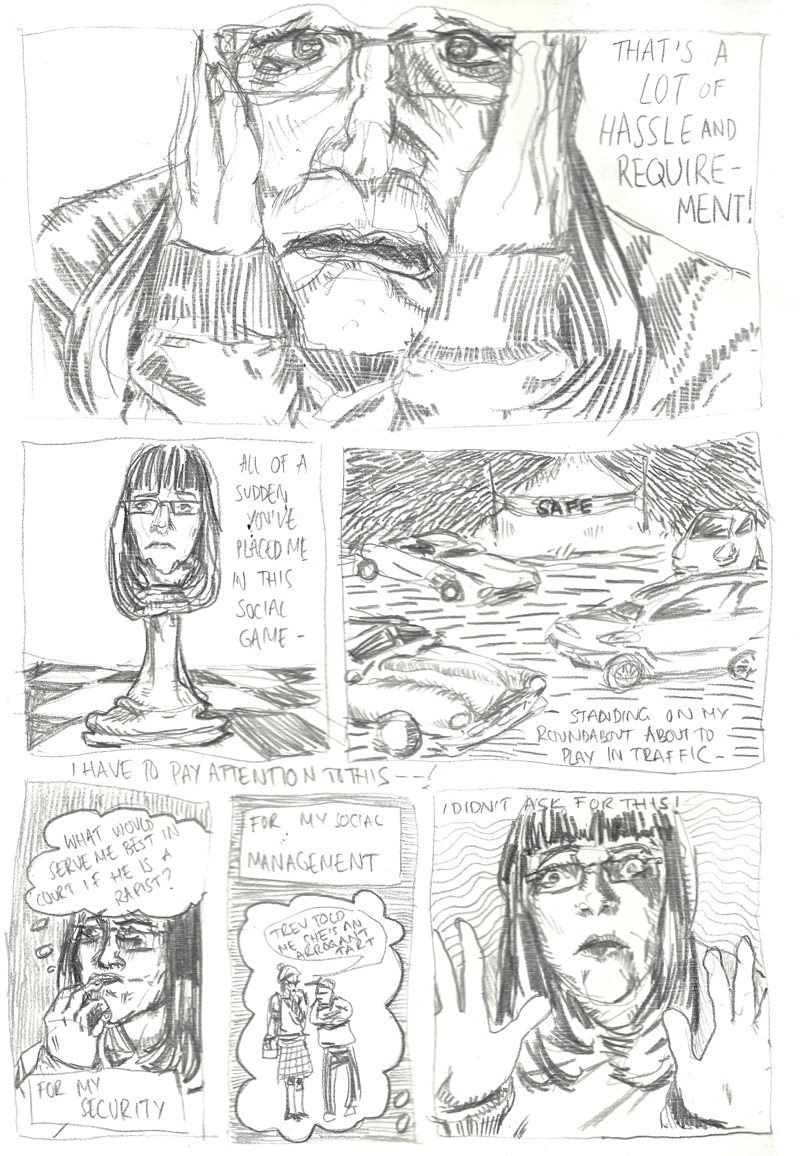
Claire Napier is a midlands-based, commissionable illustrator and comic artist whom I met through the now-defunct Feminist Fashion Bloggers group. I saw bits of her visual work on her blog, but was largely struck by her thoughtful writing, whether that be things like her musings on conventional femininity, or something out of our shared sphere entirely, like her awesome gift guide for the unemployed. So when she reached out to me about my series on compliments with some ideas about visually expressing her own complex feelings toward unsolicited compliments from men, I jumped at the chance. Enjoy!


Wednesday, October 10, 2012

Beauty Privilege: Can We Talk?


Illustration by Steph Becker


Just like me—in fact, just like pretty much every woman who has ever written about beauty in a public forum—the coauthors of Beauty Redefined have been critiqued as being both A) too pretty to understand the challenges surrounding looks bias, and B) so unpretty that it's no wonder they're writing about body image and self-esteem issues, the poor jealous things. What's that I hear you saying? Something along the lines of: But those statements are totally contradictory? Why yes, they are. That is, they're contradictory in their sentiment, but they're identical in their value, which is: Whatever this woman—or any woman—is saying about appearance must be evaluated by her own beauty, or lack thereof.

Lindsay and Lexie at Beauty Redefined have some excellent talking points at their post on this matter, and if I could cosign the entry, I would. Their entry also got me thinking about one of the more elusive aspects of beauty privilege and looksism, which is: It’s really difficult to talk about.

I mean, we can talk about beauty privilege—or negative beauty bias—in the abstract, and we can talk about things we witness. But you think it's difficult to prove something like the subtler forms of ageism or racism or sexism? Try just discussing looksism. Not only is looksism even more amorphous than plenty of other "isms," but think of how you sound if you talk about it openly: It can seem hopelessly narcissistic to own up to one's "beauty privilege," and hopelessly affirmation-seeking to talk about suffering at the hands of looksism. Unlike privilege that comes from being white, able-bodied, male, thin—and even, to a lesser degree, being heterosexual or middle class—beauty privilege is something that's both physically evident and seemingly impossible to deconstruct from a personal point of view, which is a key way that privilege (and lack thereof) comes to be understood and taken seriously.

I'm guessing that as a woman who is nominally attractive but in no immediate danger of launching a thousand ships, I've received some benefits from looking the way I do but have been spared both the grander forms of beauty privilege (I'm fairly certain I've never been hired as set decoration) and the major drawbacks of beauty (nobody assumes I’ve coasted by on my looks). But here's the thing: I'll never really know to what degree I've experienced beauty bias, in either direction. Few of us do. It could be that the small perks I've been attributing to being a nice-enough-looking lady—say, getting slipped a free cookie now and then at the deli—are just people being kind, and that they'd do the same if I were homely, or a man. I'm sure that is indeed the case sometimes, but I've been smacked down by my own naivete in this regard enough times to know better than to get all Pollyanna here. (One of the free-cookie men suddenly stopped giving me cookies after I stopped by once with a male friend. It was the illusion of availability that he liked—and once that fell to the wayside, so did my supply of white chocolate-macadamia treats.) We can have our hunches, but for the most part that's all we have.

I think of the "click" moments I've heard time and time again of women discovering, without a doubt, that they were feminists; much of the time it's an instant recognition of and reaction to sexism. I'm left wondering what sort of "click" moment it would take for a woman to discover, without a doubt, that she was receiving or being denied a form of beauty privilege. Receiving privilege is particularly difficult to tease out, in part because privilege functions by being unspoken, and unrecognized. (Sitting at the front of the Montgomery city bus in 1954 wasn't what we'd now term "white privilege"; it was the law. Beauty privilege may be encoded in a handful of circumstances, but for the most part it's not.) And since looks are painted as being an ineffable part of a woman's essence—particularly in the case of women considered conventionally beautiful—it becomes even murkier than other forms of privilege. How can you have a "click" moment about something that's supposedly transcendent?

I don't write a lot about beauty privilege, and this isn't the only reason why (mostly I just feel like there are more interesting things to write about). But yes, it's a reason. Not only is there a fear of being called a narcissist if I write about whatever forms of privilege I might have experienced, there's a fear of being called delusional if any given critic doesn't find me...privilege-worthy, shall we say. Maybe this fear is rooted in my personal reality of being an attractive-enough but not stunning woman. Or maybe it's rooted in the reality of being a woman, period. (And, as it happens, I've been called both a narcissist and delusional just for writing about appearance at all, so there you have it.) As much as women are punished for not measuring up to some amorphous beauty standard, we're punished just as much for thinking we're "all that."

“When we dismiss someone’s words due to our assessment of their appearance, we’re minimizing them to their body,” write Lindsay and Lexie at Beauty Redefined. That’s absolutely true, yes. Yet unlike Beauty Redefined, a good portion of The Beheld is expressly written from a first-person perspective. Much as I’d like my words to speak for themselves, I can’t say it’s necessarily wrong to take the looks of people writing personal essays about appearance into account when reading their work. My experience of beauty is undoubtedly different than, say, Charlize Theron's, just as Charlize Theron's experience is beauty is different than it would be if she wore her Monster look 24/7. Readers who assume after looking at a photo of me that they know something unwritten about my perspective might not be entirely wrong—but as the disparate evaluations of my looks from various commenters has shown, they can't all be "right."

We’re so used to viewing women as objects (I include women in this) that we may forget they are subjects too, particularly when discussing looks. Most of the time we talk about beauty, we understandably talk about it in terms of how we look at people, not about the subjective experience of looking beautiful, or plain/cute/weird/misshapen/hot/ whatever. Certainly we don’t usually talk about it in terms of how we believe we’re seen. And if we want to understand the labyrinth of beauty in a richer manner, that might be the most revealing perspective of all.

Monday, October 1, 2012

Invited Post: Pretty/Funny


Eve Plumb, Lisa Ferber, and Lisa Hammer in The Sisters Plotz and Their Afternoon of Will-Reading and Poetry


When I interviewed artist, writer, and “highly productive bonne vivante” Lisa Ferber last year, she shared how two of her childhood heroines were Lucille Ball and Gilda Radner, because they managed the supposedly impossible feat of being both funny and pretty, and how as an adult she came to admire Fran Drescher for the same reasons. Lisa’s no slouch herself in the humor department—she writes and stars in a hilarious web and film series called The Sisters Plotz, directed by Lisa Hammer; its most recent installment, The Sisters Plotz and Their Afternoon of Will-Reading and Poetry, will air on Manhattan’s MNN Lifestyle Channel October 3 at 2 p.m., and on MNN’s Culture Channel October 7 at 10:30. It will also be live-streamed on MNN.org during those times. (And if you need further incentive to watch, yours truly has a small role in it. I even sing!) So I’m particularly delighted to have her guest post today about critic Nikki Finke’s Emmy live-blogging feat in which she claims that—well, read on.

I snapped today when I read Nikki Finke’s much-talked-about critique of the Emmys, specifically her thoughts on Julie Bowen’s win for Outstanding Actress in a Comedy Series. I’ll put Finke’s entire tirade here to spare you the trouble of clicking through (but if you must, it’s here): “Listen-up, Hollywood: Beautiful actresses are not funny. They don’t know how to do comedy. (As Bowen demonstrated with her acceptance speech that repeated the phrase ‘nipple covers’ 3 dozen times. To zero laughter.) Only women who grew up ugly and stayed ugly, or through plastic surgery became beautiful, can pull off sitcoms or standups. Bowen isn’t a comedienne just like Brooke Shields wasn’t and a zillion more. Because it’s all about emotional pain and humiliation and rising above both by making people laugh with you instead of at you. So stop casting beautiful actresses when you should be giving ugly women a chance. (Tina Fey always points out she looked like a troglodyte when she was younger.) This also applies to handsome men, by the way. Now argue amongst yourselves.”

Finke knew what she was doing; hits for her piece would go up by declaring something so controversial. And she’s already had responses with people ranting about her and posting photos of funny women, talking about what a fool she is. That’s all great and helpful. My response is that I’ve never understood why the funny vs. beautiful dichotomy even exists—and I’m questioning how we created a world in which it does. (Okay, and also that Brooke Shields is hilarious. When I saw her on Friends as the obsessed soap opera fan, I thought, “Yes, Brooke! You went from underwear model to blasé movie actress to Norma Desmond! You will not let people tell you who are!” Only someone who is unwilling to let herself grow would look at Brooke Shields and decide that a woman who used to parade around in her panties for a living can’t decide to start letting her wit do the dazzling…while still looking movie-star perfect.)

Beauty is mesmerizing, transportive; it makes tongues wag and it makes times slow down. Beauty says, “I am here as an object for you to admire,” and while it contains power, it’s a power that turns its owner into an object of projection and fantasy. Comedy is refreshing, jarring, true, smart. Comedy says, “I am powerful, in a way that means I am going to call it like I see it, and sometimes you will feel taken aback.” The ability to deliver a comedic line is a form of confidence that a person has—or doesn’t have. The ability to show up at an event and know that a certain percentage of people will stare at you is a confidence a person has, or doesn’t have. The difference is that beauty, though a quality that dazzles a room, invites people to make up who you are and fill in the blanks; comedy shuts that down. When a beautiful woman demonstrates a sense of humor, it goes one step past showing she’s smart and gets right to, “I’m not just smart, I’m questioning and I’m making observations. I am an active participant, not a shell.”

The idea that a woman can only be funny if she has suffered is an interesting one, for humor can be a sign that someone is able to find happiness at all times, and it is often developed as a survival mechanism for those dealing with hard times. But the implication—and this is not just Finke, it’s the reason she and others have this issue in the first place—is that beautiful people don’t have everyday problems and therefore can only be funny if they’ve suffered the plight of the underdog. What’s particularly disturbing about this implication is that a beautiful, funny person has to keep proving their pain—has to keep apologizing. “I’m still hurting! I’m not just enjoying being funny and beautiful! I hope that makes you feel better about your sucky life and limitations!” Why do we need to know that Tina Fey wasn’t attractive when she was younger? Why did Joan Rivers constantly make fun of her own appearance, then pick relentlessly on gorgeous Liz Taylor when Liz was struggling with her weight, and then resort to frightening plastic surgery? Do we need to see a funny, successful woman apologizing constantly for her wit and success in order to feel that all is right with the world? Must every beautiful funny woman pull out “awkward teenage photos” to prove “but I’m one of you! Really!”

The beautiful vs. funny issue comes down to the recurring problem of women not being allowed to embrace all forms of their power. A beautiful woman, out of politeness, has to pretend she doesn’t notice she is being watched, even though of course she should be aware of it, for reasons ranging from self-protection to understanding why she might receive special treatment, either preferential or jealous. A funny woman proves consistently that she is aware of herself in the world, and is insightful about human behavior and motivation—and when this is combined with prettiness, it leads to a viewer wondering, “Wait, so are you aware that each hair toss drives people wild too? How much of this are you picking up on?”

The division between beauty and humor hasn’t always been as sharp as it is now, and throughout film history there have been women who have shimmied through the cracks. On the late ‘80s/early ‘90s hit Designing Women, a rare woman-focused show where attractive ladies were not trying to cut each other’s throats for men—though they all did date and had some lasting relationships—beauties Dixie Carter and Delta Burke both owned their physical beauty and their comedic strengths. In The House Bunny and Legally Blonde, Anna Faris and Reese Witherspoon, respectively, win our hearts as women who discover that underneath their pretty exteriors they really are smart…and they are hilarious doing so. But the shining era of beautiful, glamorous, hilarious women in film was the 1930s. Myrna Loy, Constance Bennett, Carole Lombard, Jean Harlow, Kay Francis—heck, just watch The Women (the 1939 original, please) and you’ll see why I get so frustrated with how far we’ve regressed from when a film like this allowed each lady to shine.

So what changed? The foundational problem some members of our culture, like Finke, have with funny, pretty women is that they’re just too much of a threat—and in 1939, most women weren’t really seen as threatening in the least. Carole Lombard could be beautiful and hilarious in 1936’s My Man Godfrey because the biggest threat her dizzy socialite character could possibly pose would be selecting the wrong “protégé.” Fifty years later, women had gained in status, income, and independence—so quick, call off the funny ladies! You can see the unimaginative screenwriter’s dilemma: “Wait, she dazzles me and I project my fantasies onto her, but she also sees the world in a way that shows an ability to question everyday behavior and call bulls**t when she sees it. Should I objectify her, or go to her for wisdom? Can’t she make this easier for me?”

I’ve dealt with a rare type of snarky man who can’t laugh at a woman’s joke, and I smell it right off. I see humor as play; I see it as a way to connect, to loosen the atmosphere, and most men respond to this. But there are exceptions. When I was 20, I worked at a food counter in the stock market. All the men were sweet and friendly to me, but there was this one smarmy fellow who would never laugh at my jokes. My delivery is sweet and friendly, and occasionally dry, but I’m never trying to be “one of the guys.” When I delivered the food, I would banter, and the men would banter back, and it was fun. But this one fellow just couldn’t laugh, because I was a cute girl in his age group and therefore my purpose was to be an object he could look at as powerless. He would look at me in the sleaze way, but my jokes were not welcome. One day, I’d had it up to here with him. So when I showed him the day’s menu and he said to me, “Is the fish fresh?” all I could think was, He’s toast. So I put my hand on my hip and said, “Yeah, I shot it this morning.” Dude was so shocked that he burst out laughing, and I walked away thinking, “That’s right. Who’s your daddy now?” But it was only because I was finally saying, “Enough already—you’re going to deal with it,” that I broke him out of his attempt to make me feel that my attempts at showing smarts were unwelcome.

I currently write and star in a web and film series called The Sisters Plotz, featuring Eve Plumb and Lisa Hammer. We style ourselves in a vintage, feminine way with an indulgent dose of camp-glamour. Eve and Lisa are two seriously pretty women. Am I about to tell them to disempower themselves by perhaps wearing less flattering outfits or messing up their hair a little bit because I’m trying to decide if they should be funny or pretty? Maybe we should all make jokes pretending we think we’re fat or we should pick on some part of our face or body, because that will make people love us? Um, no. Right now I want to live the dreams I had when I was growing up. This is the one chance I get to be in the world, and I understand that there will always be acts of cruelty or even just idiocy that I don’t understand. But I want to live in a world where women are allowed to be funny and pretty and smart and free and strong and glamorous all at the same time—or none of these things if they don’t want to be—and I know that there will always be people who just don’t agree that I’m allowed to enjoy this type of privilege. But that’s all right. My red lipstick and I are ready.


__________________________________________________________________
Lisa Ferber paints and writes witty character portraits influenced by her fascination with humanity. Her works display an appreciation of the beauty and quirks of human behavior, as well as a compassion for its foibles. Her paintings have shown at National Arts Club, Mayson Gallery and other venues, and sell to private collectors. Her films have screened at the Tribeca Grand and the Bluestocking Film Series, and her film "Whimsellica's Grand Inheritance" won the People's Choice Award at the "It Came From Kuchar" festival. Her plays have been performed at notable theaters such as LaMama, DR2 Lounge/Daryl Roth Theatre, and her play "Bonbons for Breakfast" was a New York magazine "notable production." To learn more about her projects, please visit LisaFerber.com

Thursday, June 28, 2012

Values, Stereotypes, and Big Feelings: Compliment Week, Part II


I’d planned on writing about male-to-female compliments, but honestly, the more I read of these compliment studies the more fascinated I become. I’ll get to male-female compliments soon, but for now, a few findings of compliment scholarship:

1) Compliments reveal our values. A successful compliment must be about something that’s recognized by both the complimenter and the complimentee as having value. (That’s not to say that both parties have to personally value the thing being complimented—I’ve been complimented on haircuts I hated—rather that both parties have to recognize that it has value. Otherwise, the compliment isn’t complete.) The consequence here is that compliments can tell us a good deal about what we as a culture actually value. Studies have repeatedly found that the number-one topic of compliments given to American women (from both sexes) is appearance, so—surprise!—it seems we value women for their appearance. (Correspondingly, we value men for their skill.) But here’s the thing: Part of the way we assign value is observing where and how others assign value, which means that sometimes we generalize our values in order to make sure they’re recognized. Compliments are verbal gifts, and who wants to give a gift you’re not sure the recipient will value? So complimenting women on appearance is the spoken equivalent of giving them a nice lotion, a bar of chocolate, a bottle of wine: a gift that is valuable not only for what it actually gives its recipient (soft hands, a satisfied sweet tooth, a hangover), but because we all understand its function as a generic placeholder for sentiment.

2) Compliments based on positive stereotypes don’t feel so great to hear. When people give compliments to a member of a group based on positive stereotypes of that group, the recipient, understandably, is likely to be displeased. As in, if you’re white and start telling a black person how great black people are at sports, you’re not exactly doing anyone any favors. Now, appearance-based compliments aren’t usually directed toward a group; they’re directed toward an individual. Yet I still wonder about the implications of group stereotypes here. If you tell me you like my lipstick, we’re both acknowledging certain assumptions about women as a class: that women should wear lipstick, and that wearing lipstick is something to be rewarded. It’s also assuming that there’s a right way (and therefore a wrong way) to wear it, meaning that it might be possi
ble for me to fail at femininity at a later date.

3) Compliments can make us feel bad. Or...good. Women who lean toward self-objectification do so because they’ve internalized the idea that, as a woman, they are there to be looked at. Is there anything that more clearly ascertains that you’re being looked at than a compliment about how you look? In this study, women who scored high on a test measuring their tendency to self-objectify reported feeling more body shame after receiving an appearance-based compliment. But! In another study, women who had that same personality trait of self-objectification reported an elevated mood after hearing an appearance-based compliment. (In both studies, the compliments were controlled and took place within the bounds of the study; subjects weren’t reporting back on real-life experiences.) With my entirely inadequate scientific background—I fulfilled all my college science requirements with astronomy—I’m going to take a leap and say that these experiences aren’t as contradictory as they seem. While I’m unlikely to brighten my mood when I’m feeling bad about my body, the body shame brought on by self-objectification isn’t quite the same thing, at least not for me. I’m guessing it’s more about the kind of body shame brought on by a hyperawareness of one’s appearance—the same sort of hyperawareness that John Berger was writing of when he wrote in Ways of Seeing: “A woman must continually watch herself. She is almost continually accompanied by her own image of herself. … And so she comes to consider the surveyor and the surveyed within her as the two constituent yet always distinct elements of her identity as a woman. … Thus she turns herself into an object—and most particularly an object of vision: a sight.” Truth is, sometimes my mood is elevated when I notice
that I’m being looked at. That doesn’t mean I don’t simultaneously experience the detrimental effects of that self-consciousness.

4) When we don’t say “thank you,” it may be because we care. As sociolinguist Robert Herbert points out, we all know what the “correct” response is to a compliment. Think of the prompt parents give to their children after someone has given them an unexpected treat: “What do you say to the nice lady?” You say thank you, of course. Yet when asked how they felt upon hearing compliments, many participants in one of Herbert’s studies said they they didn’t know what to say. With the exception of women accepting compliments from men, responses along the line of “thank you” only accounted for anywhere from 10 to 29 percent of compliment responses in the study. Why, when saying “thank you” is the known proper response, do we suddenly feel like we don’t know what to say? The answer lies in the true meaning of embarrassment: We feel embarrassed because we care about the relationship we have with the person we feel embarrassed in front of. We may feel embarrassed that we didn’t say something complimentary to them first, or that we’ve done something (or worn something) that separates us from the other person status-wise, or that we’re suddenly acutely aware that the person holds us in some sort of esteem. We know full well that “thank you” would suffice, but i
t can also feel like “thank you” leaves something out.

In fact, sometimes a simple “thank you” does leave something out. When I first shared my experience of floundering in conversation when I tried to start a conversation with a woman by complimenting her shoes and was met with a simple thank you, I was putting the blame for the flatlined conversation on myself. And to be sure, I should work on my opening gambit. But the more I learn about compliments from a sociological standpoint, the more I see that she may have been a little tone-deaf as well. If “comment history”—i.e. conversation—is the most common response in woman-to-woman compliments, it’s clear that most of us understand the offering a compliment symbolizes. We may not be comfortable with it; we may refuse it, or turn it around, or question its sincerity, or permit it to alter how we see ourselves. But we understand its small humility, its request, its vulnerability, its expressed wish to grow closer. Sometimes we might even let the wish come true.

Monday, March 12, 2012

A Humble Plea

Love on the rocks.

I don’t share much about my romantic life here. This isn't necessarily by design; my gentleman friend doesn’t mind when I write about him, as he trusts I wouldn’t write anything about him that would make him uncomfortable or violate his—our—privacy. It’s more that the issued that would be relevant to write about here as far as our relationship—say, the keen desire to be desired, sometimes specifically for how I look, and how that plays out between two people who give a good deal of thought to authenticity and representation in relationships of all sorts—are things I’m still wrestling with. I frequently figure things out through writing about them, but that can be dangerous in a number of ways when the “thing” in question is another person, one you care about immensely. The end result—at this point, anyway—is that while the role of romance in beauty is hardly verboten from The Beheld, its presence is far less frequent than one might imagine.

So what I’m about to ask is, like, totally unfair. I’m working on a project (related to but separate from this blog) in which I need to hear from a lot of women about looks, appearance, and being seen—specifically, how those things play into dating and relationships. I’ll be making similar pleas in the future but for now I’m looking to talk with women about the role appearance, beauty, and the wish to be seen (or not seen) has played out in their romantic relationships and dating life. I’m not looking for any particular type of woman—in fact, I’m looking for a diverse range of people to talk with. The only requirement is that you consider yourself a woman.

If you’re interested in talking with me about how looks have played into your romantic life, please drop me an e-mail at the.beheld.blog at gmail dotcom; I’ll send you a few questions and we’ll go from there. Sound good? All responses will be confidential.

Tuesday, March 6, 2012

Recommended Reading

The initial inspiration for The Beheld was, unsurprisingly, The Beauty Myth. But when Rebekkah Dilts of Radar Productions interviewed me recently, I found myself articulating for the first time why I’m eager to look beyond The Beauty Myth. Wolf’s work is incredibly powerful and necessary—we’re hardly free of the “Iron Maiden” of beauty standards, but if it weren’t for The Beauty Myth giving a name and common language to those standards, we’d feel a lot more isolated in our internal struggle regarding our bodies/our selves (and possibly more passively accepting of the rules of beauty too).

But as I said, I’m eager to look beyond this polemic from 20 years ago. I bring up its age not to say it’s no longer relevant but rather to point out that it is relevant, perhaps more than ever—and that we’re still stuck in a lot of the same old ways of thinking. I bring plenty of thought here that sprang from The Beauty Myth, but I’d also like to offer a sort of parallel track alongside Wolf’s sharp cultural critiques: Without merely being dupes of the patriarchy, plenty of women still want to be beautiful (Wolf never says we shouldn’t want that, by the way). Let’s look at what we’re actually doing within the confines of the beauty myth; let’s look at the reasoning we offer ourselves and one another; let’s examine the agency we bring to the vanity table—and, sure, the passive beliefs we’ve absorbed—and go from there.

So, yes, any true primer on beauty for women today must include The Beauty Myth, absolutely. But there are plenty of other books out there that are informing what I’m doing here in trying to work alongside Wolf's book. Here are just five of them.


Ways of Seeing, John Berger
John Berger’s classic text on art and visual culture is a must-read in its entirety. But that goes double for the chapter on representation of women in art, and the ways art mirrors the cultural roles carved out for and inhabited by women. “A woman must continually watch herself. She is almost continually accompanied by her own image of herself. Whilst she is walking across a room or whilst she is weeping at the death of her father, she can scarcely avoid envisaging herself walking or weeping. … And so she comes to consider the surveyor and the surveyed within her as the two constituent yet always distinct elements of her identity as a woman. … Thus she turns herself into an object—and most particularly an object of vision: a sight.” It was instrumental to my mirror project, and indeed instrumental to the way I think about being a woman in public. How much can equality matter when I am constantly under my own surveillance? 


Facing Beauty, Aileen Ribeiro

Facing Beauty takes the morsels that gave birth to the slim Ways of Seeing and expands them into a gorgeous color volume examining historical views of women as revealed through various art forms. Social mores, morality, artifice, and idealization all make their way to the canvas through how women are depicted, whether it’s the role of “common” sex workers and courtesans as muses or the strategic revealing of bared breasts. Even more engaging than the traditional art history is the treatment of cosmetics history as lived art on its wearers. From the always-beloved paintings of women at their vanities to the decorations on the actual bottles and pots of cosmetic creams, the painted self is worth as much examination as the canvas, and Facing Beauty treats it as such.


The Thoughtful Dresser, Linda Grant
I’m forever thankful to Terri of Rags Against the Machine for recommending this book after I wrote about Anne Frank packing curlers. Linda Grant’s book may as well be a manifesto for every woman who has cared about fashion or beauty and felt the sting of dismissal when someone has called those pursuits trivial. They can be treated trivially, of course, but Grant masterfully shows us why we care so much even when we don’t think we should. With Holocaust survivor and fashion buyer Catherine Hill as our default protagonist, the book serves as a sort of psychic history of fashion—why consumerism, specifically fashion consumerism, was tied in with women’s liberation (and not just for women who could afford to buy new clothes), and why even those of us who don’t particularly care about trends wind up buying into them more than we realize. Read this and just try to resist the urge to put on something beautiful. I dare you.


The Second Sex, Simone de Beauvoir
The ten pages that constitute the twenty-second chapter of this classic are some of the most important pages ever written if you’re interested in the relationship between women and vanity. Titled “The Narcissist,” instead of simply damning women who take pleasure in their own visage, the chapter shines a brutal light on why the mirror can provide such refuge: When one of our primary public roles is being gazed upon, is it any wonder we may wish to look at ourselves to see what all the fuss is about? “All love requires the duality of a subject and an object,” de Beauvoir writes. “The reality of man is in the houses he builds, the forests he clears, the maladies he cures; but woman, not being able to fufill herself through project and objectives, is forced to find her reality in the immanence of her person.” Much has changed since 1949; women—ta-da!—can clear forests and cure maladies. But the vestiges of the prefeminist era remain in vanity, and as much as vain is often used as an insult to women, we must examine it in a feminist context (instead of a moral one) before we can understand our relationship to our self-image.


The Managed Heart, Arlie Russell Hochschild
This sociological study of the emotional labor of flight attendants and bill collectors is a fascinating look into the ways many of us harness our feelings in the course of our jobs. Whether we’re managing our feelings about the chain of hierarchy or channeling our “authentic” personality to help us shine at our work (as with friendly, compliant flight attendants), it’s near-impossible to avoid having our emotions, to some degree, commodified in the workplace. What does this have to do with beauty? It wasn’t until I read Hochschild that I was able to pinpoint my own “emotional beauty labor”: The small and large ways in which I attempt to play the part of a nice-looking woman, in ways that go beyond styling my hair or putting on makeup. It’s these small acts of emotional beauty labor—say, walking the line between the gracious and obsequious in receiving compliments, using femininity to command attention but keep it in the realm of appropriacy--make up a greater drain on our personal resources than just makeup. This book is key to understanding our own emotional labor of all sorts, whether appearance-related or not.